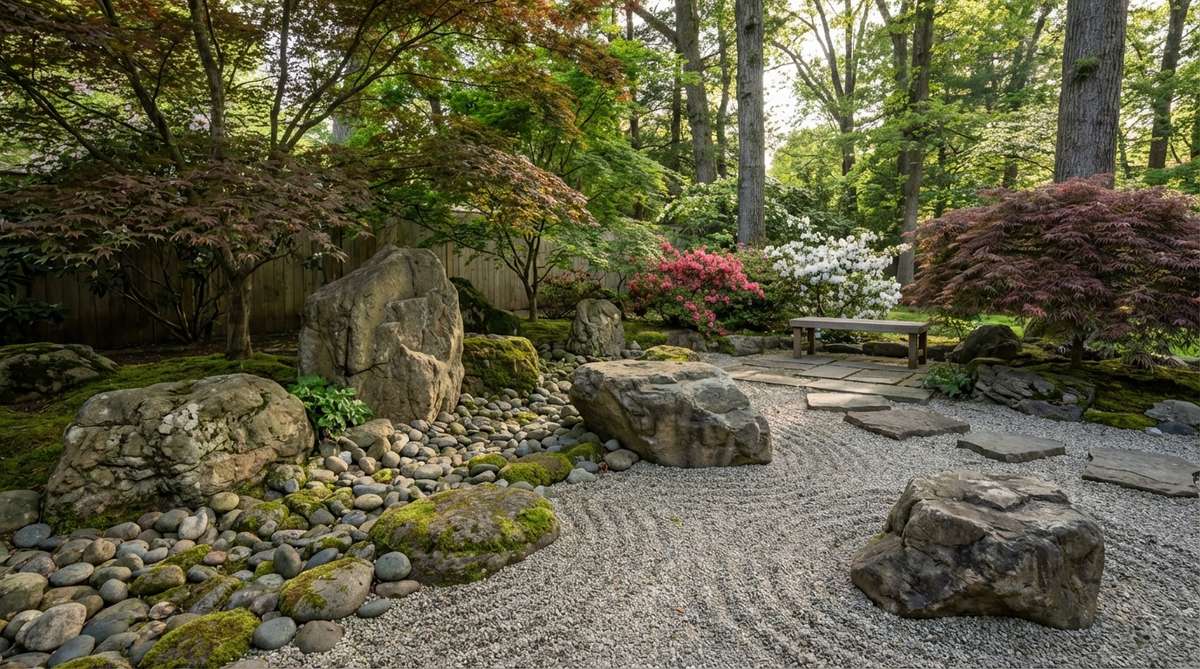
Zen garden rocks serve as the foundation for creating contemplative outdoor spaces that embody tranquility and natural harmony. The strategic placement of boulders and natural stone transforms ordinary landscapes into meditation retreats that honor centuries-old Japanese design principles. Fresh Garden Ideas brings you expert arrangements that blend traditional stone placement techniques with contemporary landscape design approaches.
Design SnapshotKey Principles
- Odd Number Rule: Arrange rocks in groups of 3, 5, or 7 to create natural asymmetry and visual balance
- Partial Burial: Bury boulders 50-80% deep to simulate natural mountain formations emerging from the earth
- Symbolic Placement: Position stones to represent mountains, islands, or flowing water using angular shapes and varied heights
- Focal Anchoring: Establish one dominant boulder as the visual centerpiece, allowing secondary stones to create supporting rhythm
Traditional Mountain Formations Using Angular Boulders
Mountain-inspired rock arrangements form the spiritual backbone of authentic zen gardens. These vertical compositions use angular boulders to evoke the majesty of distant peaks. Designers favor stones with sharp edges and weathered surfaces that capture the rugged character of natural mountain ranges.
1. Three-Peak Mountain Triad
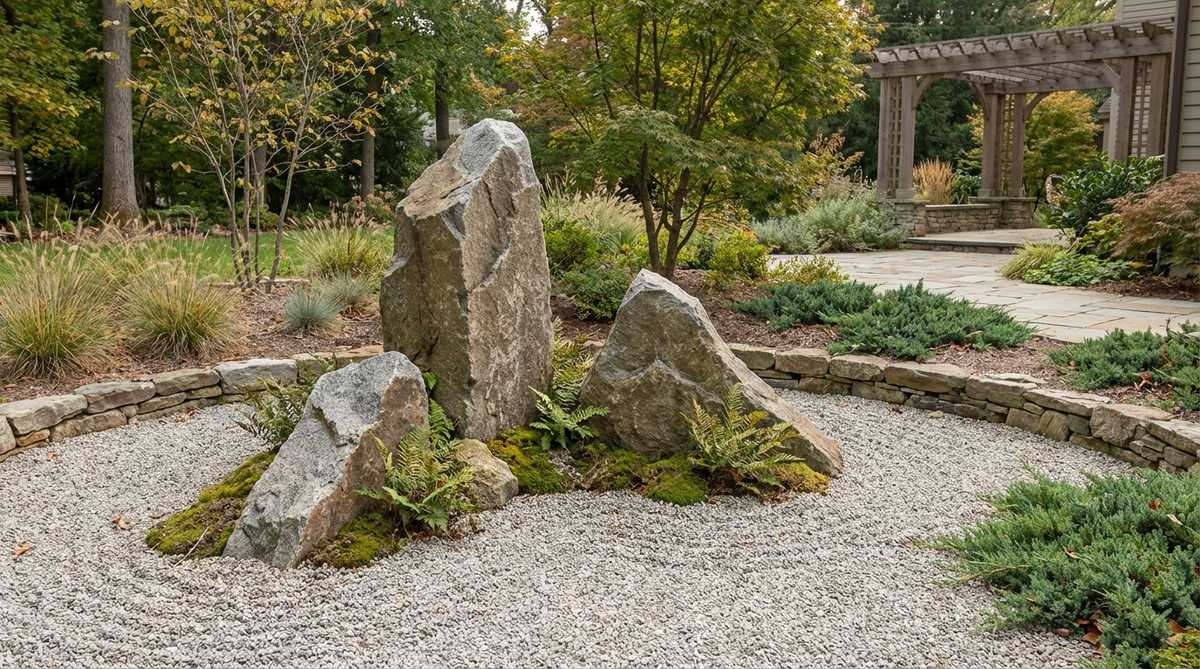
Position three angular boulders in a triangular formation with the tallest stone offset from center. The dominant boulder rises 3-4 feet while supporting stones stand at 50% and 40% of the main height.
Bury each boulder 70-80% deep to create the illusion of mountains emerging from clouds. Orient the tallest stone with its most dramatic face toward the primary viewing angle.
This classic arrangement symbolizes the Buddhist trinity and creates powerful vertical interest in flat landscapes. The asymmetric positioning guides the eye naturally through the composition.
2. Distant Range Horizon Line
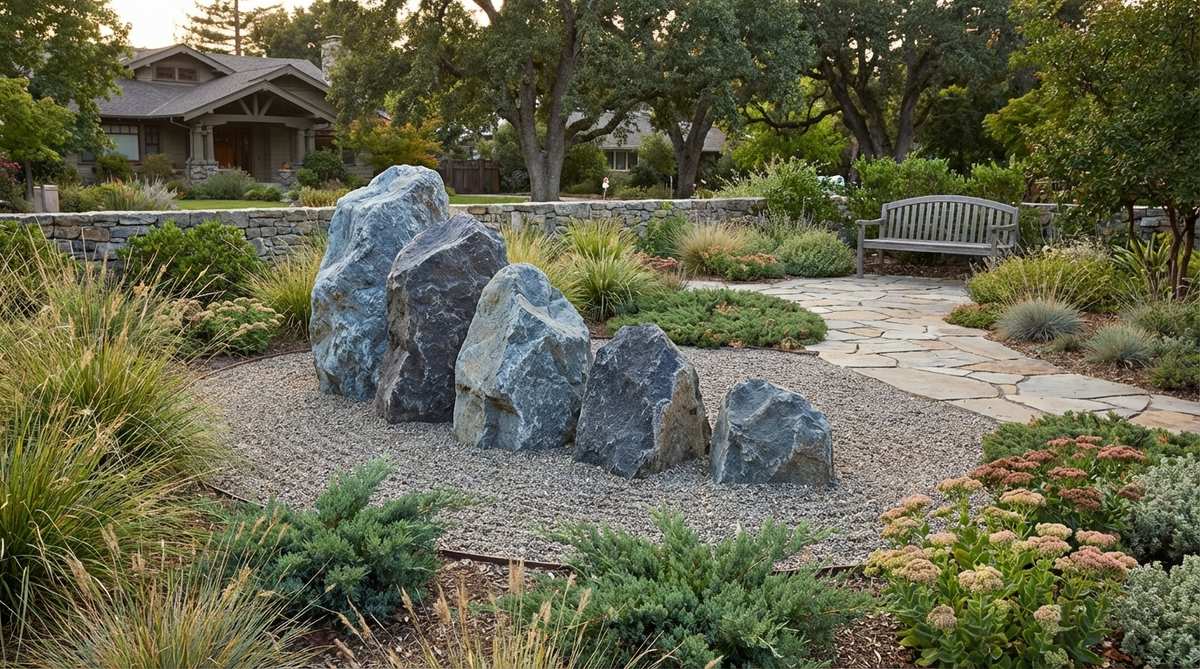
Arrange five progressively shorter boulders along a gentle curve to mimic a mountain range receding into the distance. Space stones irregularly, with wider gaps between distant peaks.
Use blue-gray or charcoal-colored granite to enhance the depth illusion. Position this arrangement along the garden’s rear boundary to maximize the perspective effect.
The graduated heights create natural depth perception while maintaining visual harmony. This technique works particularly well in narrow garden spaces.
3. Guardian Mountain Gateway
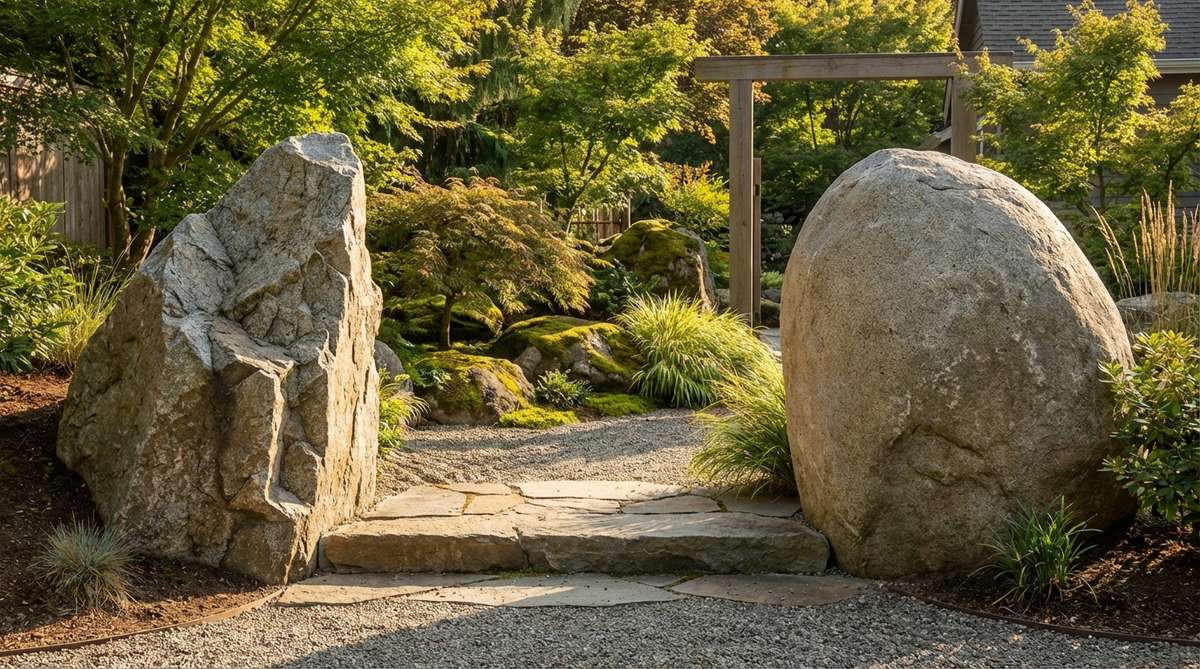
Flank a garden entrance with two substantial upright boulders standing 4-6 feet tall. Select stones with contrasting profiles—one angular, one slightly rounded—to represent male and female energies.
Position these sentinels 8-12 feet apart to frame the view beyond. Bury them deeply enough that they appear to have stood for centuries.
Gateway stones establish threshold boundaries and create anticipation for the contemplative space within. They anchor the entire garden composition visually and symbolically.
4. Sleeping Dragon Mountain
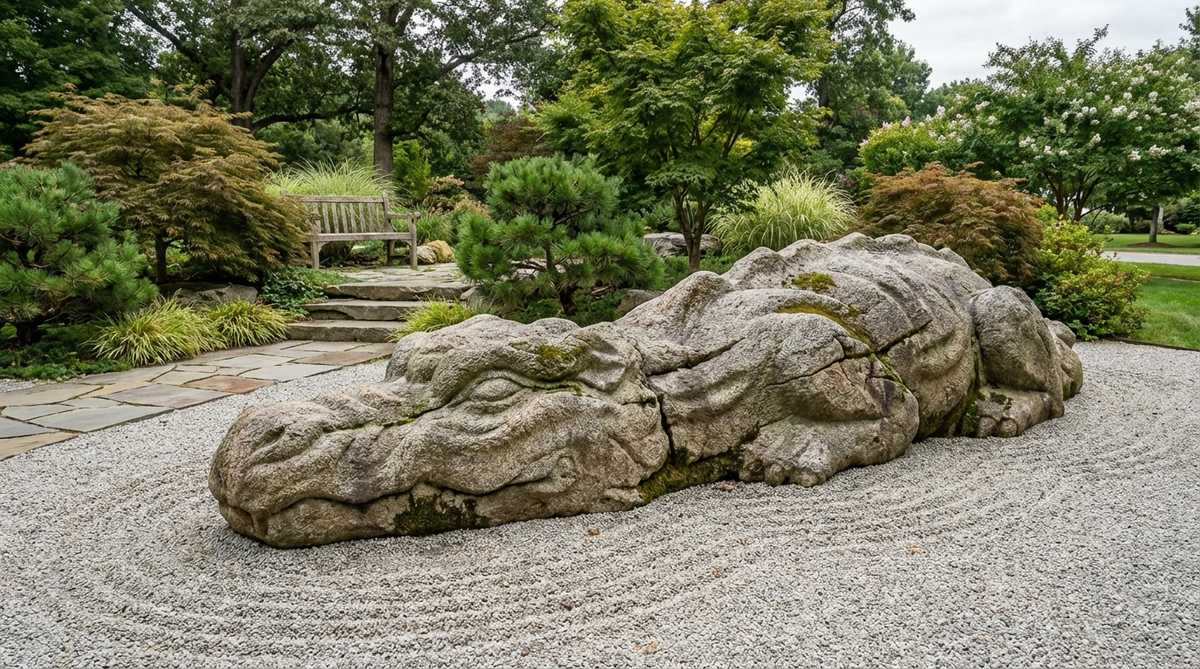
Use a single massive horizontal boulder positioned low to the ground to represent a resting dragon or sleeping mountain spirit. Choose a stone with undulating surfaces and interesting texture variations.
Bury only the bottom third, allowing the full sculptural form to be appreciated. Place it parallel to the main viewing perspective for maximum impact.
This arrangement brings powerful grounding energy and works as an excellent meditation focal point. The horizontal mass balances vertical elements elsewhere in the garden.
5. Five-Element Mountain Cluster
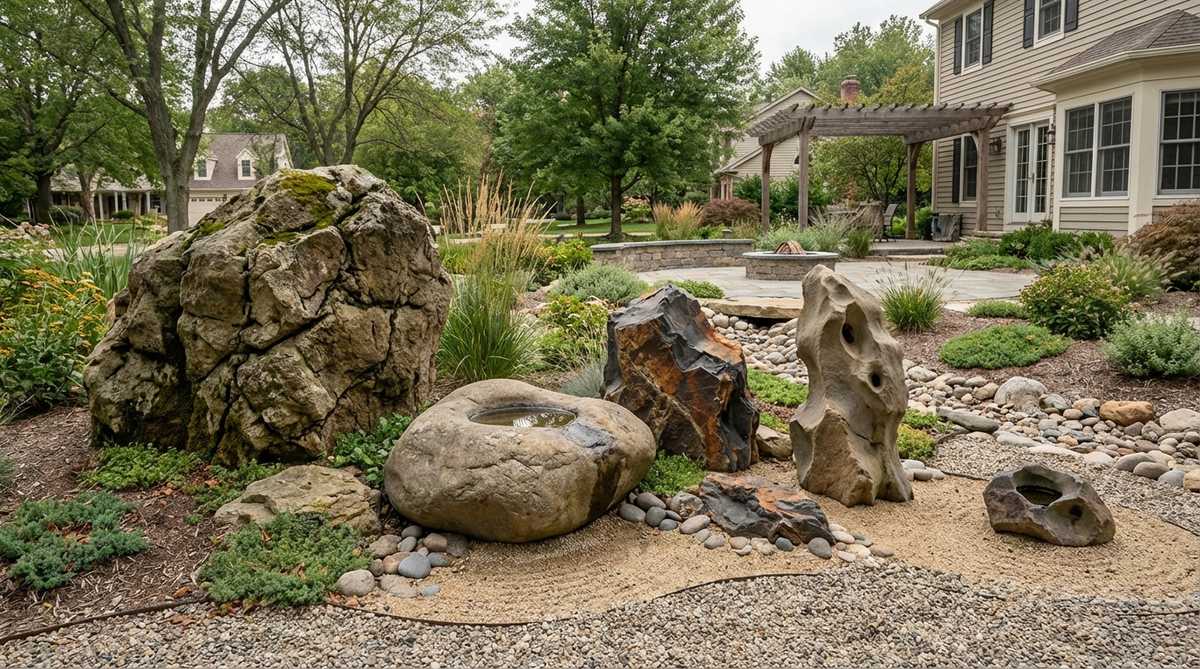
Arrange five boulders representing earth, water, fire, wind, and void in a naturalistic grouping. Vary sizes dramatically, with the earth stone being largest and the void stone smallest.
Position stones so each reveals different characteristics—sharp edges, smooth faces, weathered hollows. Create subtle height variations to suggest natural geological formation.
This philosophical arrangement invites extended contemplation of natural forces. Each stone’s unique character contributes to the whole while maintaining individual identity.
6. Cascading Foothill Formation
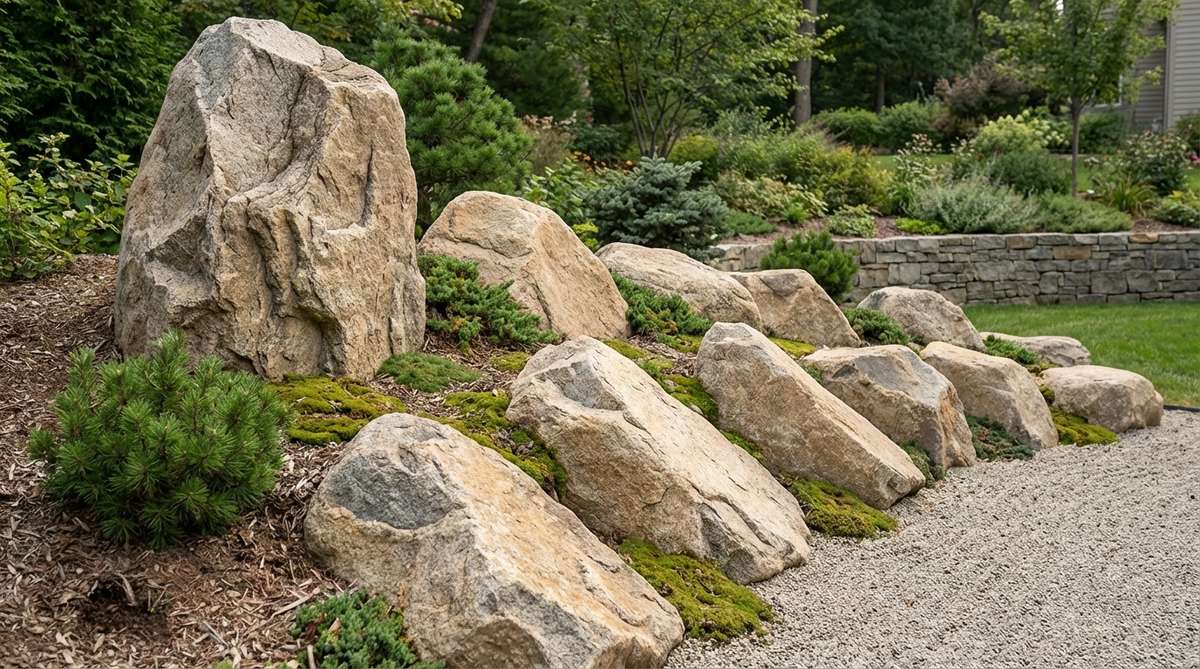
Deploy seven progressively smaller boulders descending from a tall anchor stone to create a mountain-to-valley transition. Each stone should be 20-30% smaller than the one above it.
Angle stones slightly forward to enhance the cascading visual flow. Use similar-colored rocks to maintain compositional unity.
This dynamic arrangement suggests geological time and natural erosion processes. It guides energy downward and works beautifully on sloped terrain.
Island Cluster Arrangements in Gravel Seas
Island formations represent one of the most iconic zen garden stone arrangements, where boulders emerge from raked gravel like archipelagos from ocean waters. These groupings create contemplative scenes that invite mental journeys across imagined seascapes. The contrast between solid stone and fluid gravel patterns generates profound visual tension.
7. Seven-Island Archipelago
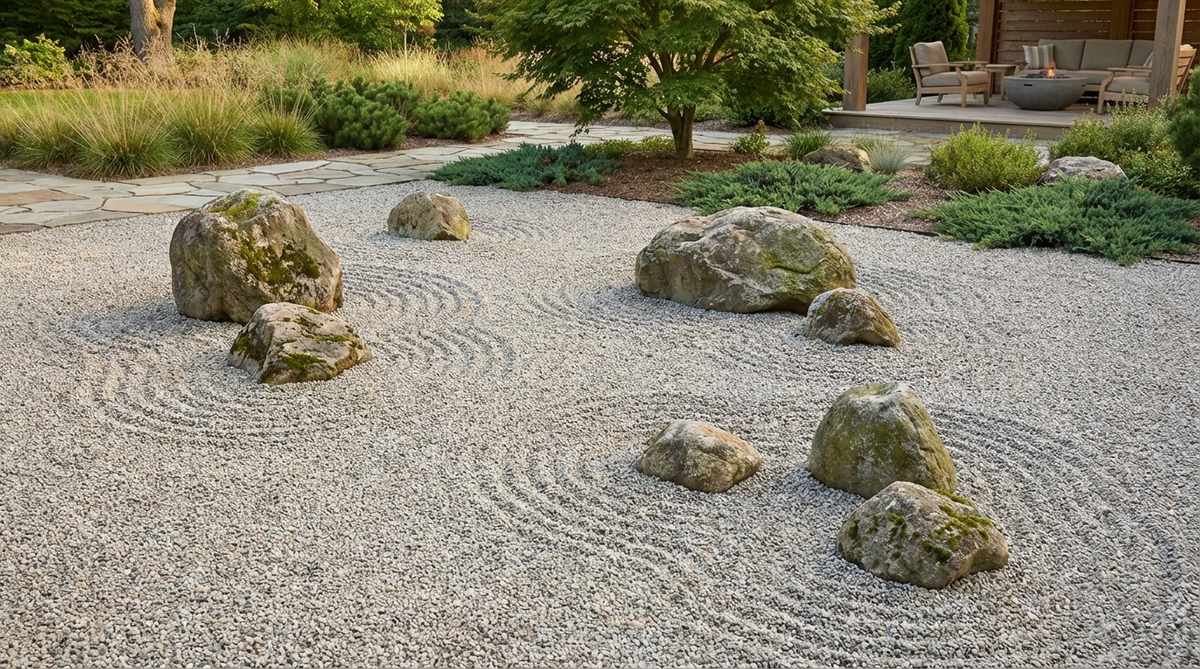
Distribute seven boulders across a gravel field in an irregular pattern that suggests natural island formation. Group stones loosely rather than in obvious clusters.
Vary boulder sizes significantly, with 2-3 prominent islands and 4-5 smaller outcroppings. Rake gravel in concentric circles around each island to represent rippling water.
This expansive arrangement encourages the mind to explore connections between separate elements. It works best in larger garden spaces with uninterrupted gravel areas.
8. Turtle Island Formation
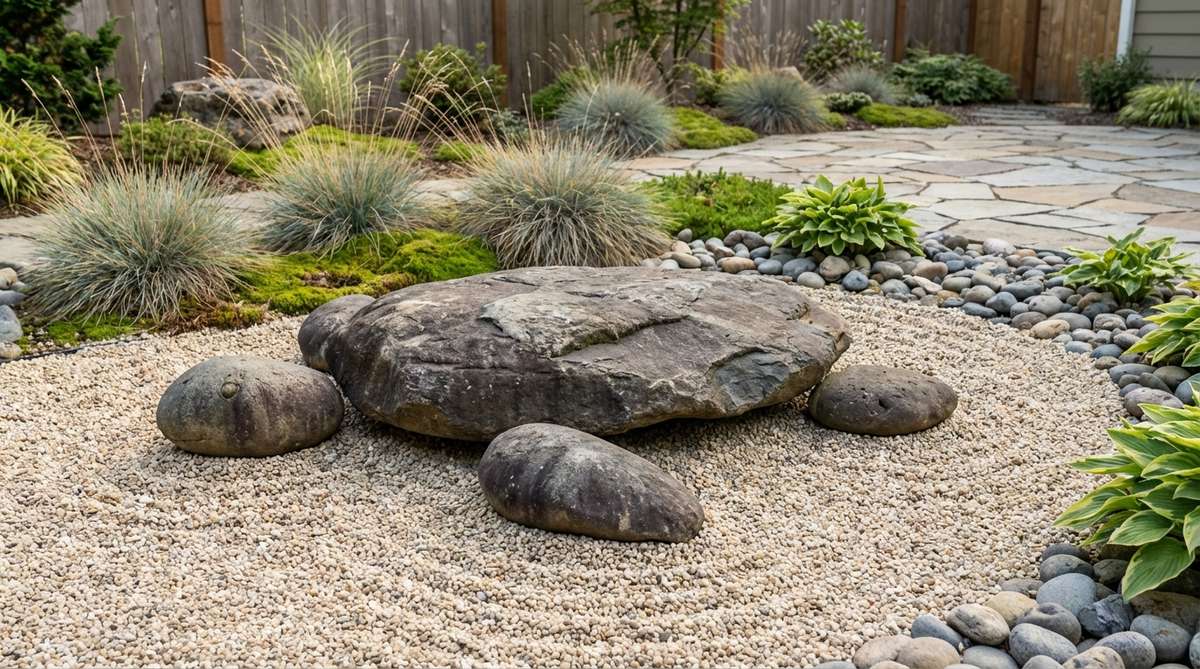
Position four stones to suggest a turtle swimming through water—one flat boulder for the shell, three smaller stones for head and flippers. Orient the composition diagonally across the gravel sea.
Use a broad, low-profile boulder for the central shell element. Partially bury the head stone to suggest movement through water.
Turtle symbolism brings longevity and wisdom to the garden space. This playful arrangement adds narrative interest while maintaining contemplative dignity.
9. Crane Island Sanctuary
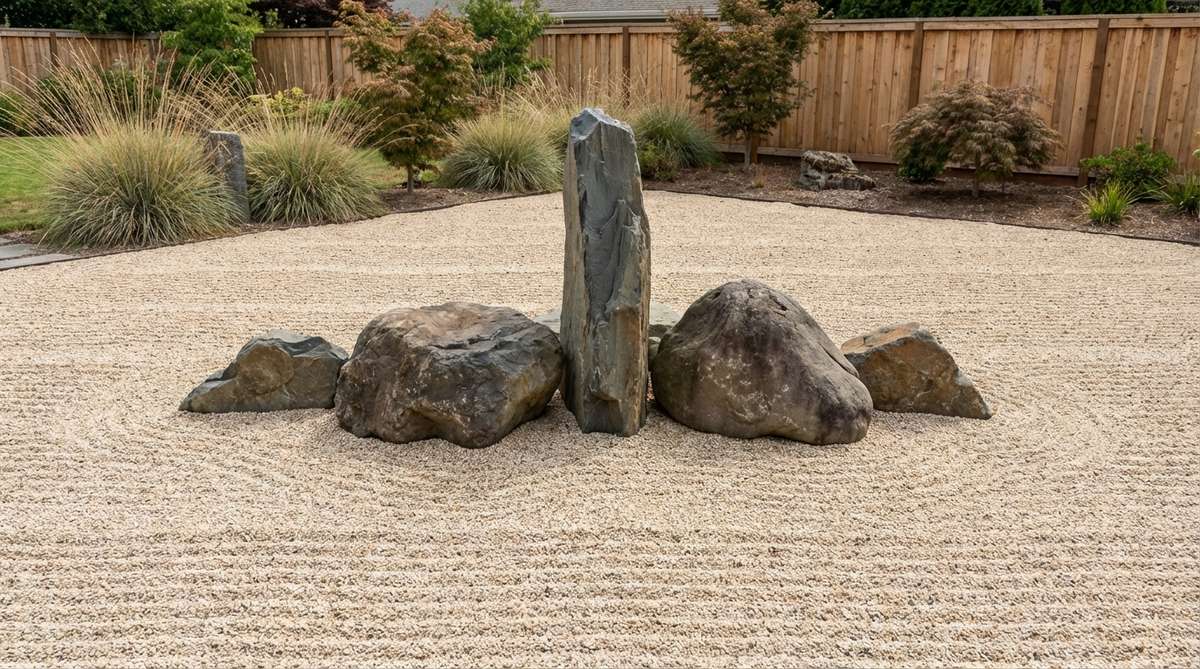
Create a single prominent island using 3-5 closely grouped boulders that suggest a crane in flight or at rest. Use one tall vertical stone for the neck and head, with lower stones forming the body.
Surround this central grouping with finely raked gravel in horizontal lines to emphasize the island’s isolation. Leave generous empty space around the formation.
The crane represents immortality and transcendence in Japanese culture. This elegant arrangement serves as a powerful meditation focus.
10. Stepping Stone Islands
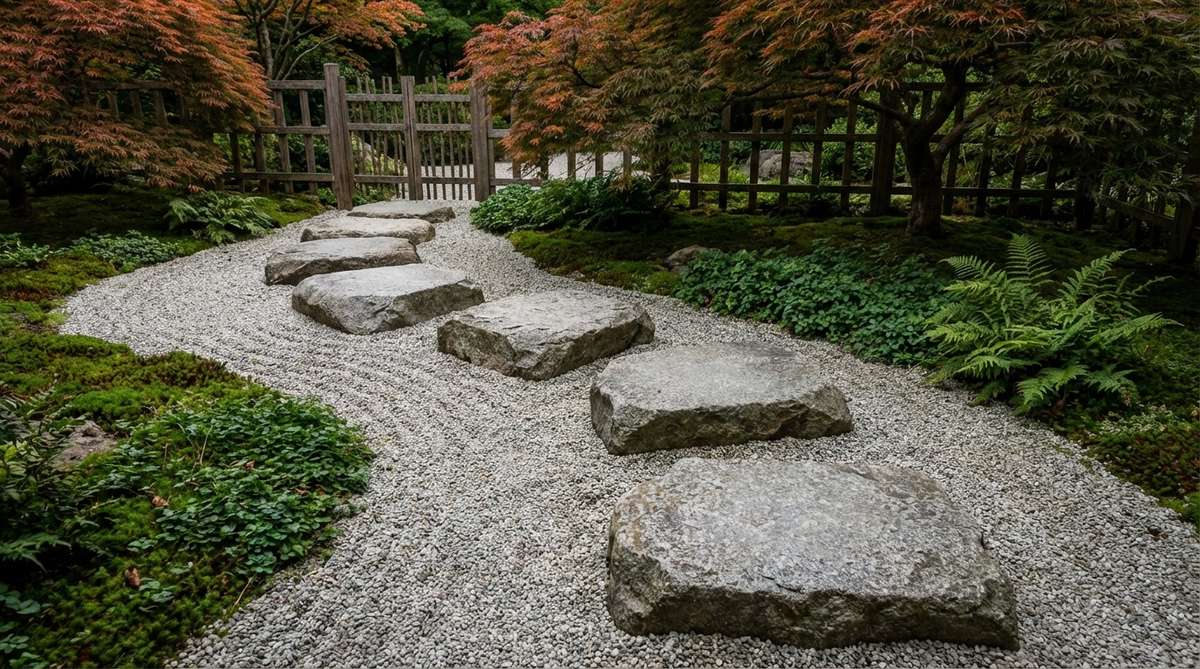
Place five flat-topped boulders in a meandering path across gravel, each partially buried to create stable stepping surfaces. Space them 18-24 inches apart for comfortable stride length.
Select boulders 2-3 feet in diameter and bury them 80% deep so only the flattest portion remains visible. Vary the path direction subtly to create a natural walking experience.
This functional arrangement invites physical engagement with the garden while maintaining aesthetic integrity. It combines traditional island symbolism with practical pathway design.
11. Three Sacred Peaks
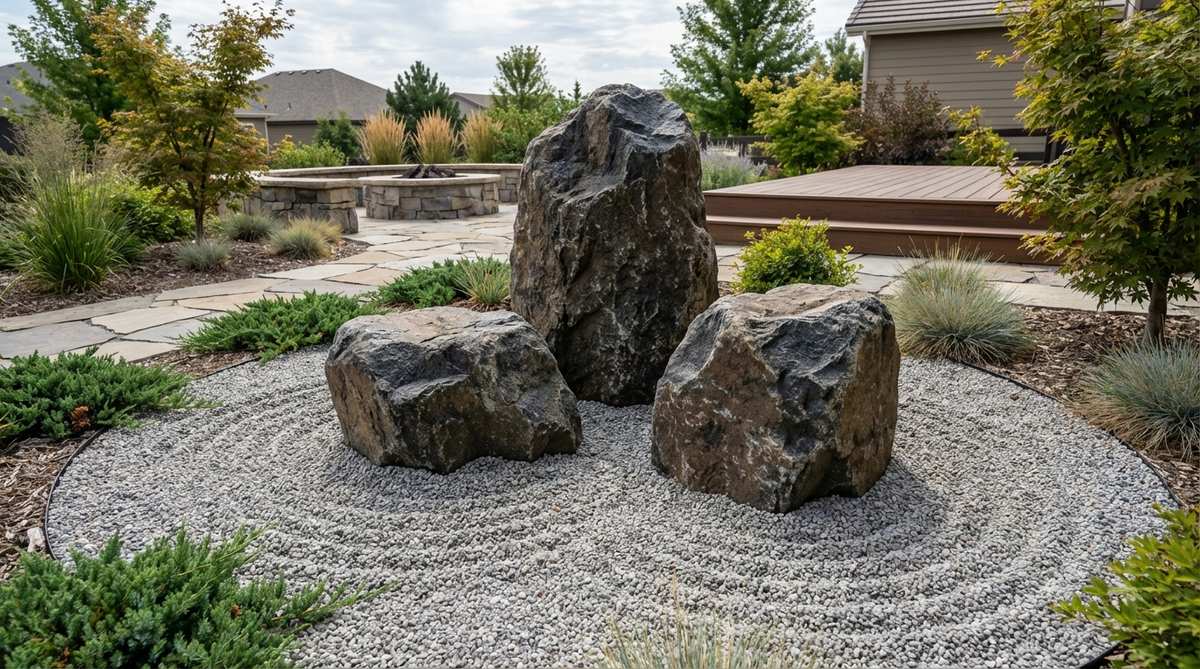
Group three substantial upright boulders tightly together to form a single unified island mass. Position the tallest stone in the rear, with two shorter stones flanking forward and to the sides.
This compact arrangement represents Mount Horai, the legendary mountain of immortals. Rake circular patterns around the base to suggest clouds or mist.
The tight clustering creates powerful visual mass and spiritual symbolism. It serves as an ideal centerpiece for meditation gardens.
12. Scattered Reef Fragments
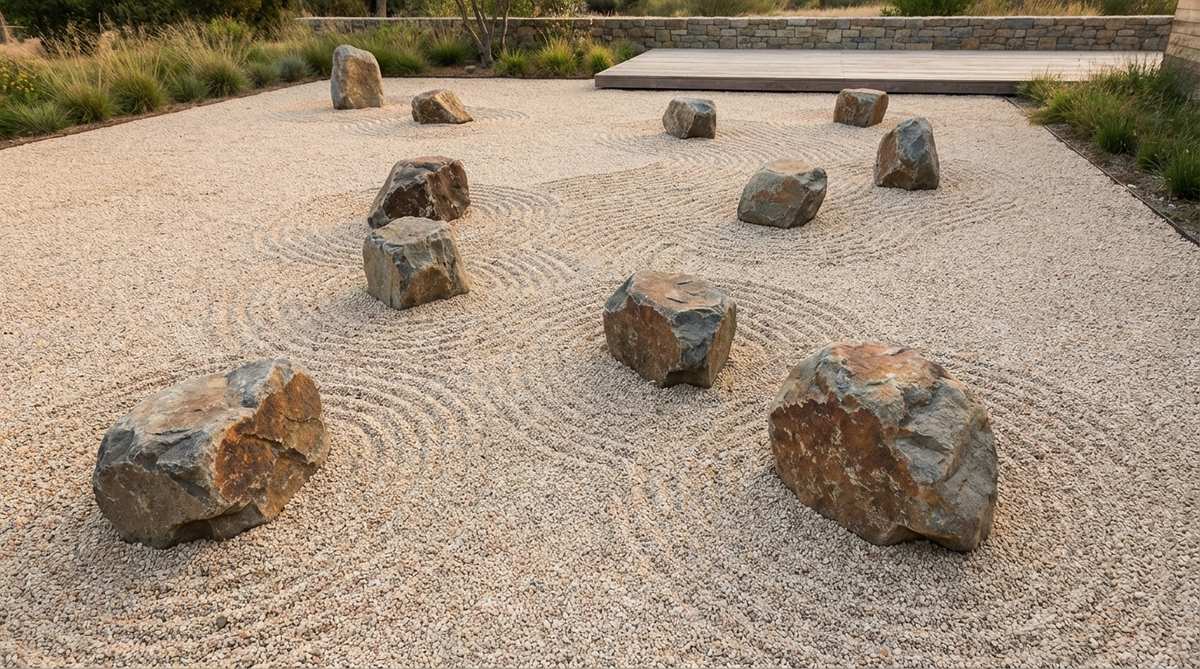
Distribute nine small to medium boulders randomly across a gravel expanse, suggesting coral reef fragments exposed at low tide. Keep stones relatively low-profile, protruding only 6-12 inches above gravel level.
Use stones with interesting surface textures and colors. Rake the gravel in irregular patterns that flow around and between the scattered elements.
This naturalistic approach creates a more relaxed, organic atmosphere. It works especially well in contemporary interpretations of zen garden design.
Zen Garden Stone Pathways and Walking Meditation Routes
Stone pathways in zen gardens serve dual purposes—guiding physical movement through space while directing spiritual contemplation. Boulder placement along these routes creates rhythm and pacing that encourages mindful walking. Thoughtful pathway design transforms simple circulation into meditative practice.
13. River Stone Meandering Path
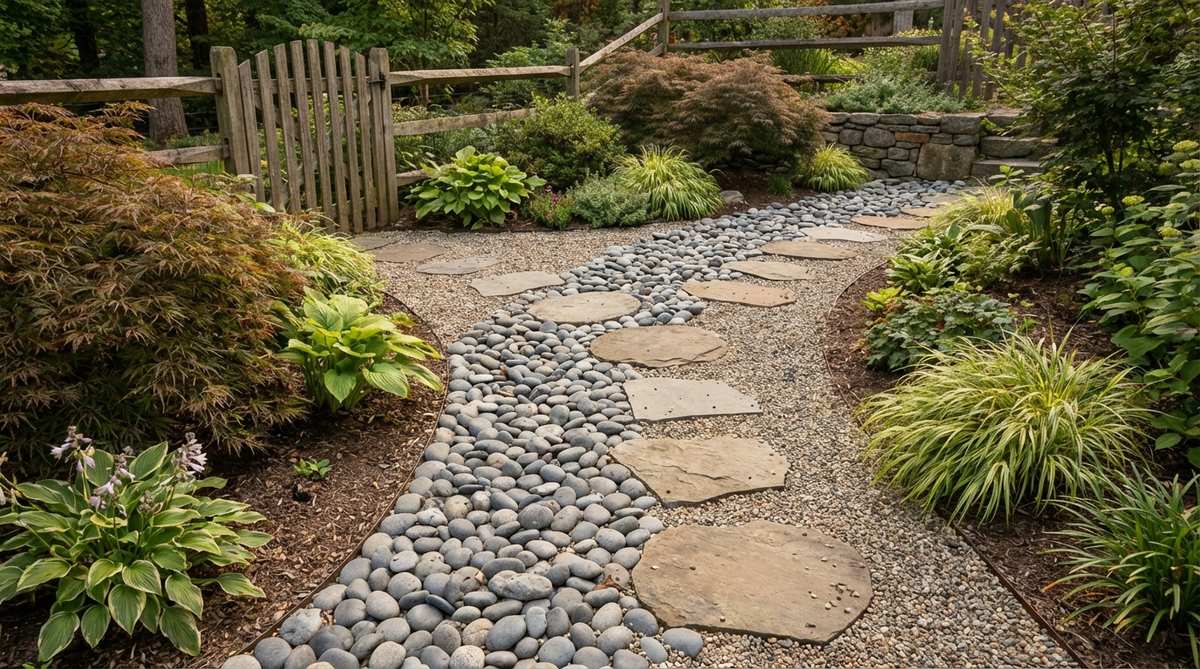
Create a flowing pathway using river-smoothed boulders embedded directly into gravel or moss. Select stones 12-18 inches in diameter with naturally flat upper surfaces.
Curve the path gently rather than in sharp angles, spacing stones to encourage a slow, deliberate pace. Alternate between single stones and paired stones for visual variety.
The irregular spacing forces mindful foot placement and prevents rushed movement. This traditional design promotes walking meditation naturally.
14. Mountain Pass Boulder Trail
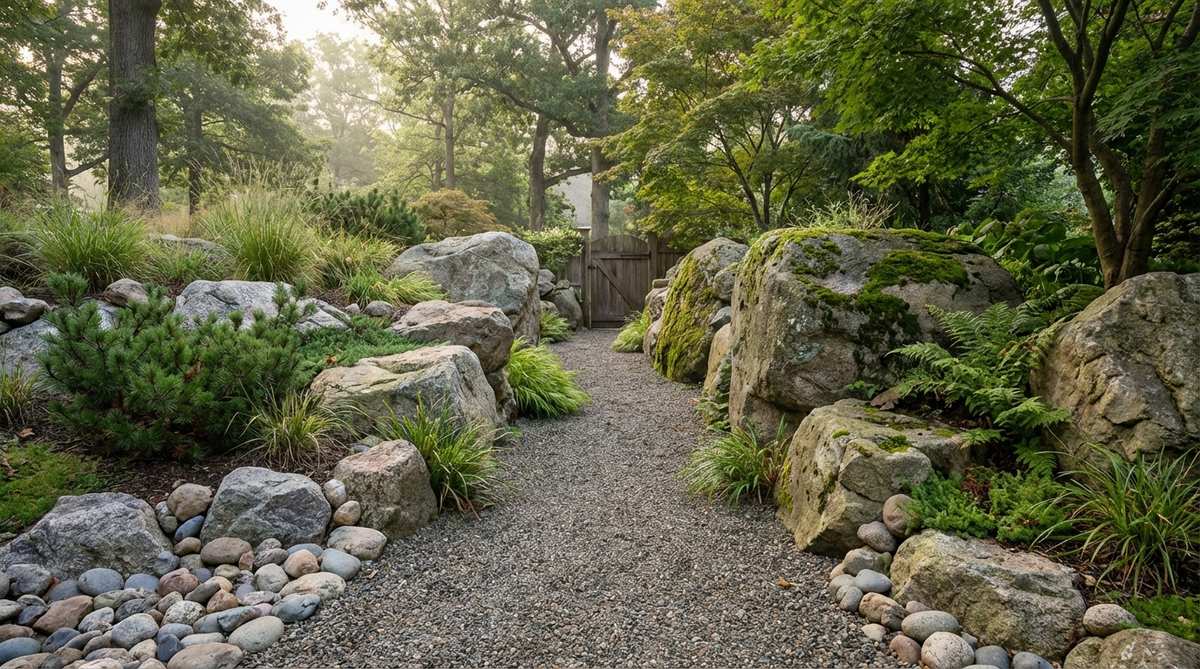
Line both sides of a narrow pathway with progressively larger boulders that create a canyon-like passage. Start with small stones at the entrance, building to 3-4 foot boulders at the midpoint.
Position boulders at varying distances from the path edge to create an organic, natural feel. Leave some areas more open while others feel more enclosed.
This immersive arrangement creates a journey-like experience through the garden. The changing scale provides psychological progression from outer world to inner sanctuary.
15. Lantern Lighting Stone Route
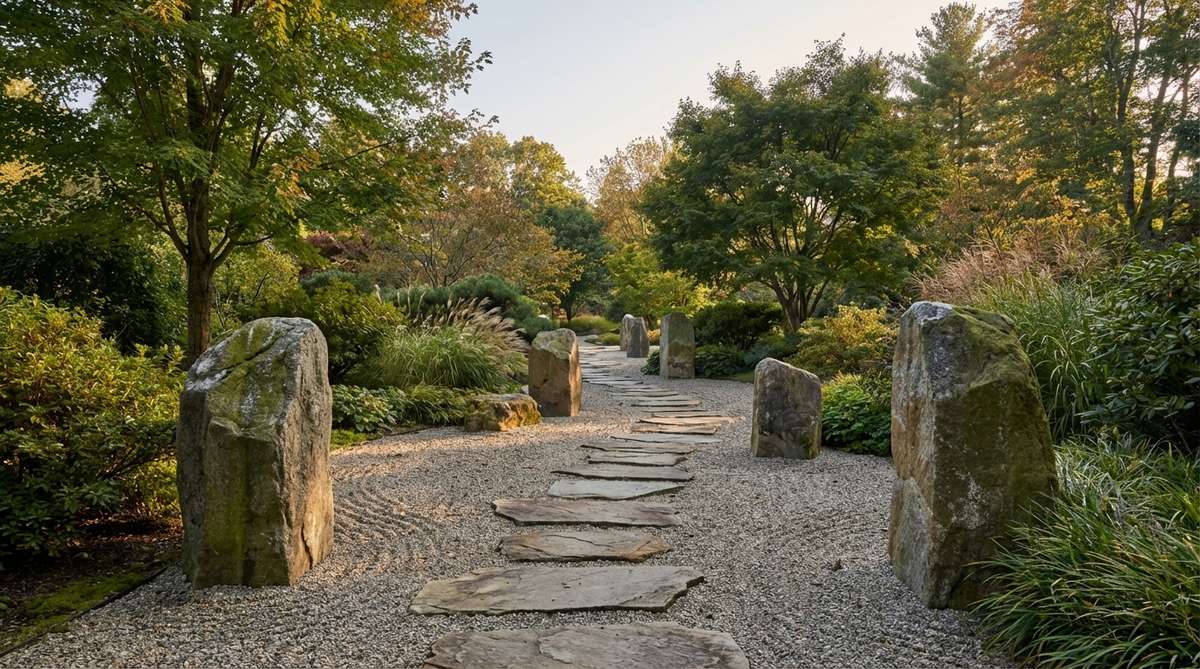
Place flat natural stone slabs as pathway elements, with substantial upright boulders positioned at intervals to suggest lantern placement points. Space the upright stones 10-15 feet apart along the route.
Choose broader slabs for primary walking surfaces and position vertical accent boulders slightly offset from the path edge. The vertical stones should stand 2-3 feet tall.
This arrangement references traditional Japanese garden paths where stone lanterns illuminate the way. Even without actual lanterns, the rhythm guides movement effectively.
16. Bridge Crossing Boulder Markers
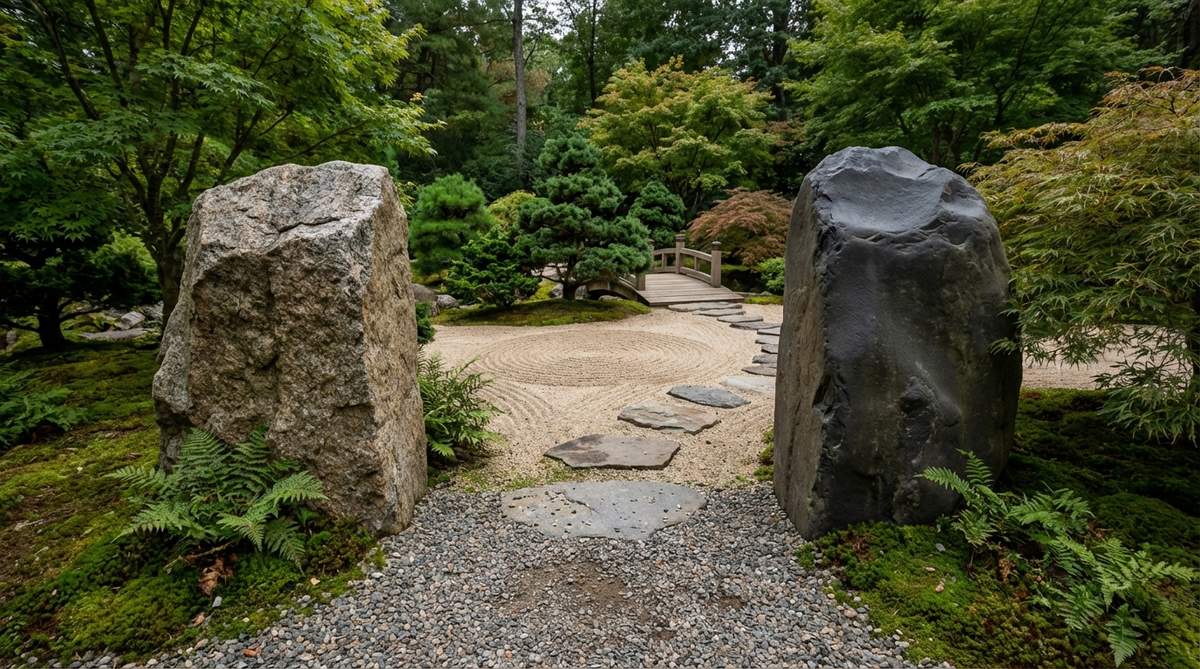
Flank pathway intersections or direction changes with paired boulders that mark transitions like bridge entrances. Use matched stones of similar size but contrasting shapes.
Position these marker pairs 4-6 feet apart to frame the pathway clearly. Orient stones to face each other slightly, creating a subtle gateway effect.
These symbolic crossings heighten awareness of moving between garden zones. They punctuate the walking experience with moments of threshold passage.
17. Spiral Meditation Boulder Path
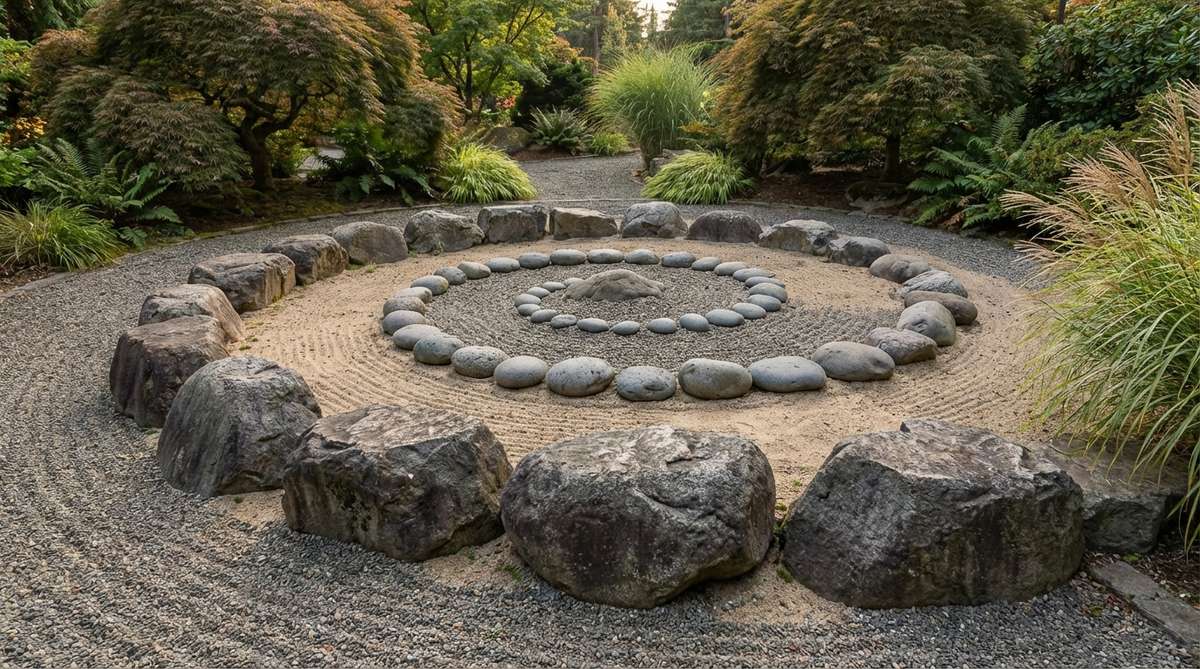
Arrange boulders in a gentle spiral pattern that curves inward toward a central meditation point. Use progressively smaller stones as the path approaches the center.
Start with substantial 2-3 foot boulders at the outer edge, finishing with modest 12-inch stones at the spiral’s heart. Space stones closer together as they spiral inward.
This labyrinth-inspired design provides a physical metaphor for inward spiritual journey. The decreasing stone size symbolizes shedding worldly concerns.
18. Cloud-Stepping Platform Path
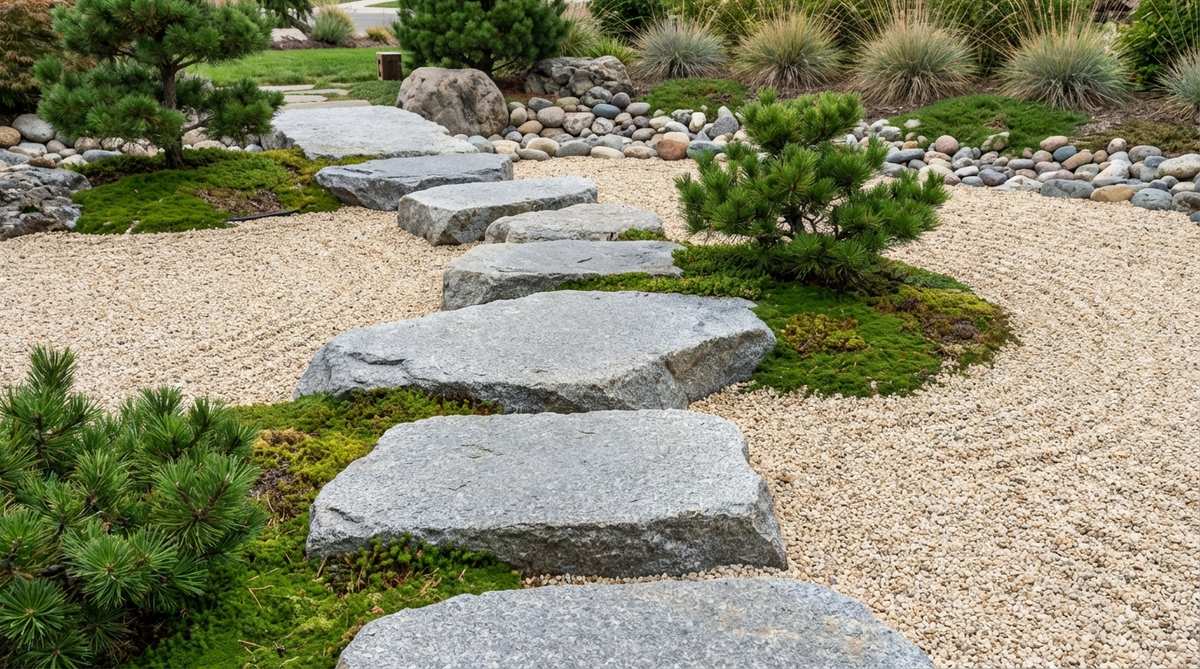
Create elevated pathway sections using broad, flat boulders that rise 4-6 inches above surrounding gravel level. These platform stones suggest stepping through clouds or crossing sacred space.
Choose boulders with naturally horizontal planes and bury them minimally to maintain elevation. Space platforms irregularly to create varied stepping rhythms.
The slight elevation change adds physical engagement and symbolic separation from mundane ground. This technique works beautifully in flat gardens lacking natural topography.
Water Element Representations Through Stone and Boulder
Boulder arrangements can evoke flowing water, waterfalls, and streams without using actual water elements. Strategic placement and stone selection create powerful aquatic illusions. These dry water features embody the zen principle of suggesting essence rather than literal representation.
19. Dry Cascade Waterfall
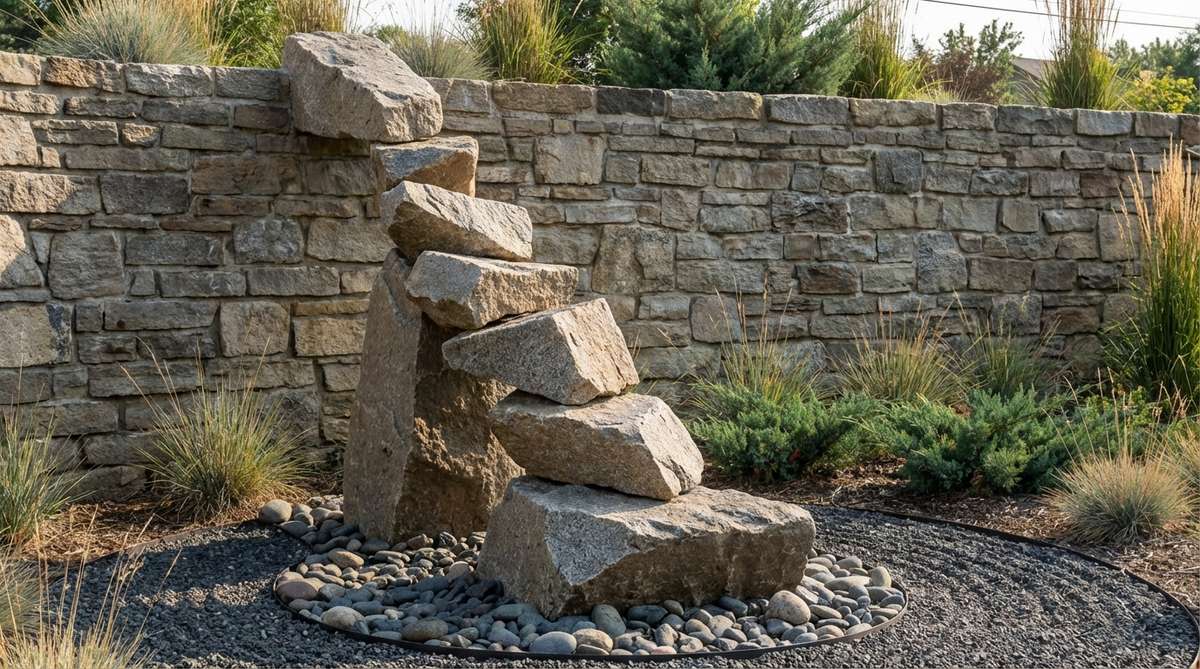
Stack angular boulders vertically to suggest a frozen waterfall, with stones slightly offset to create falling-water movement. Use 5-7 progressively smaller stones descending from a source boulder.
Position stones with their longest dimension vertical and tilt them slightly forward. Fill gaps with smaller stones to enhance the tumbling effect.
This dramatic arrangement brings vertical energy and water symbolism to the garden. It works especially well against walls or berms.
20. Stream Bed Boulder Course
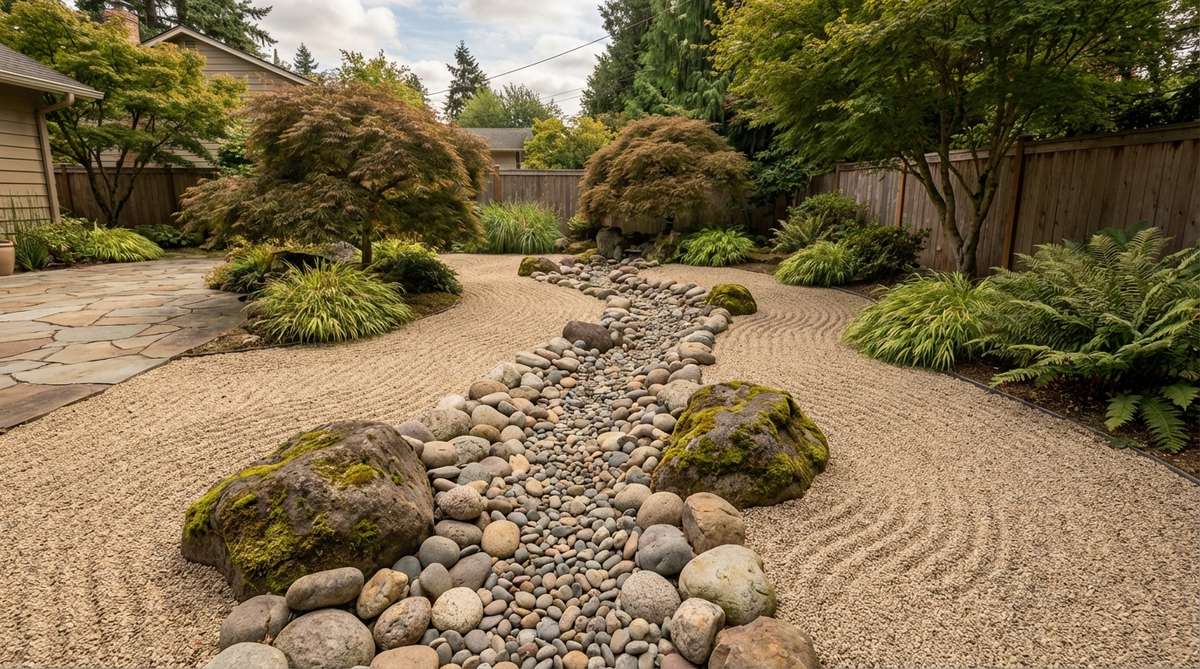
Arrange river-worn boulders in a meandering line across the garden to suggest a dried stream bed. Vary stone sizes to mimic natural water sorting patterns.
Place larger boulders at curve outer edges where water force would be strongest. Intersperse smaller stones and gravel along the center channel.
This naturalistic approach creates movement and direction in the garden layout. Raked gravel alongside suggests water flow frozen in time.
21. Whirlpool Boulder Spiral
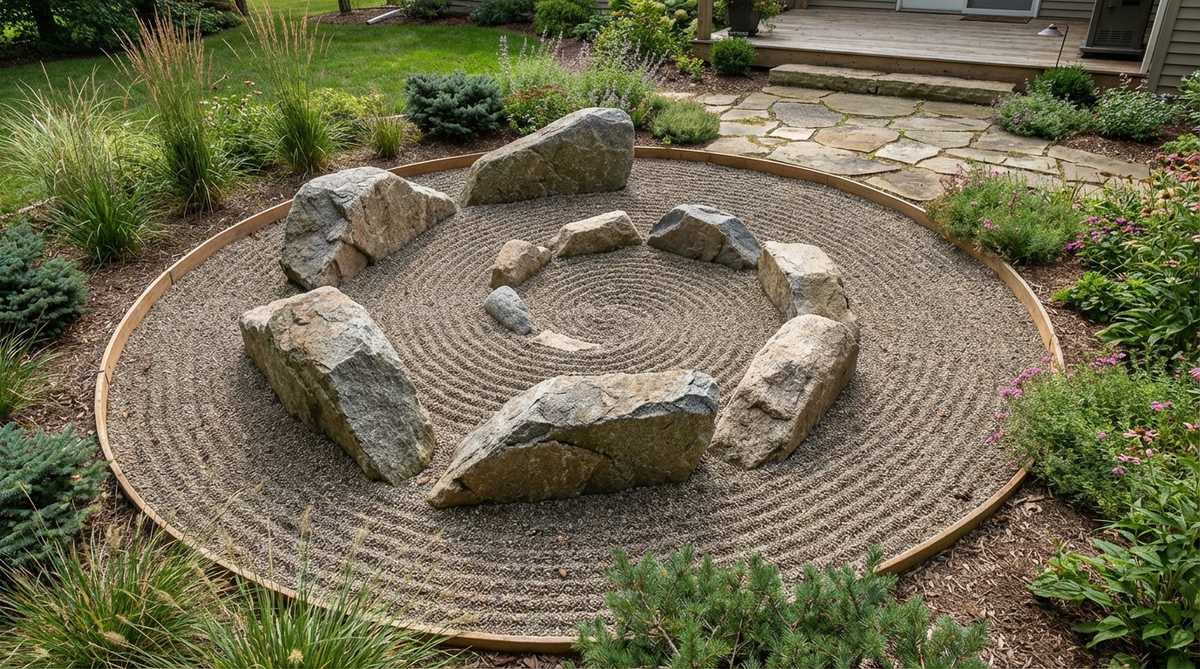
Position 5-9 boulders in a spiral formation around a central depression in gravel, suggesting a whirlpool or water vortex. Angle stones inward toward the center point.
Rake gravel in tight spiral patterns around and between the stones. The central void should be lowest point in the arrangement.
This dynamic composition captures water’s rotational energy in static form. It creates a mesmerizing focal point that draws contemplative attention.
22. Spring Source Boulder Fountain
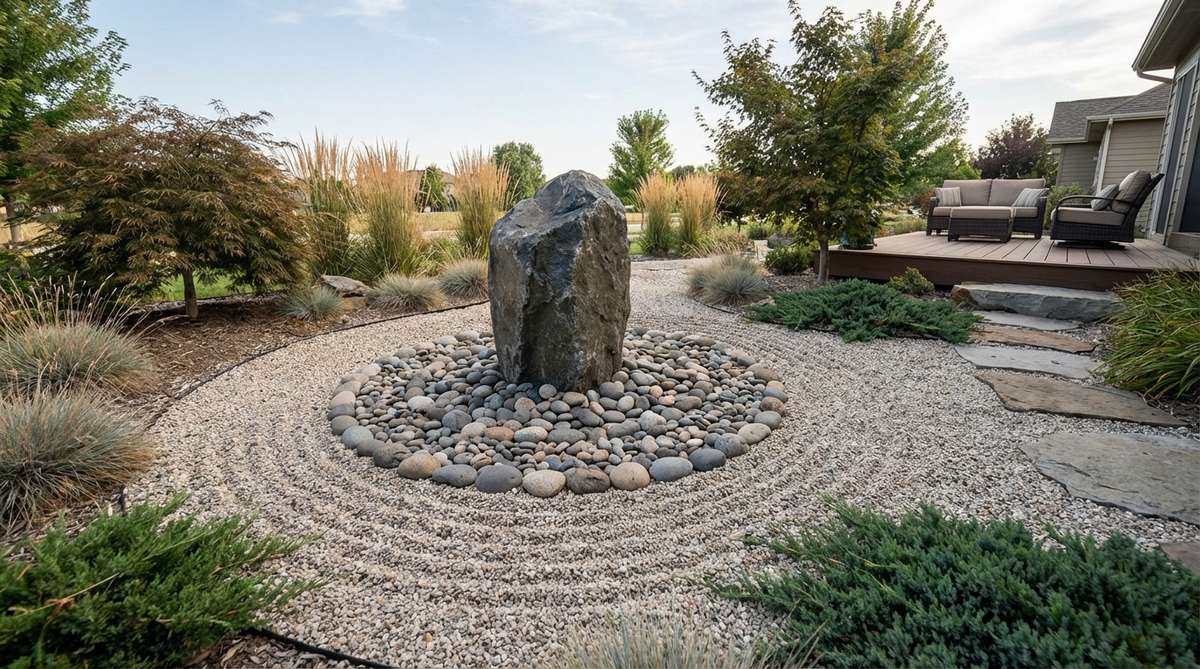
Surround a single central upright boulder with concentric rings of progressively smaller stones, suggesting water emanating from a spring source. Position 12-20 stones in 2-3 circular layers.
The central boulder should stand 2-3 feet tall with the surrounding stones barely protruding from gravel. Rake circular patterns radiating outward from the center.
This arrangement represents life force and creative energy flowing from source. It serves as a powerful symbol of renewal and origin.
23. Tidal Pool Boulder Basin
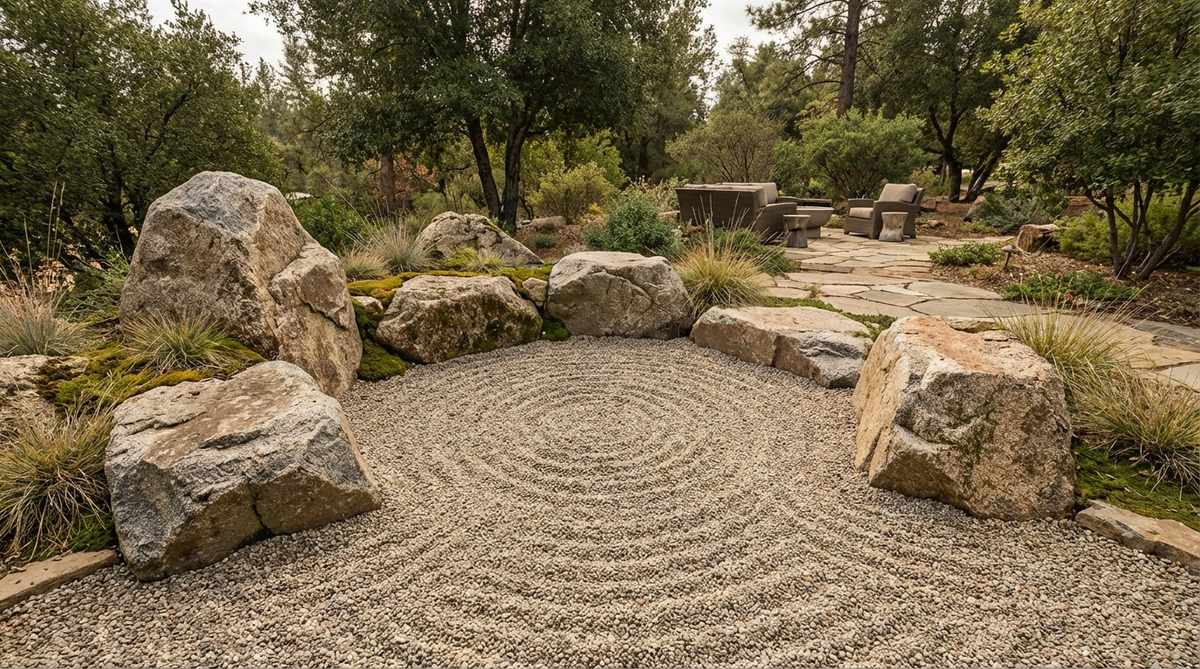
Create a depression surrounded by boulders arranged to suggest a natural tidal pool. Use 6-8 varied boulders positioned around a concave gravel area.
Rake the central depression in smooth, level patterns while creating ripple effects at boulder edges. Select stones with weathered, water-worn characteristics.
This contained composition brings intimate scale and reflective quiet. It invites close observation and detailed contemplation.
24. River Bend Eddy Cluster
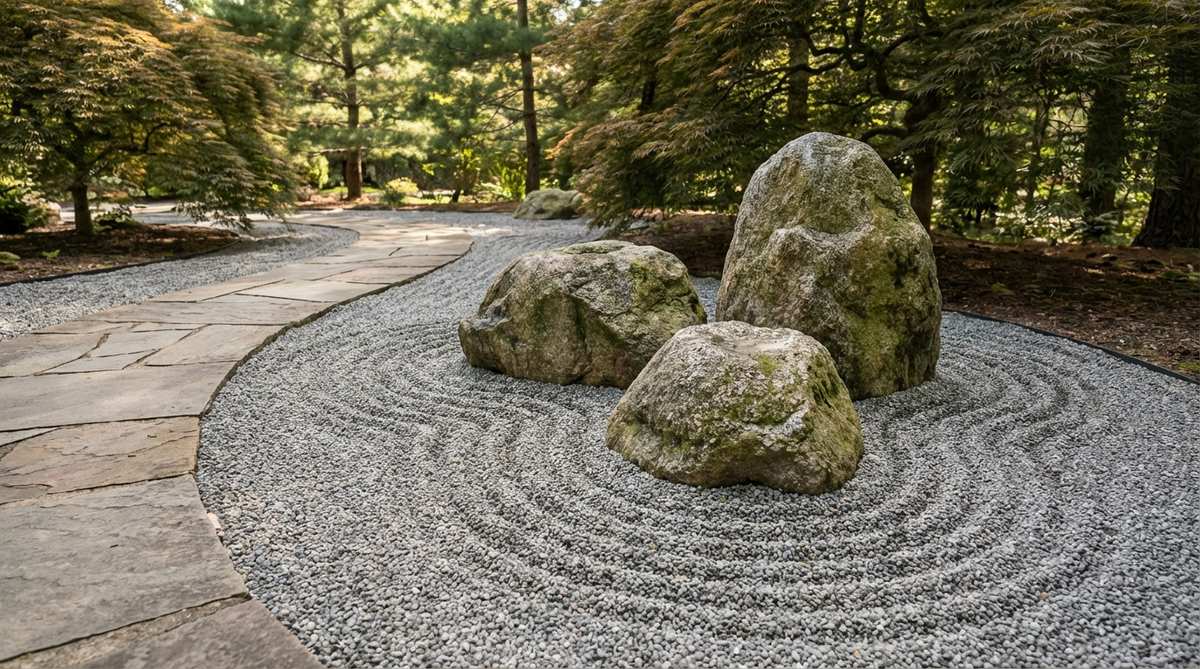
Group 3-5 boulders tightly together at a pathway curve to represent rocks that create eddies in flowing water. Position stones with varied orientations.
Rake gravel in curved lines that appear to flow around and between the boulder cluster. The pattern should suggest water deflection and turbulence.
This smaller-scale arrangement adds movement and energy to pathway edges. It demonstrates how water flows respond to obstacles.
Modern Minimalist Placements for Contemporary Spaces
Contemporary zen garden design embraces extreme simplicity, often using single boulders or pairs to create powerful statements. These minimalist arrangements focus attention intensely on stone quality and placement precision. Modern approaches honor traditional principles while adapting to architectural contexts.
25. Single Meditation Monolith
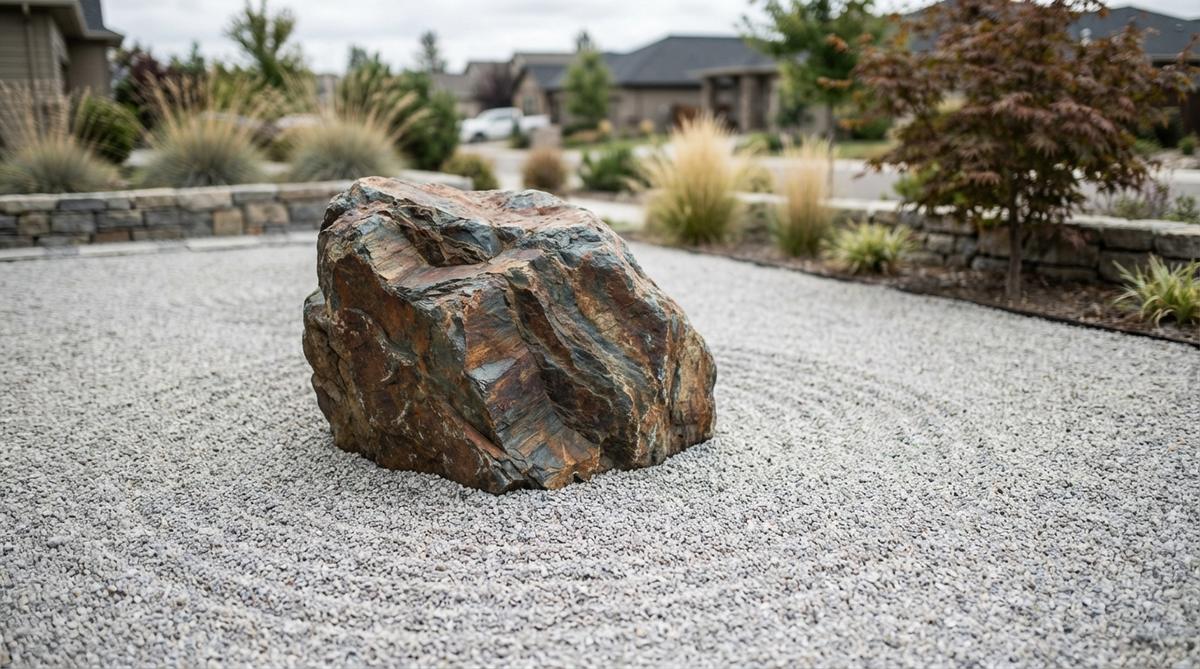
Position one exceptional boulder as the sole element in a carefully prepared gravel field. Select a stone with extraordinary character—dramatic shape, rich texture, or unusual coloring.
Center the stone in the space or use golden ratio placement for sophisticated balance. Rake gravel in simple parallel lines or concentric circles around it.
This ultimate minimalist approach demands stone perfection and impeccable placement. When executed well, it creates profound visual and spiritual impact.
26. Yin-Yang Boulder Pair
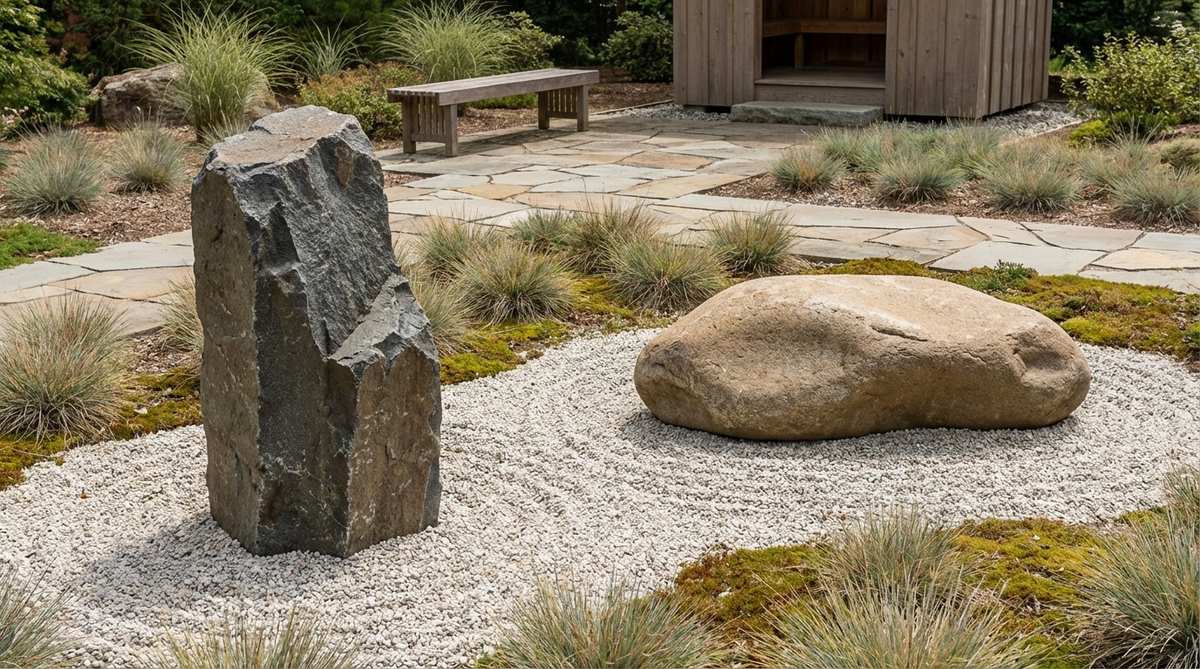
Place two contrasting boulders to represent complementary opposites—one vertical and angular, one horizontal and rounded. Position them 6-10 feet apart with clear visual relationship.
Choose stones with contrasting colors or textures to enhance the duality concept. Orient them so each stone’s best face addresses the other.
This philosophical pairing expresses balance through opposition. It provides rich contemplation material while maintaining visual simplicity.
27. Geometric Grid Boulder Array
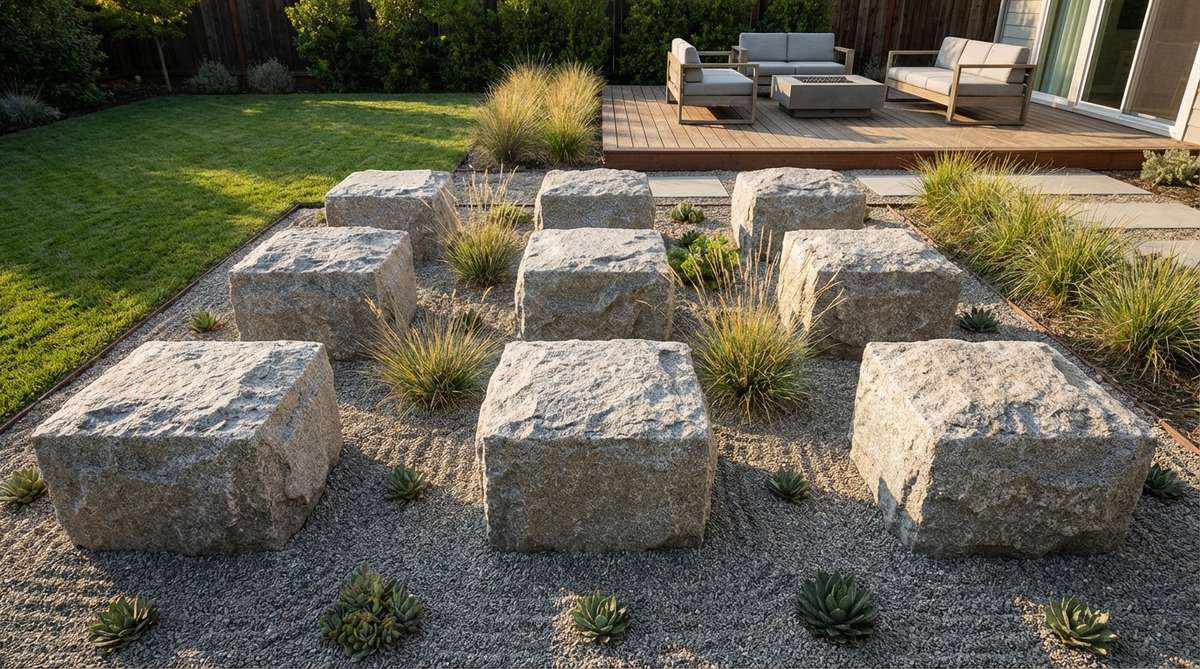
Break traditional asymmetry rules by placing nine identical boulders in a precise grid pattern. This contemporary approach creates stark geometric order.
Space stones exactly equidistant in a 3×3 grid. Use uniformly sized and shaped boulders for maximum repetitive effect.
This modern installation challenges zen garden conventions deliberately. It explores tension between natural materials and imposed geometric order.
28. Floating Platform Boulder
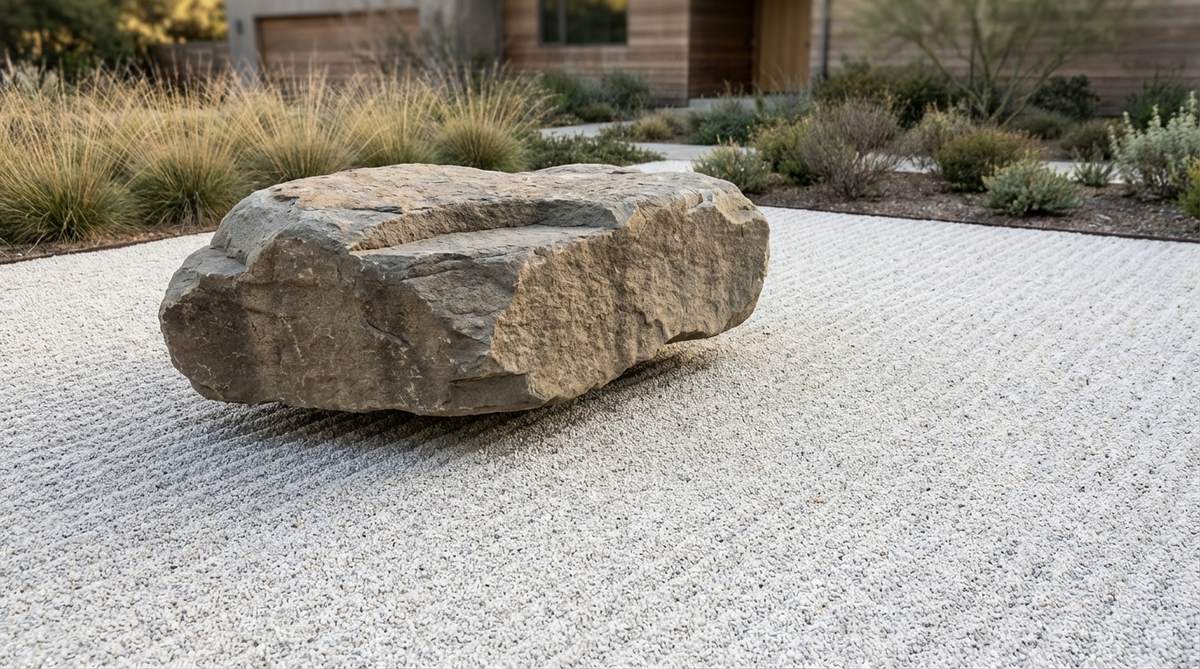
Set a broad, flat boulder in a sea of fine white gravel with minimal burial, creating a floating appearance. The stone should have a distinctly horizontal plane.
Rake the surrounding gravel in perfectly straight parallel lines to enhance the levitation illusion. Position the boulder off-center for dynamic tension.
This contemporary composition plays with perception and weightlessness. The contrast between solid mass and linear pattern creates optical interest.
29. Corner Accent Statement Stone
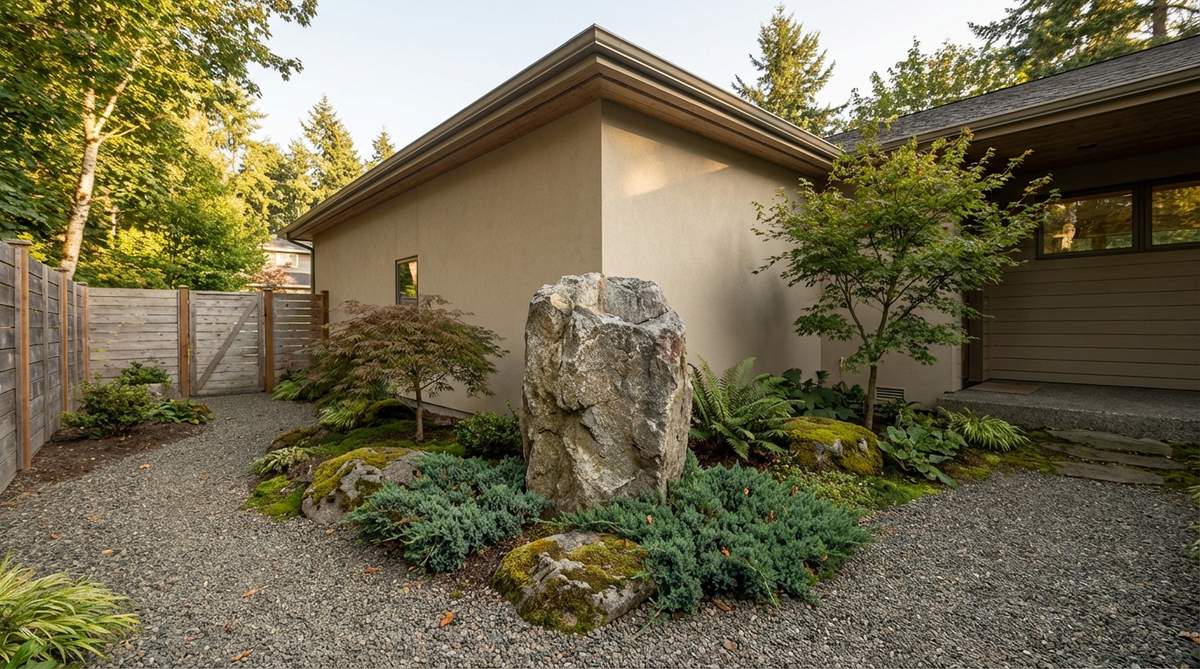
Place a single dramatic boulder in a garden corner or angular space where it intersects with architecture. Use the stone to soften hard edges and connect building to garden.
Select a boulder with strong vertical presence, 3-5 feet tall. Position it to be viewed from multiple angles as visitors move through adjacent spaces.
This architectural approach integrates zen garden principles with building design. The boulder mediates between constructed and natural realms.
30. Threshold Boulder Portal
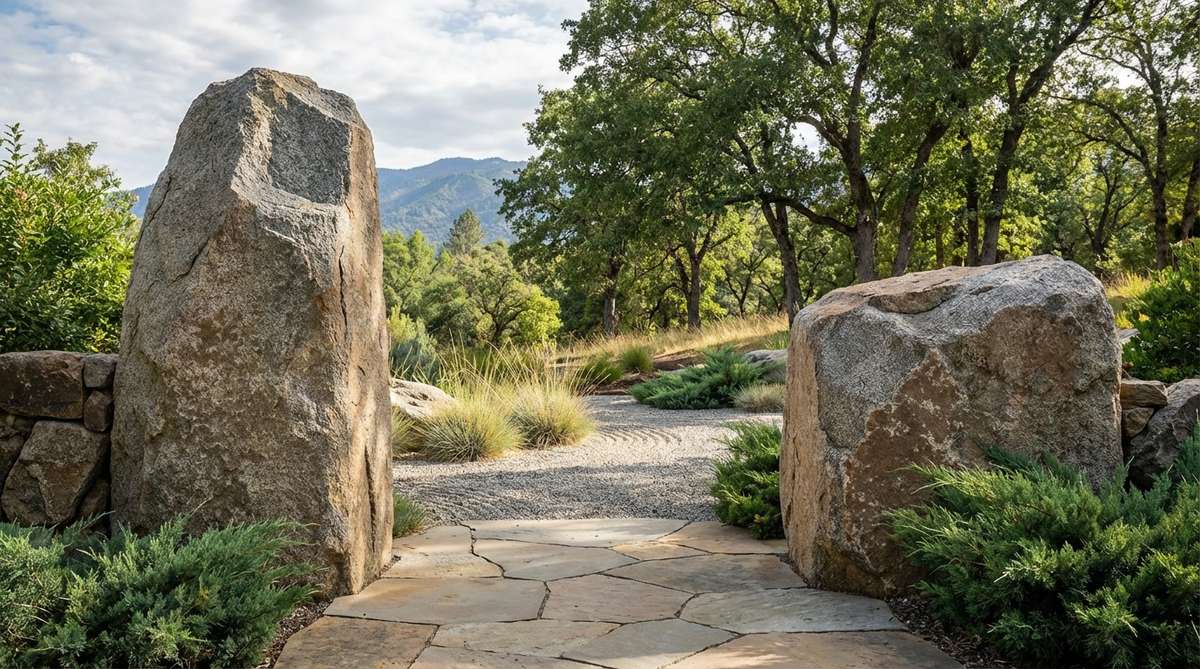
Frame a modern entrance or window view with two precisely placed boulders that create foreground interest. Position stones to frame rather than block sightlines.
Use stones of unequal height placed asymmetrically for dynamic framing. The arrangement should guide attention toward the view beyond.
This technique borrows from traditional borrowed scenery concepts. It layers viewing experiences and creates depth in compact spaces.
Vertical Stone Compositions and Upright Boulder Placements
Vertical stone arrangements create dramatic focal points and establish hierarchy within zen garden compositions. Upright boulders command attention and provide structural anchors for horizontal elements. These standing stones connect earth to sky symbolically.
31. Standing Stone Sentinel
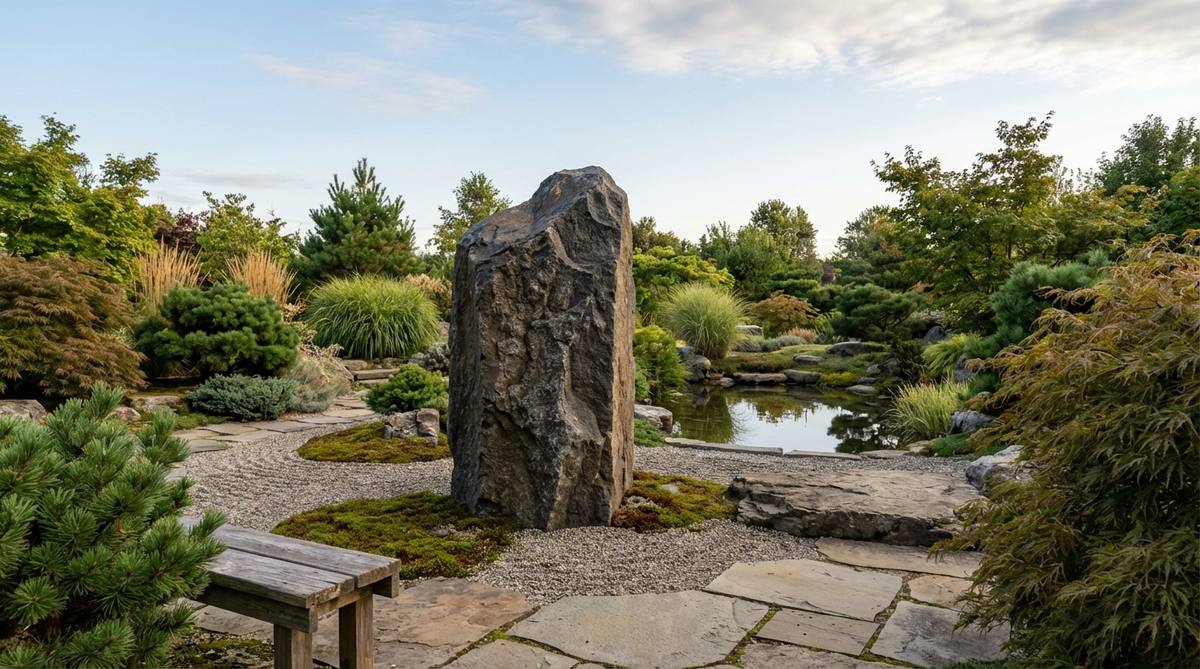
Position a single tall, narrow boulder vertically to stand 4-6 feet above ground level. Choose stone with one distinctly flat base for stable installation.
Bury 40-50% of the stone’s length for structural stability. Orient the most interesting face toward the primary viewing position.
This commanding presence establishes immediate visual hierarchy. The vertical emphasis contrasts powerfully with horizontal garden planes.
32. Three Buddha Stones
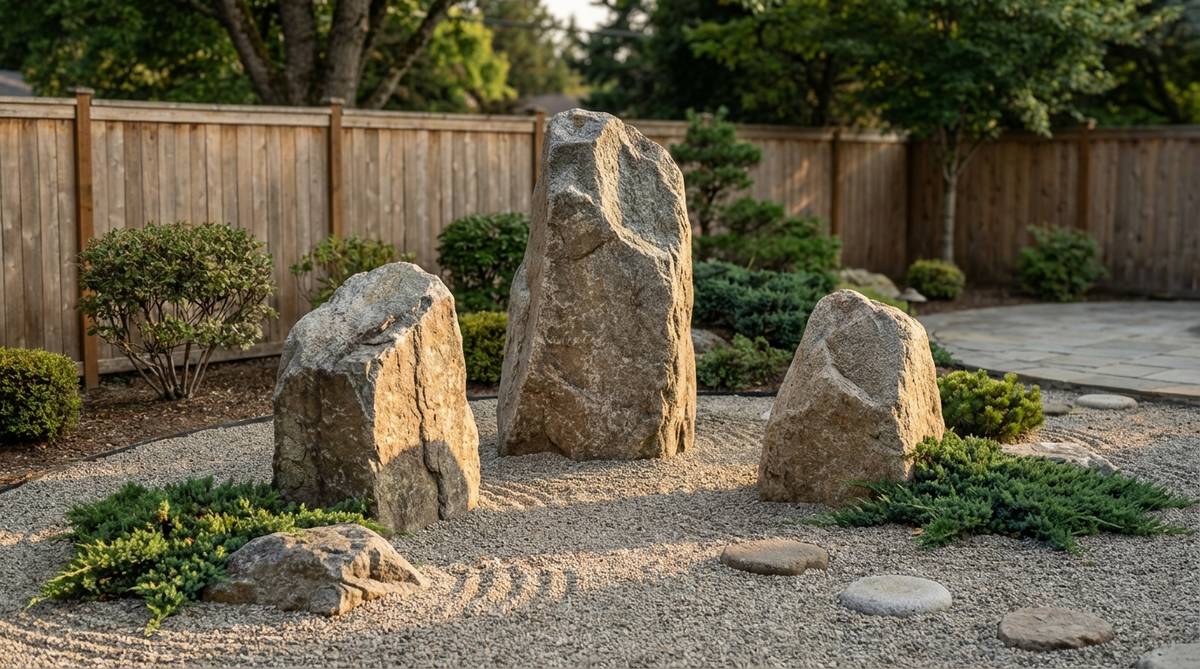
Arrange three upright boulders in a loose triangle, representing the three bodies of Buddha. The central stone should be tallest, flanked by progressively shorter stones.
Position stones close enough to read as a unified group but with distinct separation. Each should be individually beautiful while contributing to the whole.
This sacred arrangement invites spiritual contemplation. The triad formation appears throughout Buddhist art and architecture.
33. Vertical Stone Forest
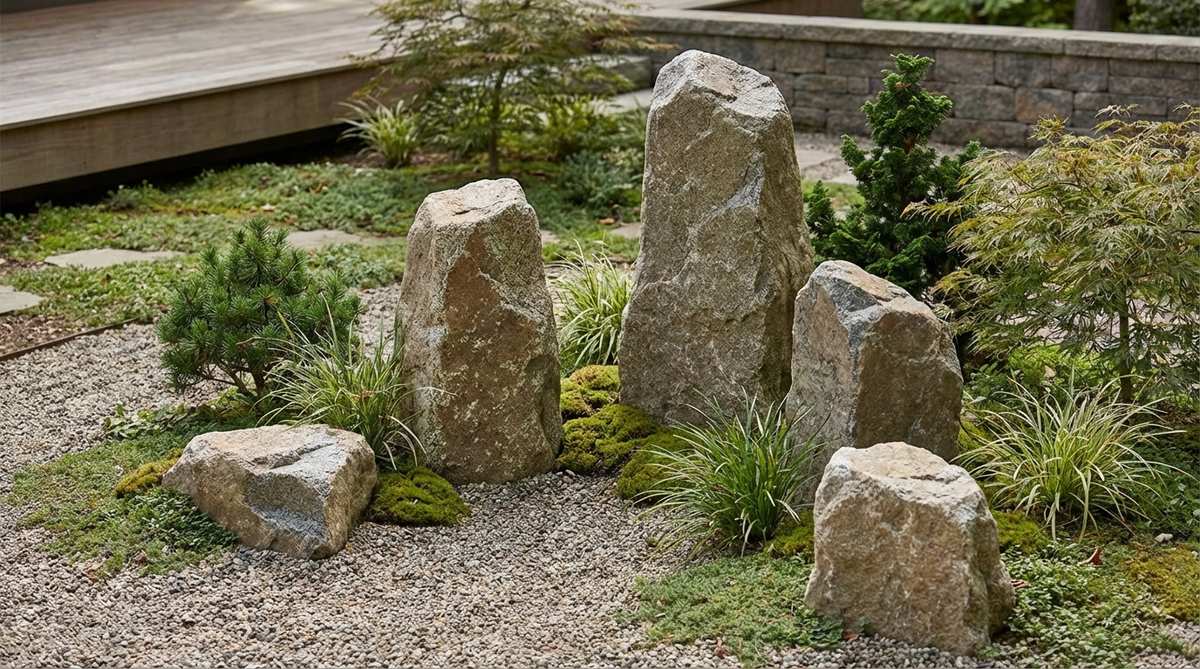
Group 5-7 upright boulders of varying heights to suggest a stone forest or bamboo grove. Heights should range from 18 inches to 5 feet.
Space stones irregularly with varying gaps between them. Some stones should be close enough to create intimate spaces, others more isolated.
This naturalistic grouping creates rhythm through repetition with variation. It generates complex spatial relationships from simple vertical elements.
34. Leaning Tower Stone
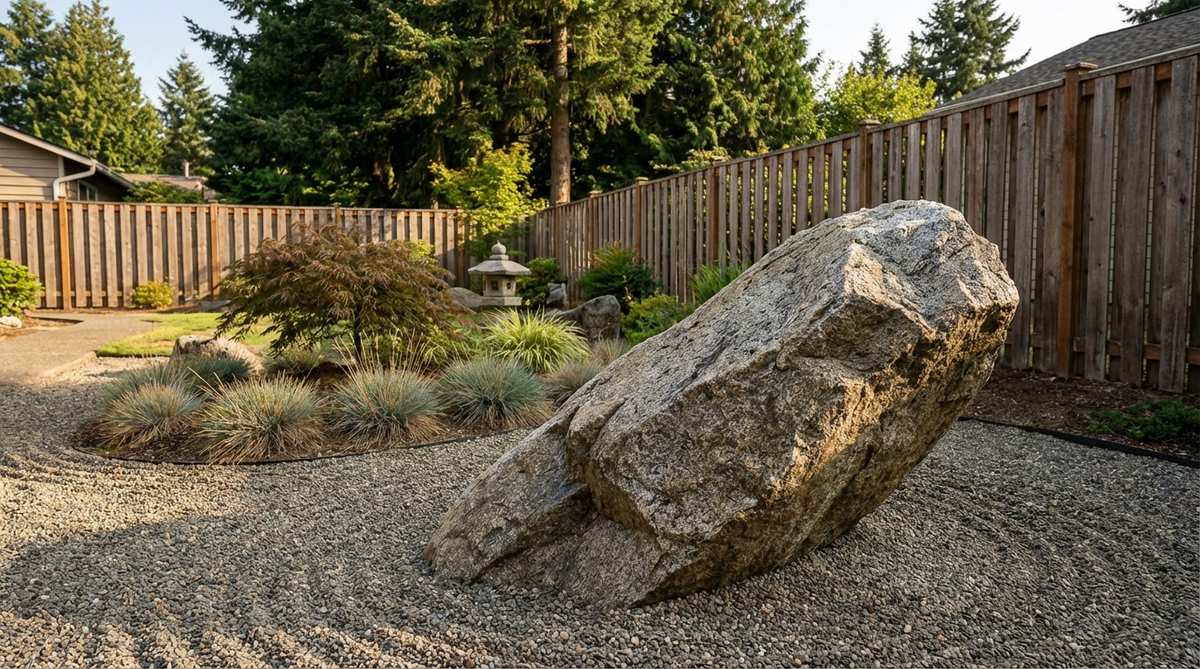
Install a substantial boulder at a deliberate angle, suggesting precarious balance or dynamic movement. The lean should be obvious but not so extreme as to appear unstable.
Secure the stone at approximately 15-20 degrees from vertical. Position it so the lean directs attention toward other garden elements.
This unconventional placement adds tension and energy. It challenges expectations and creates visual interest through implied motion.
35. Sword Stone Blade
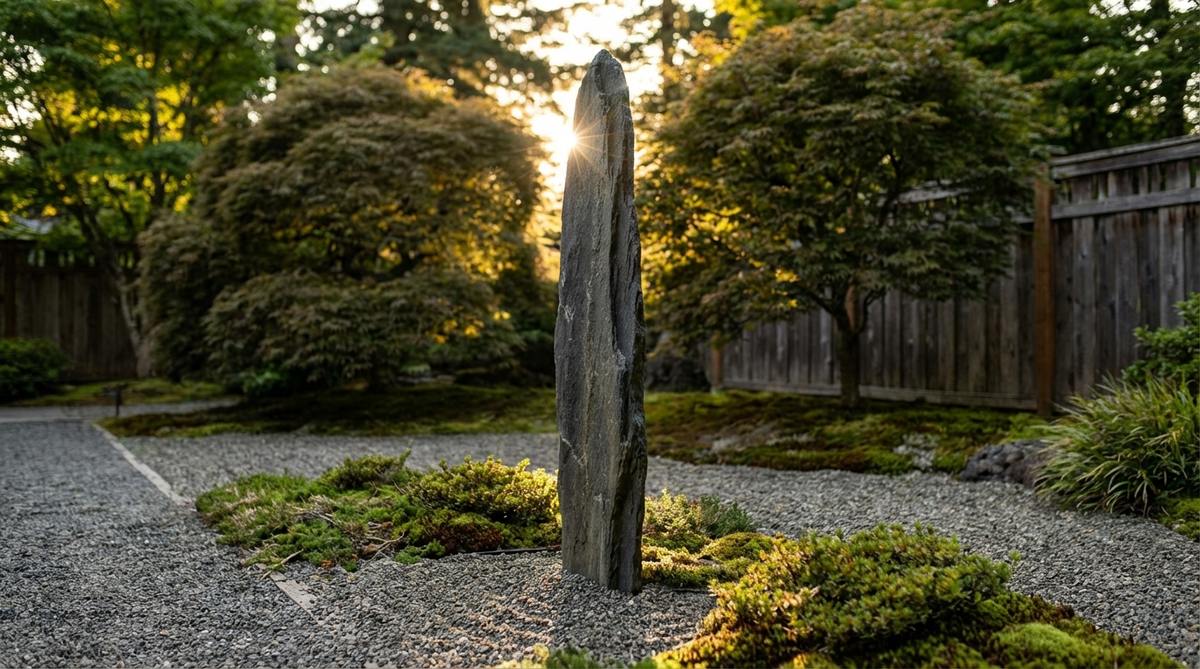
Select a thin, blade-like boulder and position it vertically with the narrow edge facing forward. This creates a sharp, cutting visual line.
Choose stone no more than 4-6 inches thick but 3-4 feet tall. The narrow profile creates dramatic silhouette, especially when backlit.
This aggressive form introduces masculine energy and protective symbolism. It works well as a boundary marker or guardian element.
36. Pyramid Peak Cluster
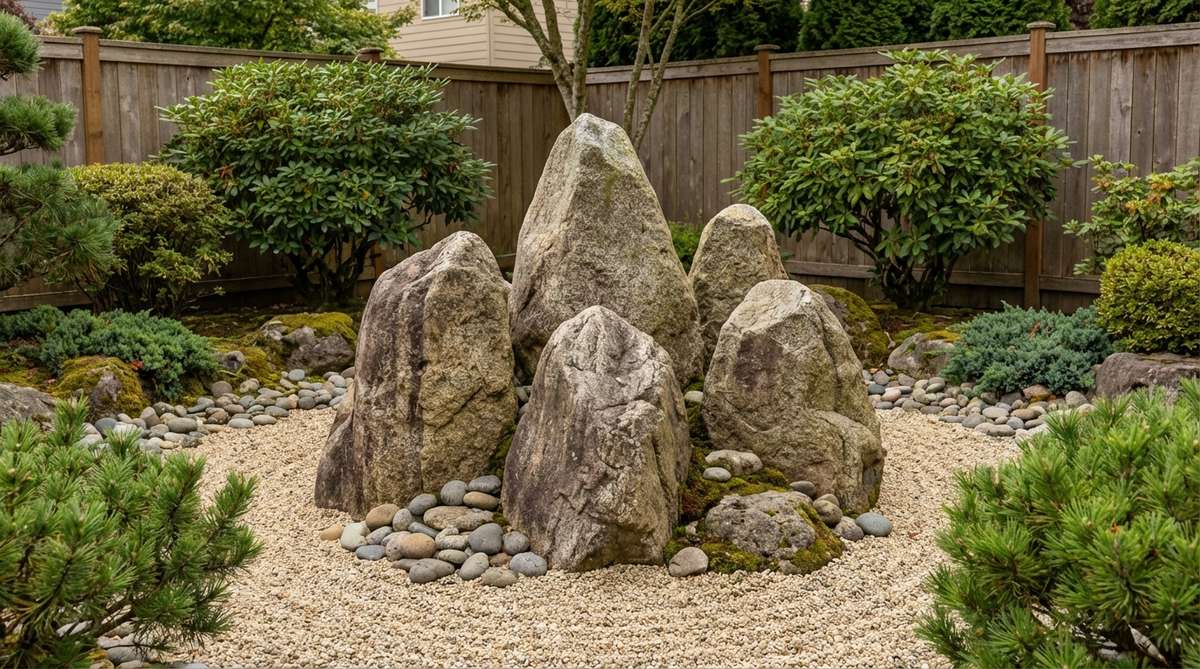
Arrange 3-5 upright boulders in a tight cluster that collectively forms a pyramid shape. The central stone reaches highest, with others descending symmetrically.
Bury stones at varying depths to achieve the desired height relationships. Pack smaller stones between major elements to unify the cluster.
This stable, grounded formation conveys permanence and strength. The pyramid form has universal spiritual resonance.
Textural Boulder Combinations and Surface Contrasts
Combining boulders with contrasting textures creates tactile interest and visual complexity. Surface characteristics—smooth versus rough, weathered versus fresh—add depth to compositions. Texture selection influences how light interacts with stone throughout the day.
37. Smooth-Rough Dialogue
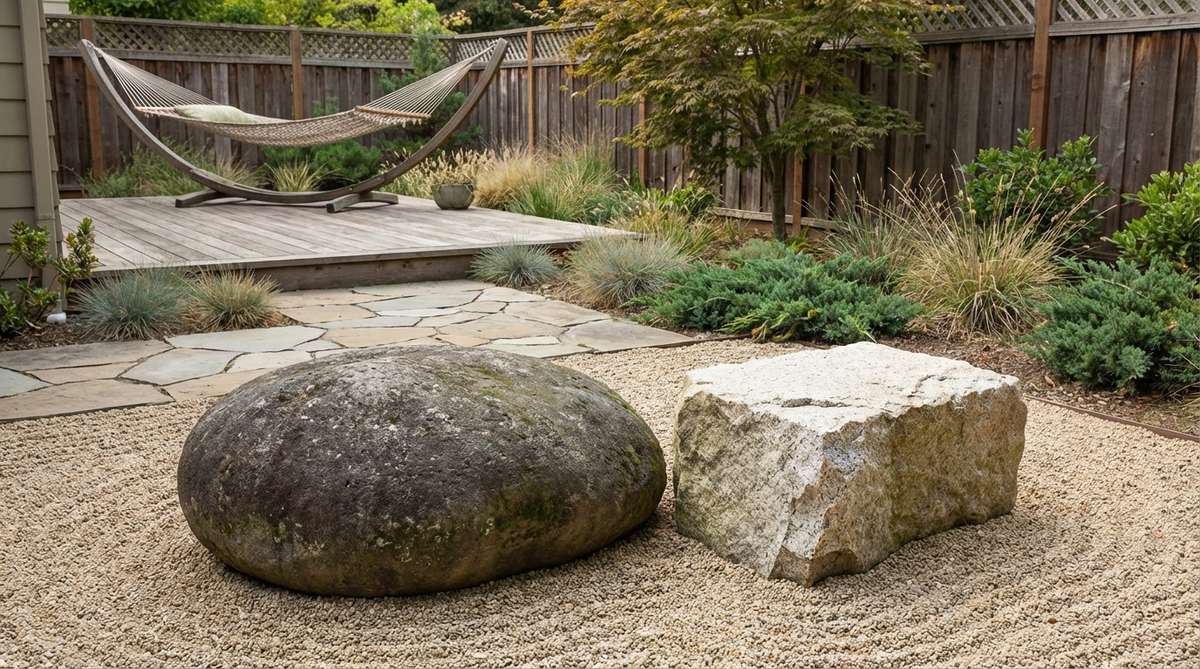
Pair a river-polished smooth boulder with a rough, angular quarried stone. Position them close enough for direct visual comparison.
Choose stones of similar size but maximum textural contrast. Place the smooth stone in slightly subordinate position to the rougher anchor stone.
This juxtaposition highlights each stone’s distinctive character. The contrast creates conversation between opposing natural processes.
38. Weathered Patina Grouping
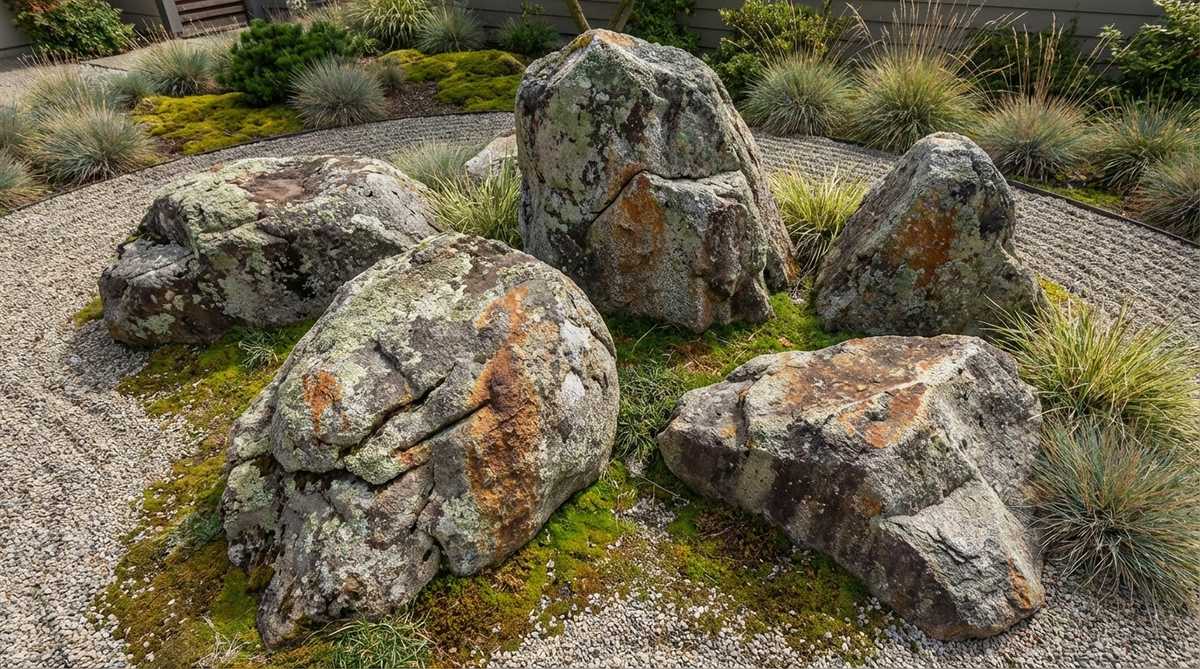
Collect 3-5 boulders showing beautiful aging effects—lichen growth, mineral staining, erosion patterns. Group them to celebrate time’s artistic effects.
Position stones to display their most weathered faces prominently. The arrangement should feel ancient and naturally formed.
These time-marked stones bring history and authenticity to the garden. Patina suggests permanence and connection to natural cycles.
39. Crystalline Structure Showcase
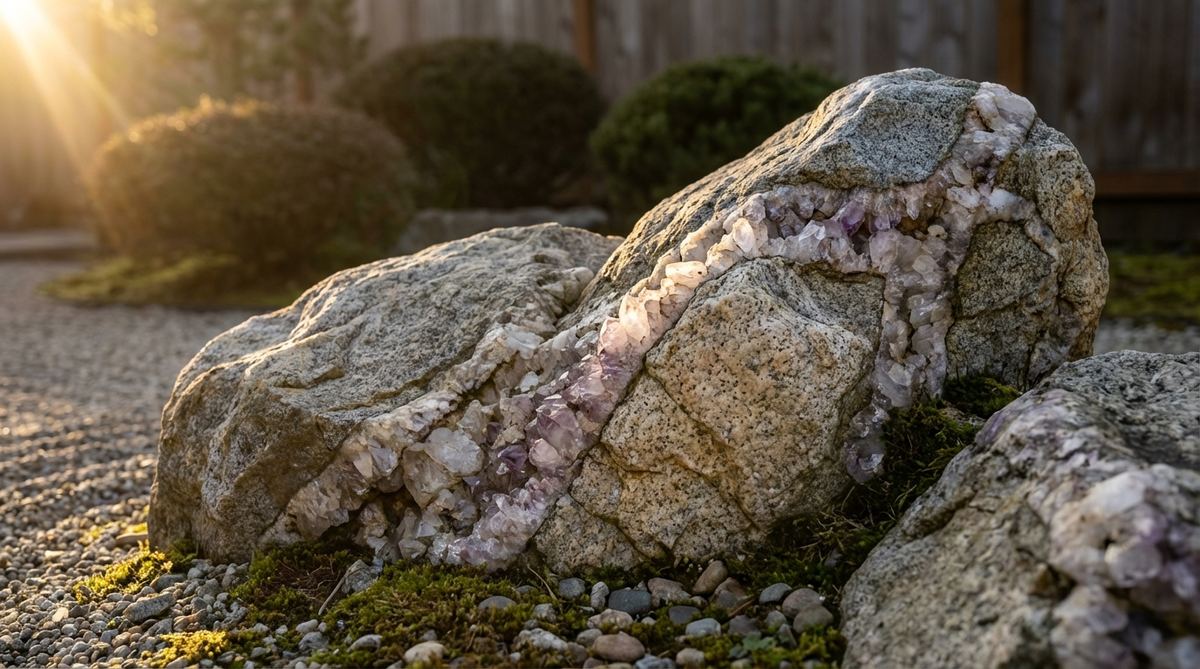
Feature boulders with visible crystal formations or distinctive mineral striations. Select stones where geological structure creates visual interest.
Position these specimens where light will illuminate internal structure. Morning or evening side lighting works particularly well.
This approach celebrates earth’s creative processes. Crystal patterns add unexpected color and sparkle to monochromatic schemes.
40. Moss-Covered Boulder Trio
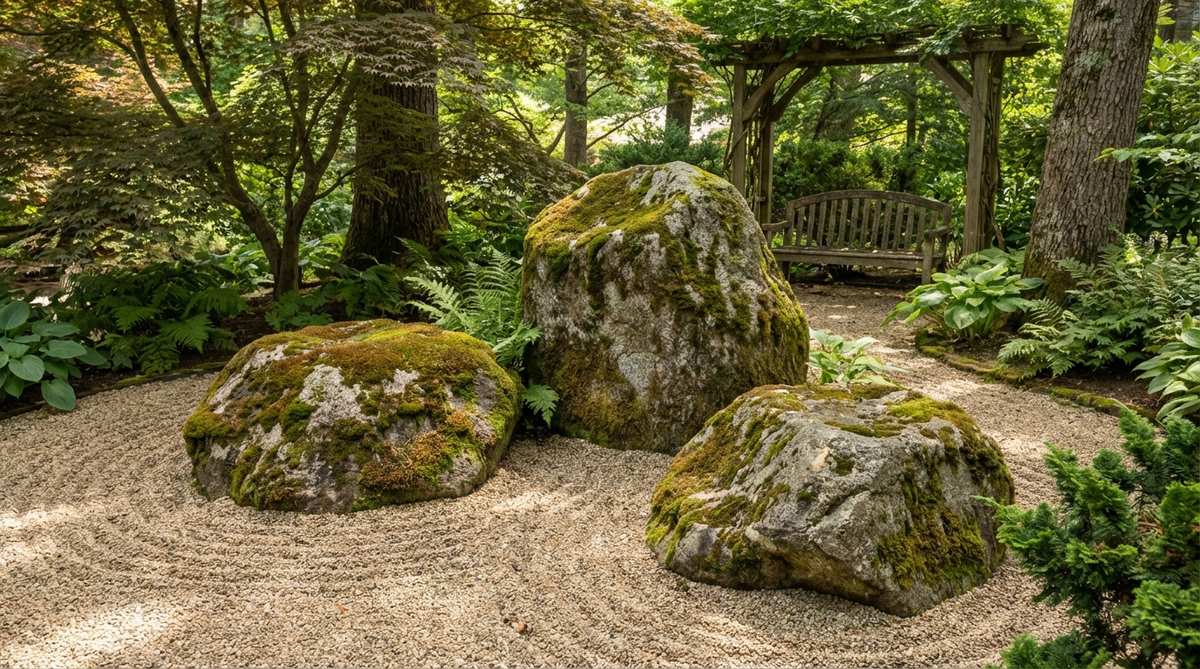
Group three stones already colonized by moss or position new boulders to encourage moss growth. The green softness contrasts with stone hardness.
Choose stones with textured surfaces that retain moisture. Position them in partially shaded locations to support moss establishment.
Living surfaces bring temporal change to permanent stone. Moss growth connects the arrangement to seasonal cycles.
41. Split Stone Revelation
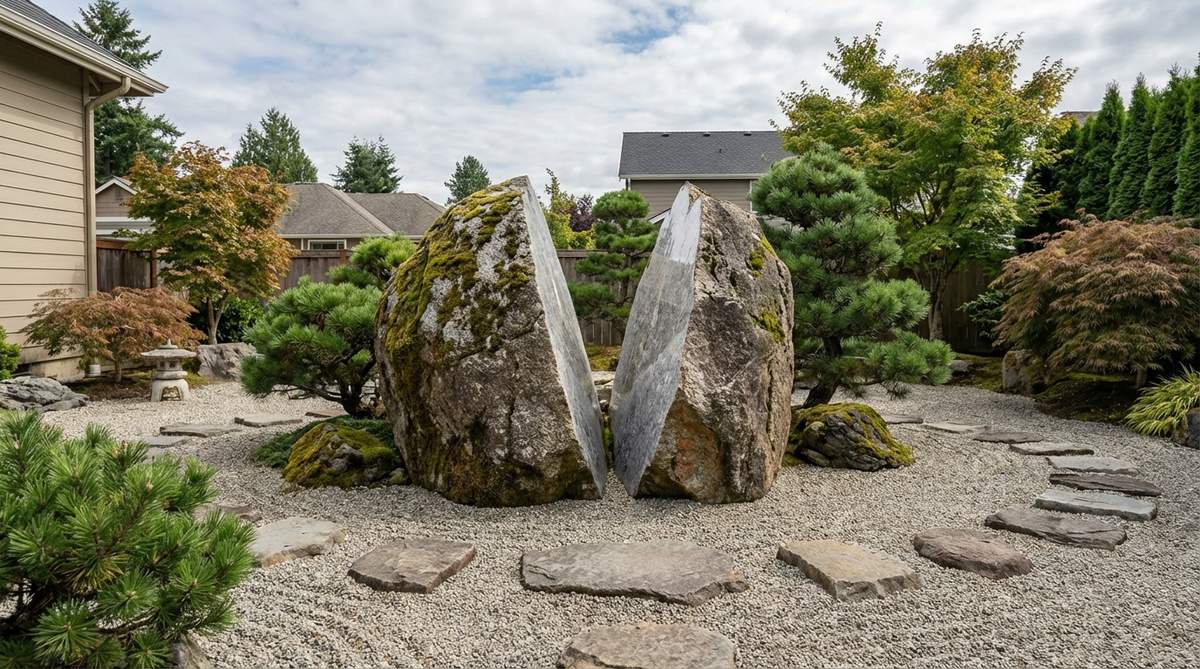
Use a boulder that has naturally split or been intentionally fractured, positioning pieces to show both external weathered surface and fresh internal structure.
Place the pieces close together but with clear separation revealing the break. Orient to display internal color and texture.
This dramatic presentation exposes hidden beauty within solid mass. It symbolizes revelation and inner truth made visible.
42. Striped Sedimentary Layers
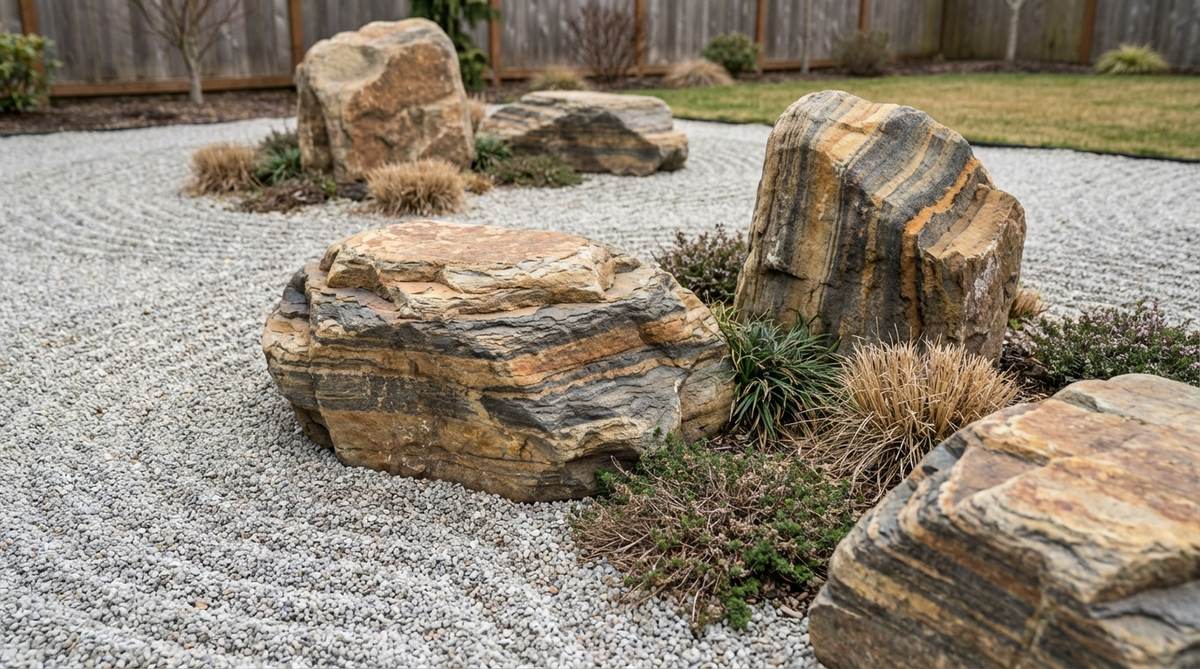
Select sedimentary boulders with pronounced horizontal banding or color layers. Position them to emphasize the stratification patterns.
Orient stones so layers run horizontally rather than vertically. This aligns with natural geological positioning and reads as authentic.
Layered stones tell geological stories of ancient environments. The horizontal lines complement raked gravel patterns beautifully.
43. Honeycomb Weathering Patterns
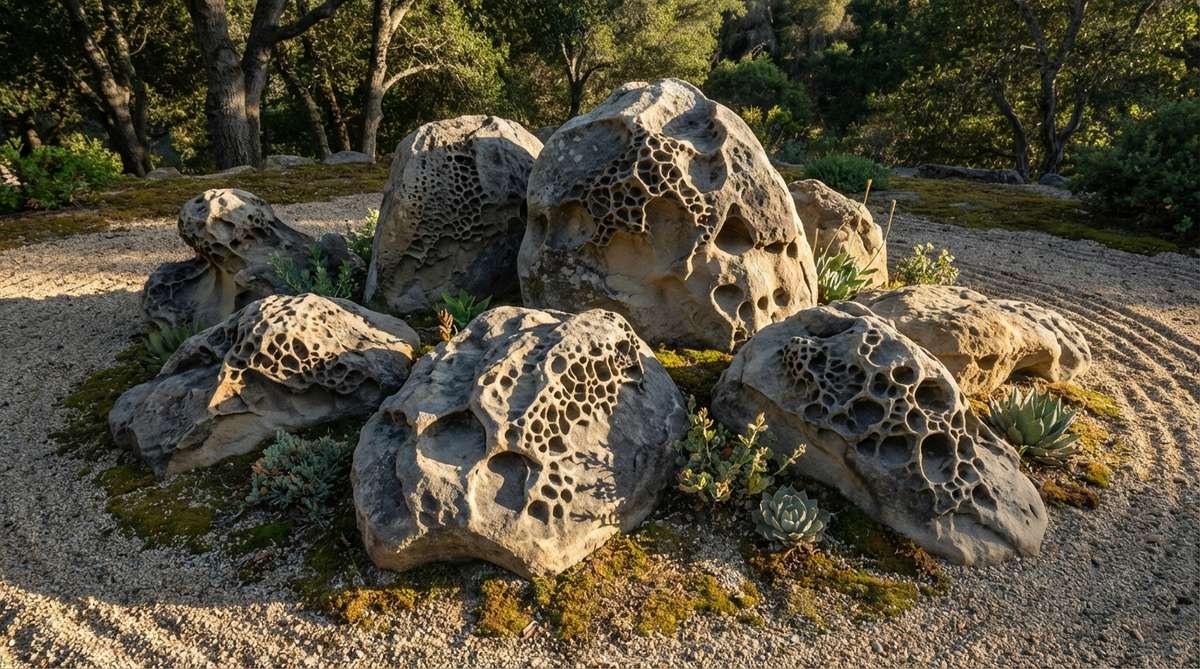
Feature stones with honeycomb or tafoni weathering—small cavities created by erosion. These textured surfaces catch light and shadow dramatically.
Position these sculptural stones where low-angle light will enhance the three-dimensional surface texture. They work well as close-up viewing elements.
The organic patterns demonstrate nature’s patient artistry. These stones reward close observation with intricate detail.
Creating Your Personal Zen Garden Stone Sanctuary
Mastering zen garden rocks arrangements requires understanding both aesthetic principles and deeper symbolic meanings that these ancient designs embody. Whether you choose traditional mountain formations, minimalist contemporary placements, or innovative textural combinations, the key lies in thoughtful stone selection and intentional positioning. Start with a single powerful boulder arrangement and expand gradually, allowing each addition to find its natural place in the emerging composition. Your zen garden becomes a personal meditation space that evolves with practice and deepening understanding of stone placement principles.
Frequently Asked Questions
How many rocks should be in a zen garden arrangement?
Traditional zen gardens use odd numbers of rocks—typically 3, 5, 7, or 9 stones—to create natural asymmetry and visual balance. The specific number depends on your space size and design goals. Small gardens work well with 3-5 featured boulders, while larger spaces can accommodate more complex arrangements. The key principle is avoiding even numbers and symmetrical placement, which feel artificial and static compared to nature’s organic patterns.
Should zen garden boulders be partially buried?
Professional designers bury boulders 50-80% of their total height to create the appearance of natural mountain formations emerging from the earth rather than stones simply placed on the surface. This deep burial provides structural stability, prevents stone movement, and generates authentic visual weight. The technique makes boulders appear as permanent geological features that have existed for centuries rather than recently installed landscape elements.
What type of stone works best for zen garden rocks?
Angular granite, basalt, and limestone work exceptionally well for zen garden boulders because they suggest mountain character and natural geological formations. Designers prefer stones with weathered surfaces, interesting textures, and muted colors like gray, charcoal, beige, or blue-gray. Avoid overly round river rocks for primary features and extremely light-colored stones that reflect harsh sunlight. Local stone varieties often provide the most authentic and regionally appropriate aesthetic.
Can I create a zen rock garden in a small space?
Small spaces actually work beautifully for zen rock gardens because the design philosophy emphasizes simplicity and essentialism over size. A compact area of just 6×8 feet can accommodate a meaningful arrangement using 1-3 carefully selected boulders surrounded by raked gravel. Minimalist approaches with a single exceptional stone often create more powerful impact than cluttered larger installations. Scale your boulder size appropriately—use 18-24 inch stones for small spaces rather than massive multi-foot specimens.
How do I arrange rocks to represent water in a zen garden?
Create water representations by positioning boulders in flowing patterns that suggest stream beds, cascades, or islands surrounded by raked gravel seas. For dry waterfall effects, stack angular stones vertically with slight offsets to imply falling water. Stream beds use river-worn boulders arranged in meandering lines with larger stones at curve outer edges. Islands emerge as isolated boulder groupings within expansive gravel areas raked in wave or ripple patterns. The surrounding raked gravel serves as the water element, with stone placement directing the visual flow.