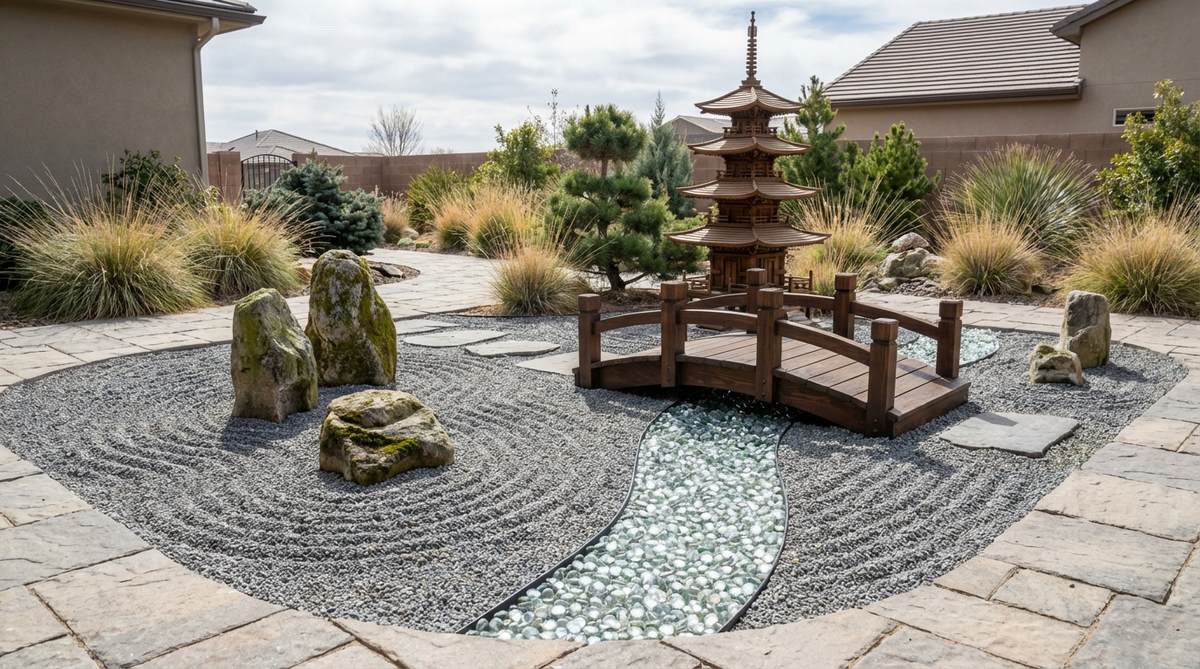
The japanese zen garden tradition of karesansui transforms simple materials—rocks, sand, and gravel—into profound expressions of natural landscapes without using water. This ancient art form, rooted in Zen Buddhist philosophy, creates contemplative spaces through carefully composed arrangements that symbolize mountains, rivers, and oceans. Fresh Garden Ideas brings you over 50 authentic examples to inspire your own dry landscape design.
Design SnapshotKey Principles
- Symbolic Representation: Rocks represent mountains and islands while raked sand patterns symbolize flowing water or ocean waves
- Asymmetrical Balance: Elements are arranged in odd-numbered groupings to create natural harmony without rigid symmetry
- Minimalist Restraint: Limited material palette emphasizes empty space and encourages contemplative viewing
- Scale and Perspective: Strategic placement of larger foreground stones and smaller background elements creates depth and distance
Classical Kyoto Temple GardensThe Heart of Karesansui Tradition
Kyoto’s Zen temples house the most celebrated examples of karesansui design, developed during the Muromachi period when confined monastery spaces demanded waterless landscape solutions. These historic gardens established the visual vocabulary still used today.
1. Ryoanji Temple Rock Garden
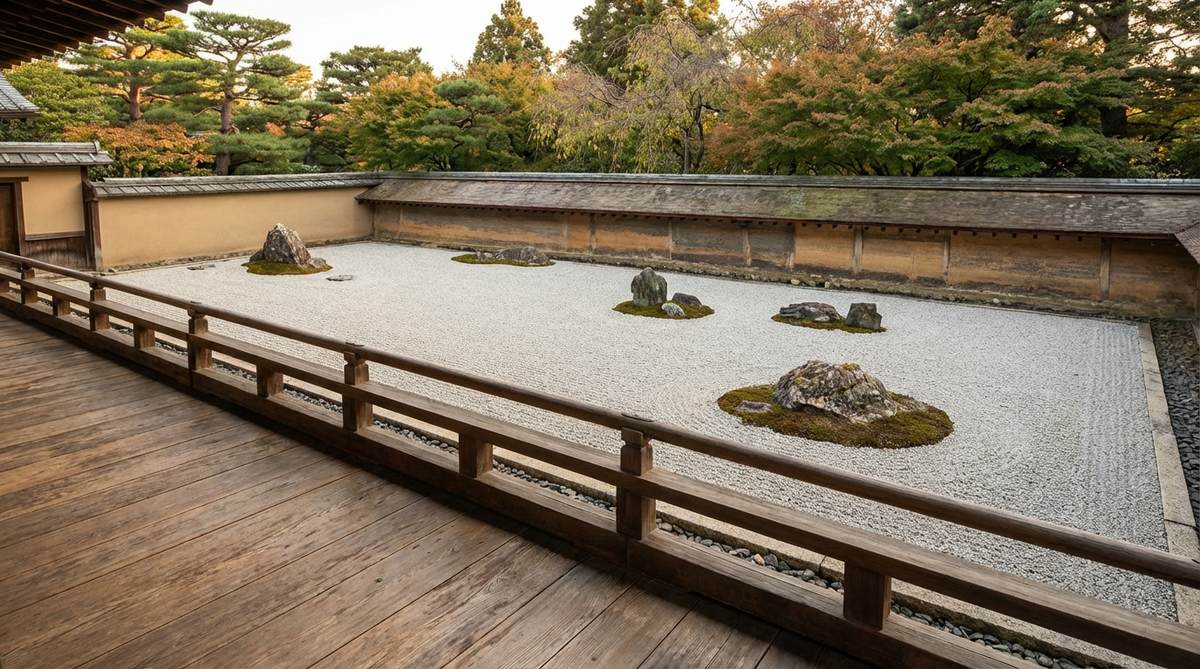
Fifteen stones arranged on a rectangular bed of white gravel create Japan’s most iconic dry landscape. The stone placement ensures that from any single viewing position, at least one stone remains hidden from sight.
Surrounded by low earthen walls topped with clay tiles, the flat composition measures approximately 25 meters by 10 meters. The viewing experience changes dramatically depending on your seated position along the wooden veranda.
This garden epitomizes the principle of “less is more” through its stark simplicity and profound spatial relationships. The luminous Shirakawa white gravel provides a neutral canvas that highlights the stones’ sculptural qualities.
2. Daisen-in Temple Dry Waterfall
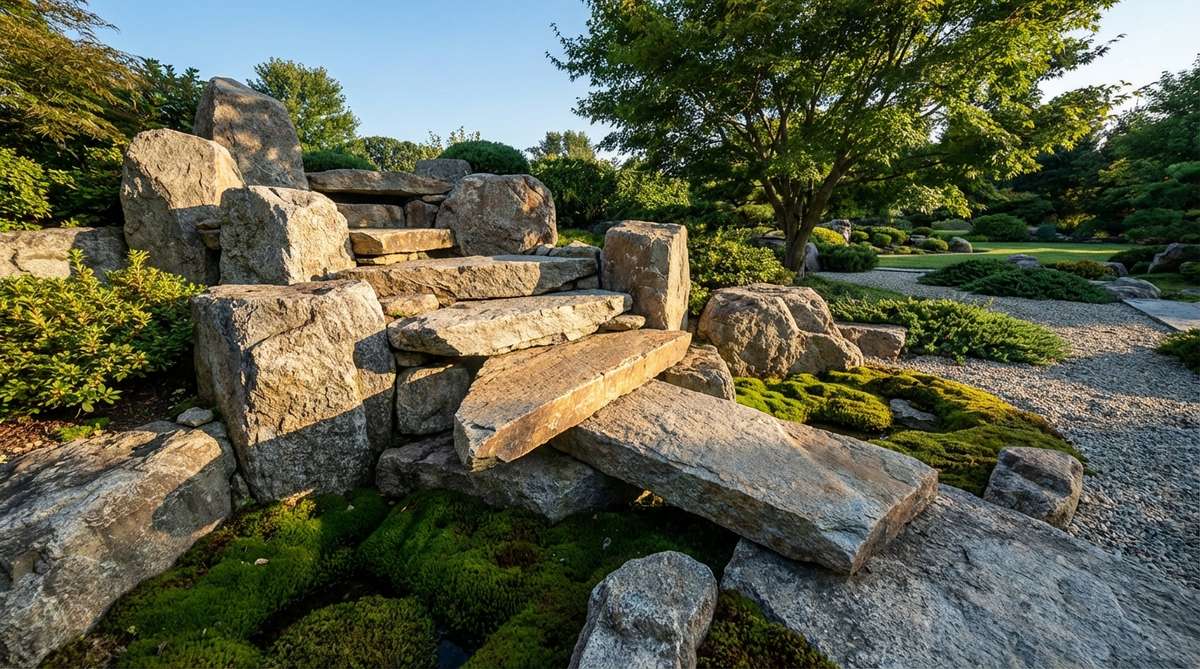
A vertical stone arrangement creates the illusion of cascading water without a single drop. Granite rocks are stacked in a stairway formation that suggests the powerful downward movement of a mountain waterfall.
The “kare-taki” technique positions flat stones at angles that catch light differently throughout the day. Surrounding moss patches, which developed naturally over centuries, now represent pools at the waterfall’s base.
This design demonstrates how stone texture and placement can evoke water’s dynamic energy. Visitors report hearing the phantom sound of rushing water when contemplating this composition.
3. Tenryuji Temple Pond Garden
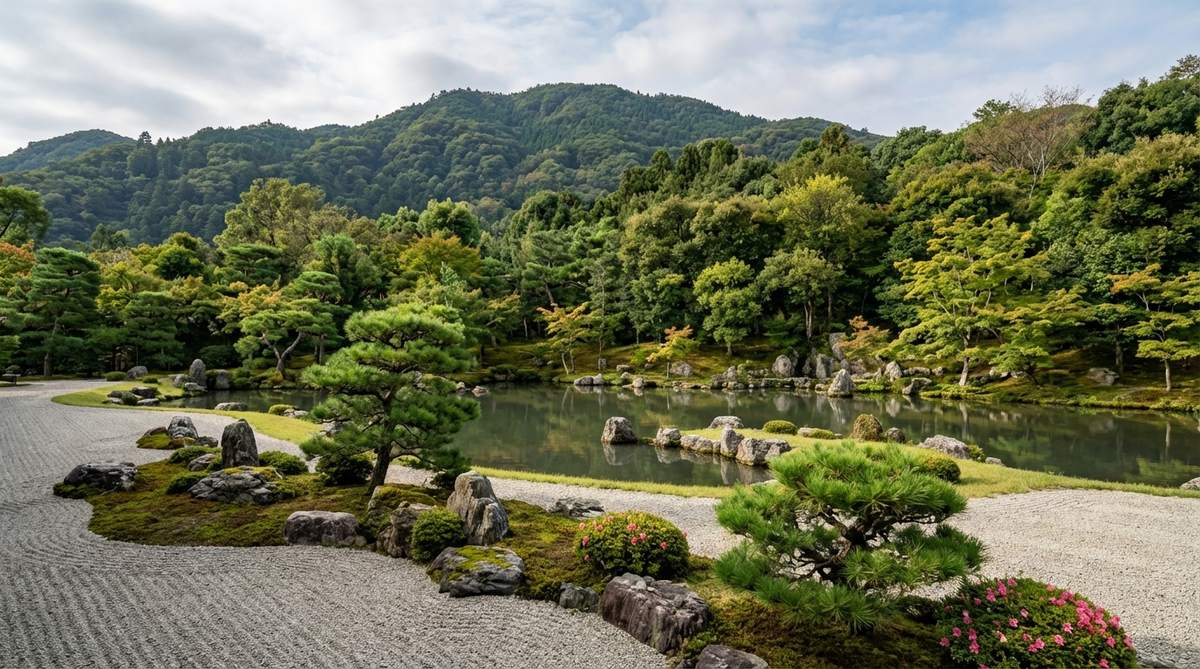
Though centered around an actual pond, this World Heritage Site incorporates extensive karesansui elements in its surrounding areas. The dry landscape sections harmonize with the Arashiyama mountains visible in the background.
Stonework and carefully pruned plants create “borrowed scenery” that integrates distant peaks into the garden composition. The designer arranged rocks to mirror the natural mountain formations beyond the garden walls.
This approach shows how karesansui principles apply to larger landscape designs. The interplay between constructed and natural elements produces a seamless visual experience.
4. Ginkakuji Silver Pavilion Sea of Sand
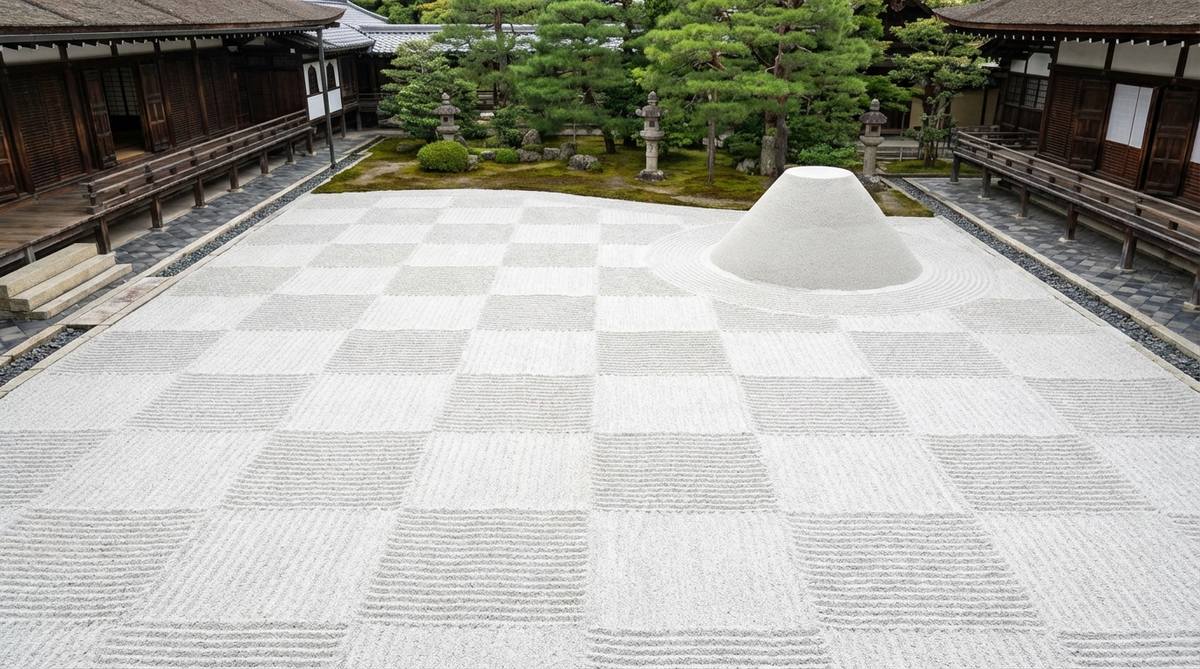
Two distinct sand formations dominate this gardena flat “sea” raked in perfect parallel lines and a conical mound rising 180 centimeters high. The cone, called “Kogetsudai,” reflects moonlight into the pavilion during evening hours.
The flat sand area extends in a checkerboard raking pattern that creates a rippling water effect. Designers use fine white sand from Kyoto’s Shirakawa River for its reflective properties.
This example demonstrates how three-dimensional sand sculpting expands karesansui possibilities. The geometric precision contrasts beautifully with the organic garden surroundings.
5. Tofukuji Temple Abbot’s Quarters
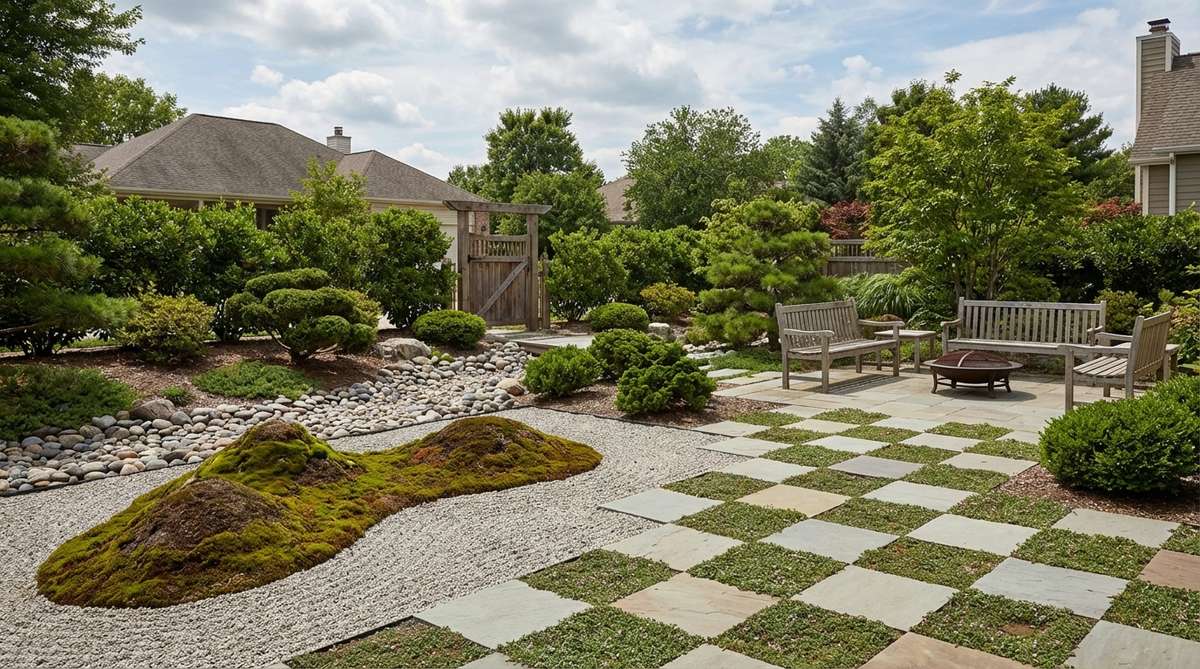
Four distinct gardens surround the central building, each representing a different era and aesthetic approach. The southern garden features five moss-covered mounds representing sacred Buddhist mountains.
The western garden arranges square-cut stones in a checkerboard pattern with moss squares alternating. This modern interpretation from the 1930s challenges traditional organic stone forms.
Multiple viewing angles allow visitors to appreciate how karesansui adapts to different spatial configurations. Each courtyard offers a unique meditation focus.
6. Nanzenji Temple Tiger Glen Garden
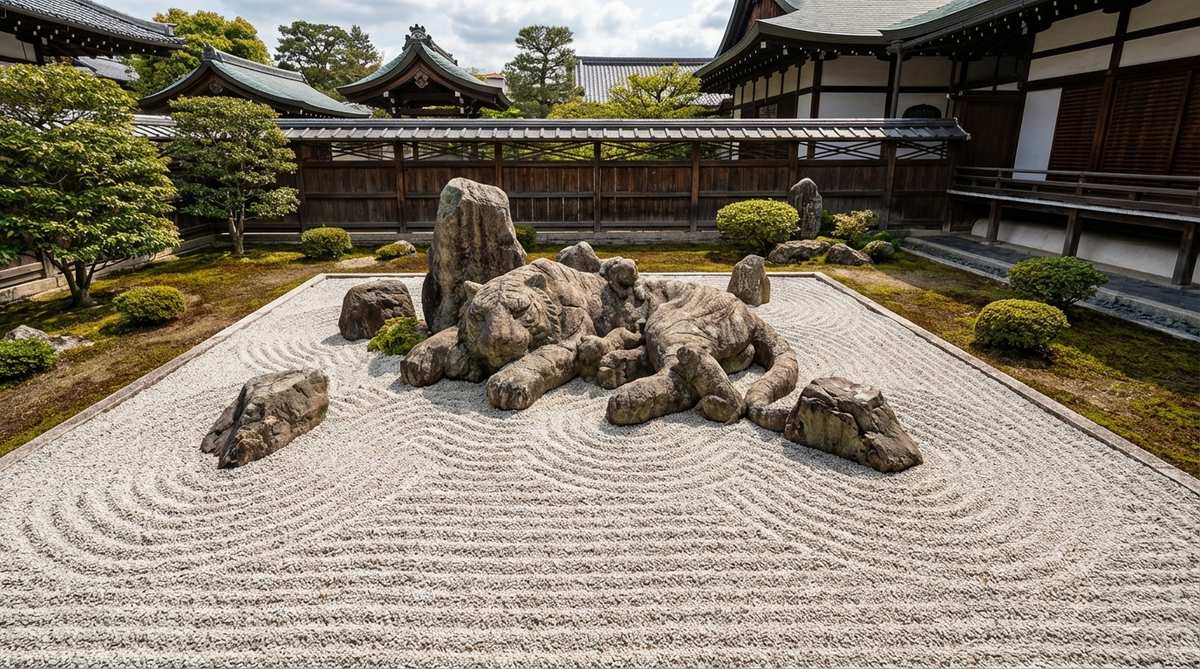
Stones arranged to suggest a tiger carrying cubs across a river demonstrate narrative storytelling through rock placement. The composition uses scale variation to indicate foreground and background elements.
Raked sand patterns flow around the stone groups in directional waves. The designer positioned stones to create visual movement that guides the eye through the scene.
This garden proves that karesansui transcends pure abstraction. Symbolic representation enhances contemplative meaning without sacrificing aesthetic harmony.
7. Ryogen-in Temple Smallest Rock Garden
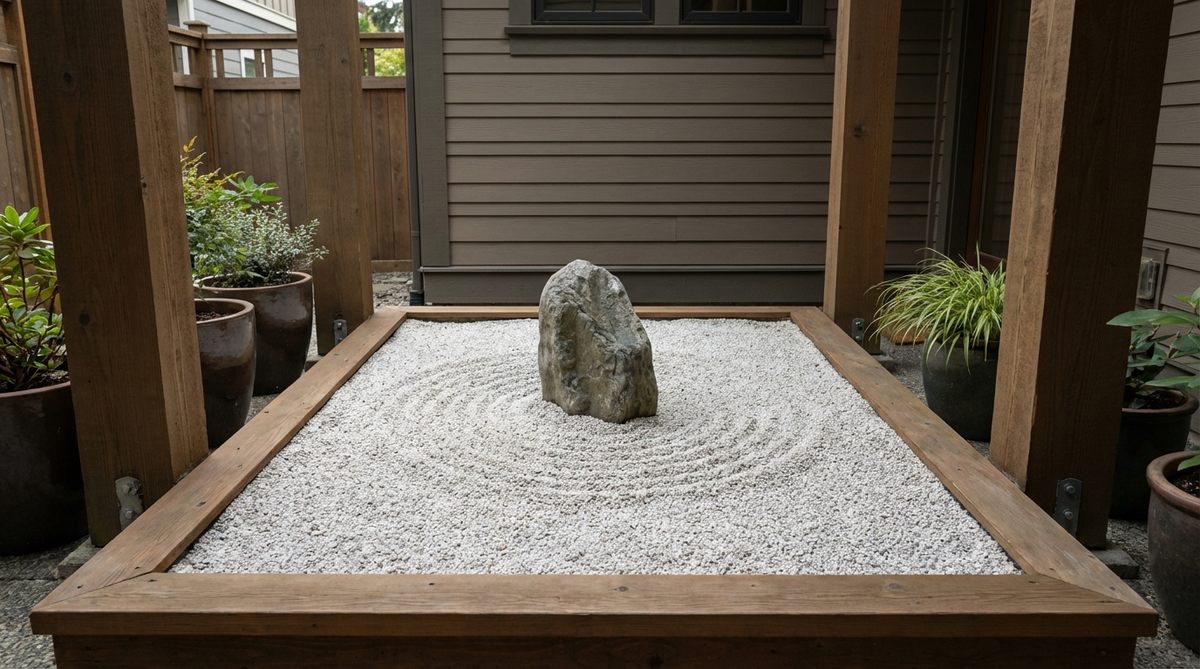
Measuring just over one square meter, this intimate garden demonstrates that karesansui power doesn’t depend on scale. A single stone rises from white sand within a small courtyard space.
The confined dimensions intensify the viewing experience. Architectural framing through surrounding buildings creates a picture-frame effect that focuses attention.
Urban gardeners gain valuable lessons from this compressed design. Minimal space requirements make dry landscapes accessible for small properties.
8. Shinju-an Temple Tea Garden Approach
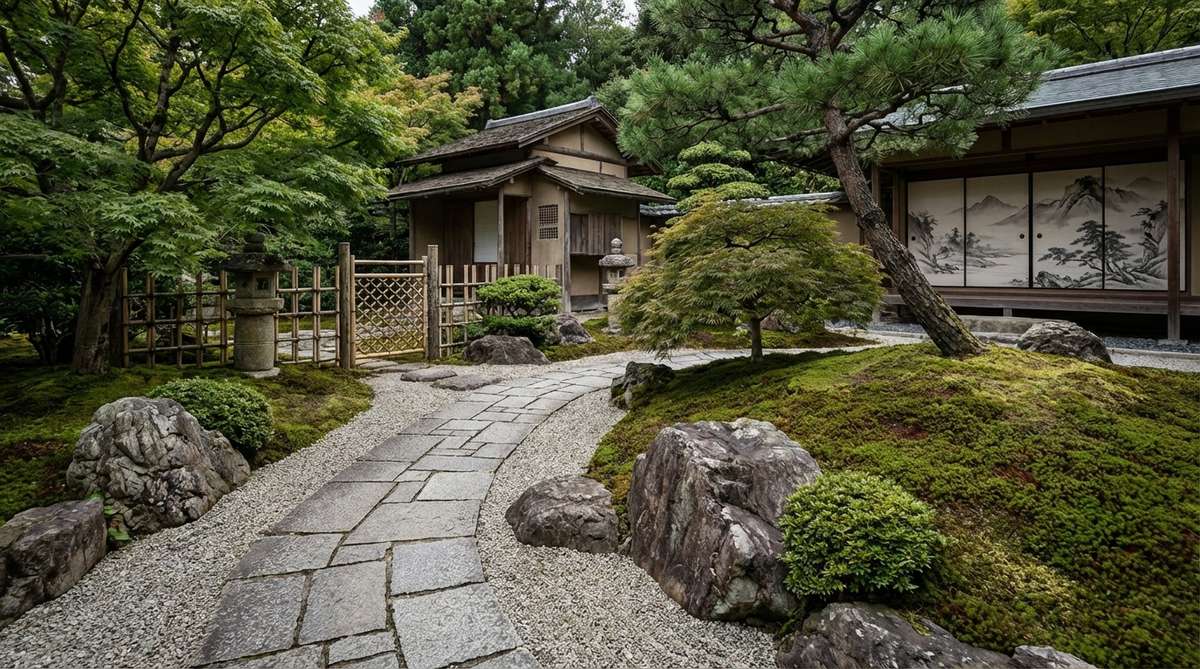
Founded by the famous Zen monk Ikkyu, this subtemple combines karesansui elements with tea garden aesthetics. Stone pathways transition between dry landscape areas and moss gardens.
Artistic treasures by master painters Kano Motonobu and Kano Eitoku influenced the garden’s compositional principles. Visual arts and garden design merge in this multidisciplinary approach.
The integration of functional pathways with contemplative spaces shows karesansui flexibility. Movement through the garden creates changing perspectives.
Flat Garden Hiraniwa Compositions on Level Ground
Hiraniwa-style karesansui gardens occupy level terrain and emphasize horizontal relationships between elements. This format became the dominant approach for temple courtyards where topographical manipulation wasn’t possible.
9. Three-Stone Triangle Formation
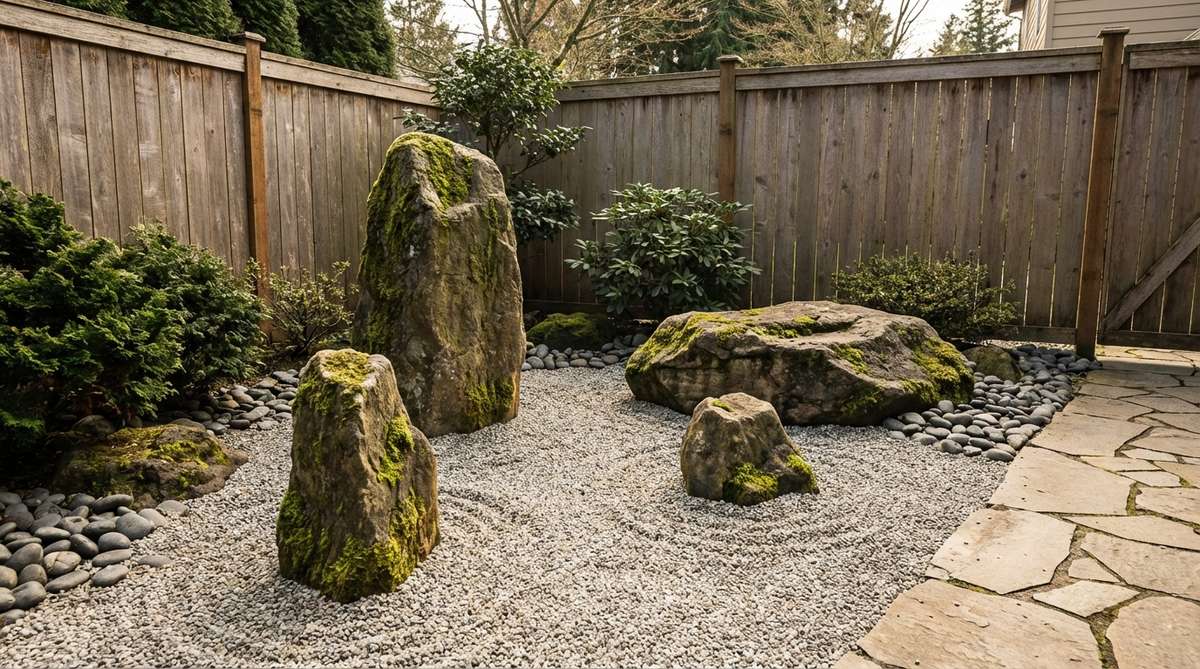
The most fundamental grouping uses three stones of varying heights arranged in an irregular triangle. The tallest “dominant stone” establishes vertical emphasis while the “anchoring stone” provides visual weight.
Place the dominant stone slightly off-center from the triangle’s geometric midpoint. The third “subordinate stone” balances the composition without competing for attention.
This classic arrangement serves as the building block for more complex designs. Repeating the pattern with different scales creates visual rhythm across larger spaces.
10. Five-Stone Buddhist Mountain Group
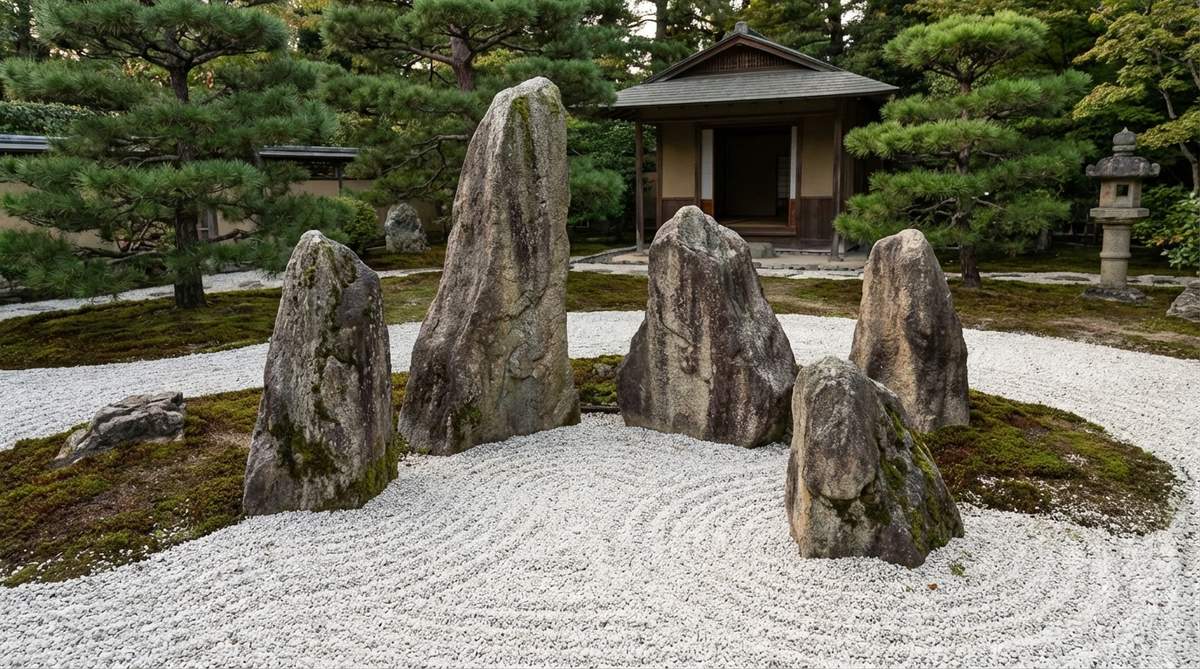
Representing the five sacred Buddhist peaks, this arrangement organizes stones in a loose cluster suggesting mountain ranges. Varying heights create a naturalistic skyline profile.
Position the stones so their vertical axes lean slightly inward toward a common focal point. This subtle convergence unifies the group visually.
The five-element composition allows more complex spatial relationships. Negative space between stones becomes as important as the stones themselves.
11. Seven-Stone Island Archipelago
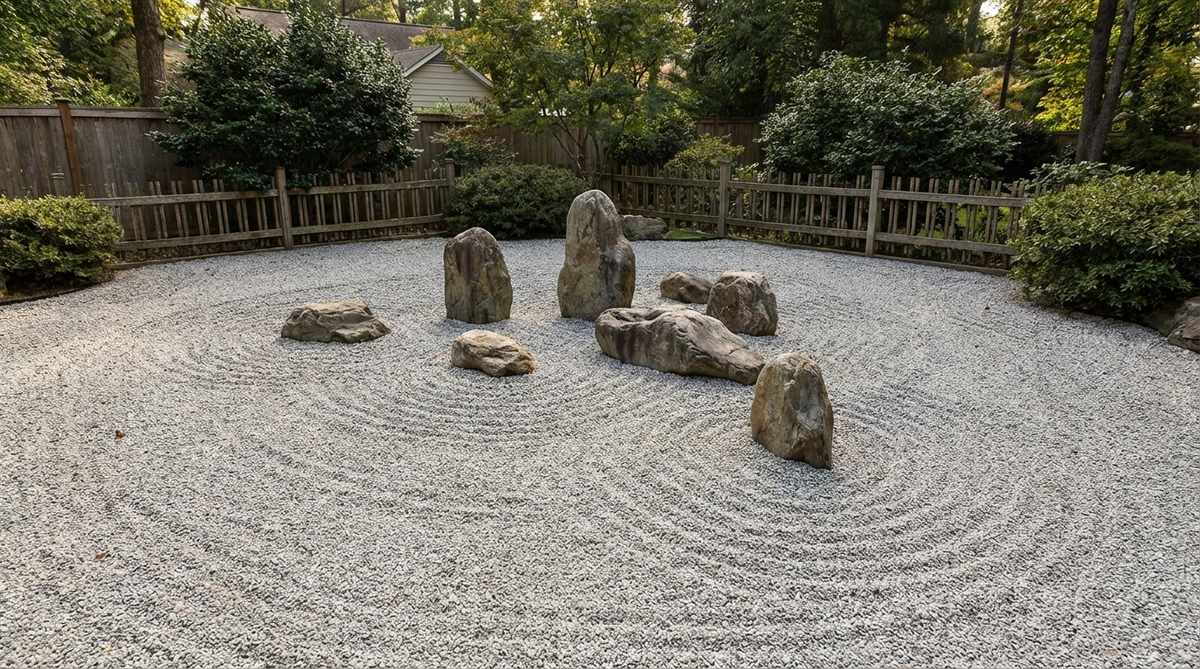
Seven stones scattered across raked gravel represent islands emerging from an ocean. The odd number prevents symmetrical balance and encourages natural-looking distribution.
Vary distances between stones to suggest depth perspective. Closer groupings indicate foreground elements while isolated stones appear more distant.
This arrangement works particularly well for larger flat areas. The empty gravel “sea” emphasizes the stones’ sculptural presence.
12. Meditation Stone Platform
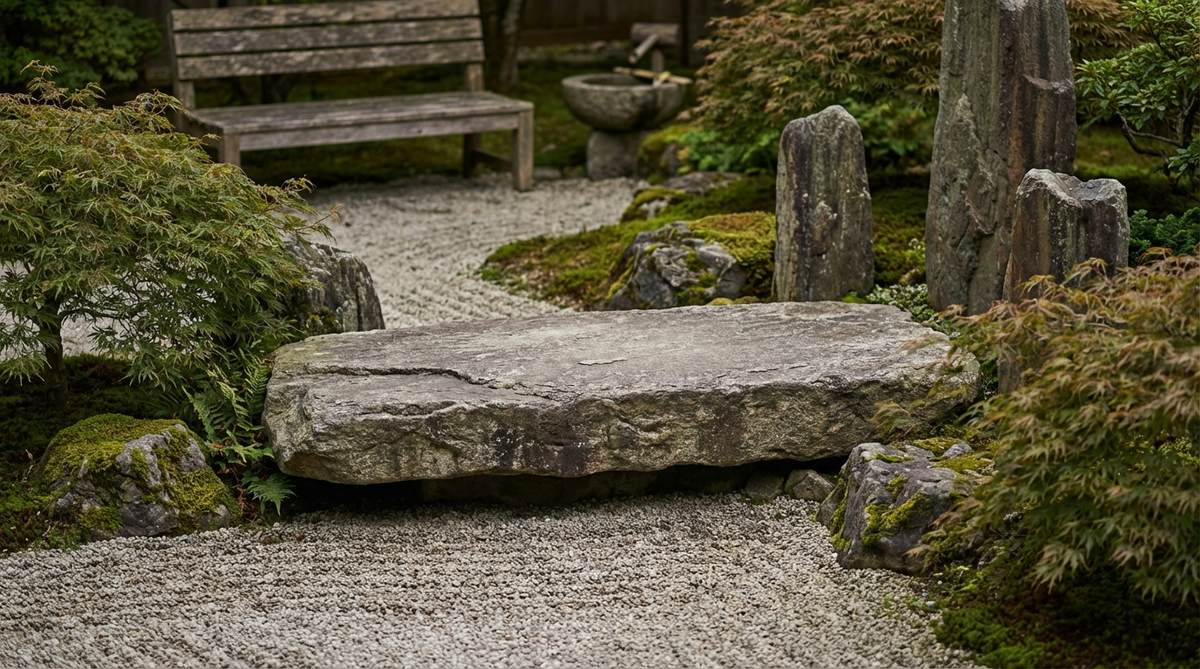
A single large flat stone called “zazen-seki” provides a physical seating surface for meditation practice. Its horizontal orientation contrasts with vertical upright stones elsewhere in the garden.
Choose granite or other weather-resistant stone with a naturally smooth surface. Position it to face the garden’s primary viewing direction.
Functional elements integrate seamlessly into karesansui aesthetics. The stone serves practical and symbolic purposes simultaneously.
13. Corner Stone Cascade
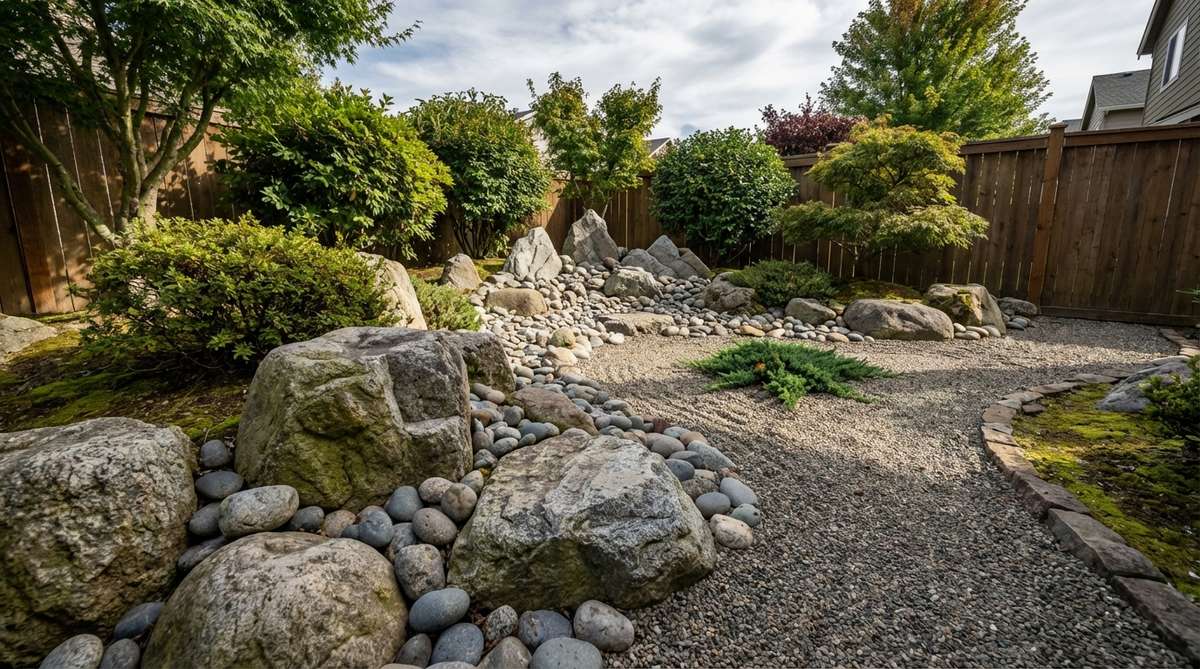
Positioning stones in a garden corner creates a compact composition that doesn’t interfere with central open space. Stones graduate in size from large to small moving away from the corner.
This arrangement suggests a mountain range receding into distance. The corner location frames the composition architecturally.
Small gardens benefit from edge placements that preserve maximum central area. The design principle applies to both traditional and modern contexts.
14. Linear Stone Progression
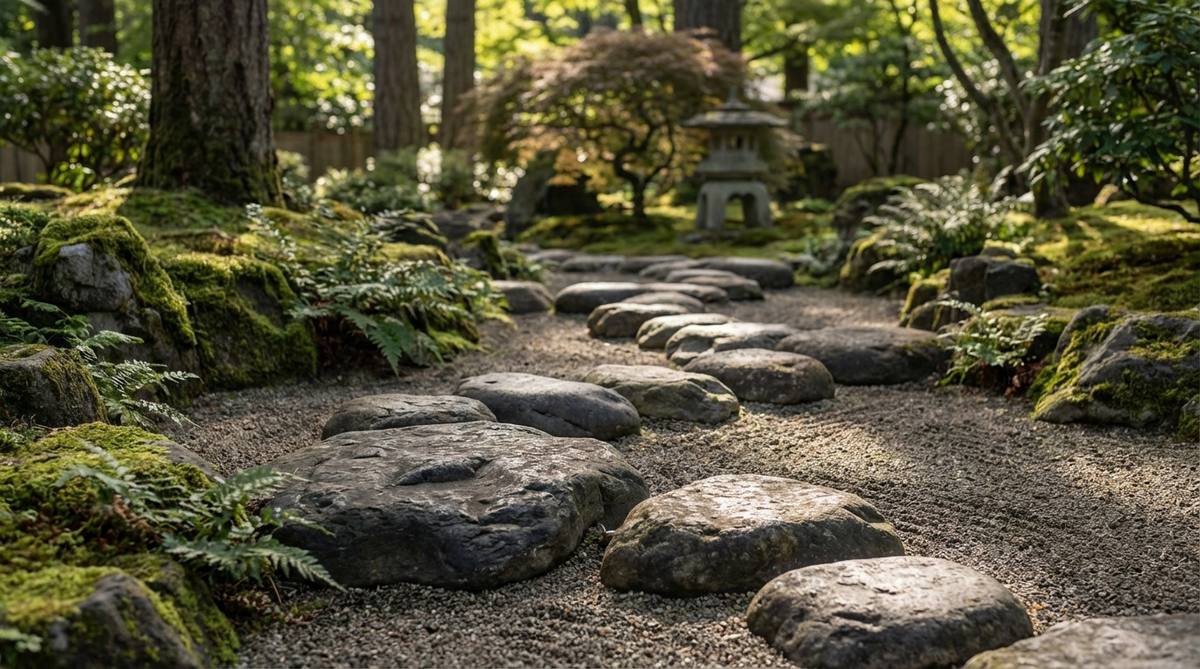
Stones aligned in a gentle curve create directional flow across a flat surface. Each stone relates to its immediate neighbors while contributing to the overall line.
Vary the spacing interval slightly to avoid mechanical regularity. Natural formations never display perfect mathematical spacing.
This technique guides the viewer’s eye through the garden. The implied movement adds dynamic energy to static materials.
15. Central Focal Point Cluster
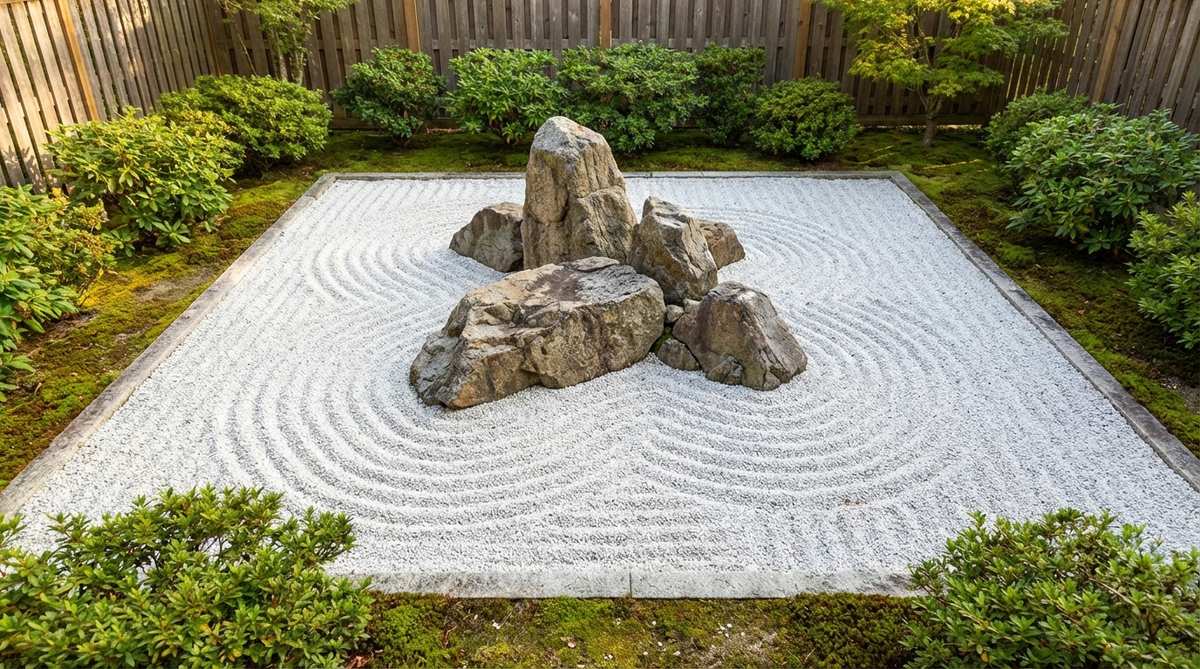
A prominent stone group occupies the garden center, drawing immediate attention. Surrounding gravel remains open and unadorned to emphasize the central arrangement.
This bold approach suits rectangular or square garden spaces. The centered placement creates formal stability while individual stone positions remain asymmetrical.
Raking patterns radiate outward from the central cluster. Concentric circles suggest ripples spreading from a stone dropped in water.
Dry Stream Karenagare DesignsFlowing Without Water
Karenagare techniques use small stones, raking patterns, and strategic placement to represent flowing water. These designs capture water’s movement and energy through entirely dry materials.
16. Meandering River Course
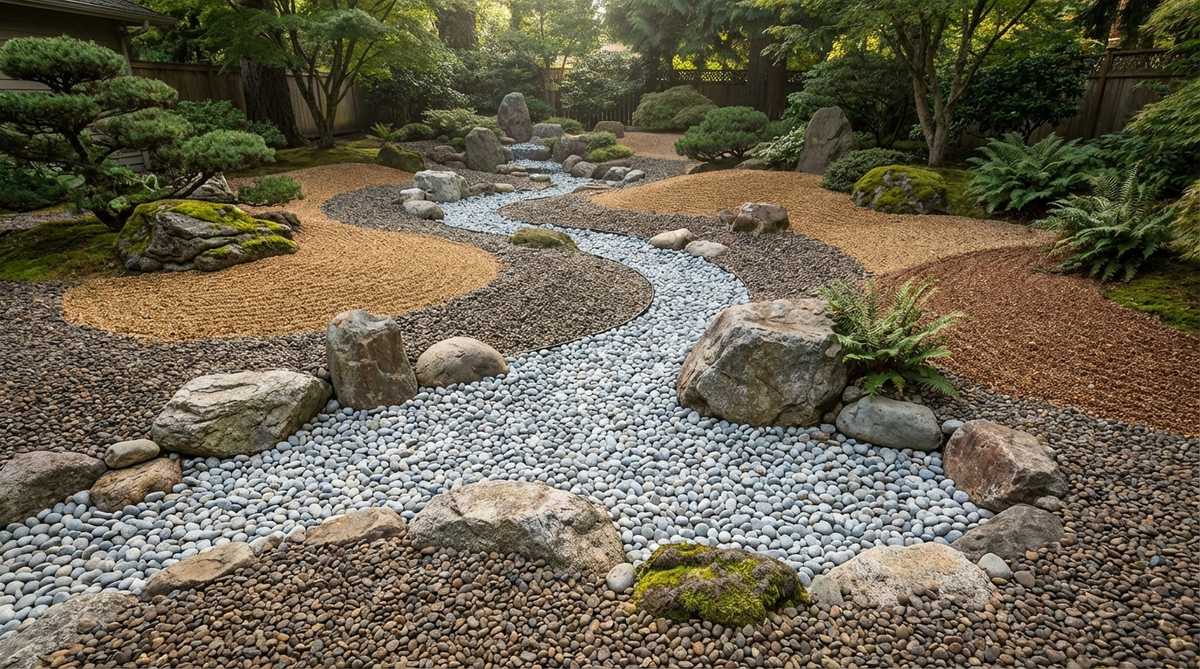
Small pebbles arranged in a curving band suggest a stream winding through the landscape. The “riverbed” varies in width to indicate current speed and volume.
Larger stones positioned along the edges act as boulders that redirect water flow. Place them asymmetrically to create natural-looking meanders.
Surrounding areas use different colored gravel to distinguish water from land. The contrast clarifies the compositional narrative.
17. Rapids and Eddies
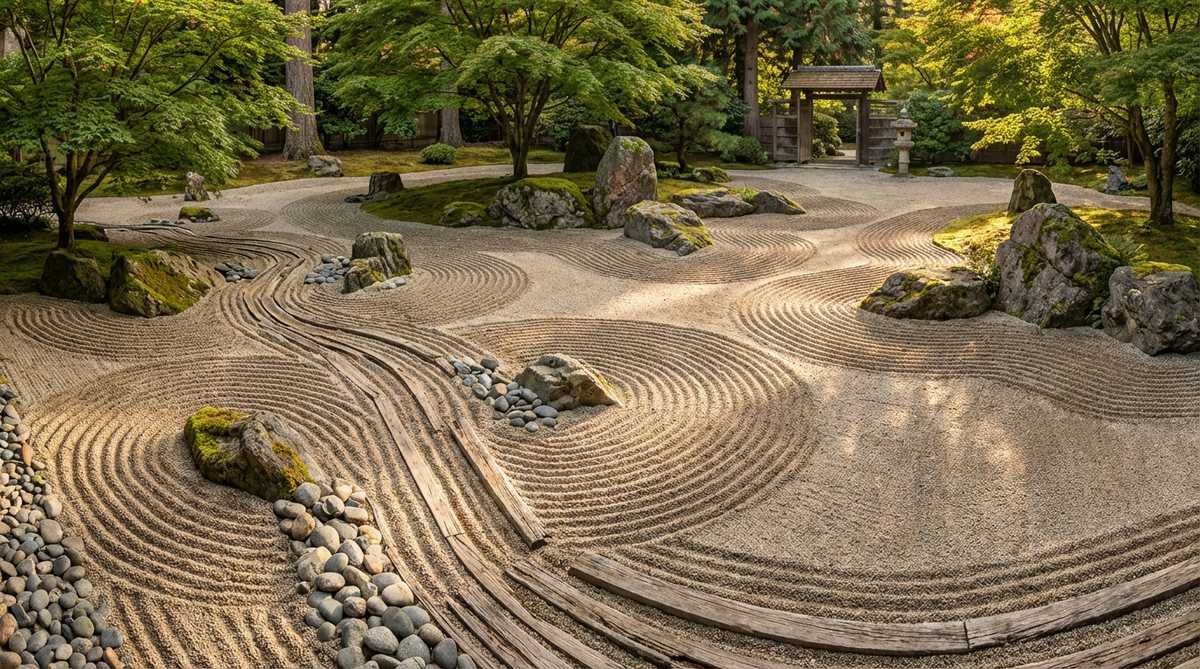
Raked patterns swirl around stones to indicate turbulent water. Circular raking behind obstacles suggests eddy currents forming downstream.
Vary raking line density to show water speed differences. Closely spaced lines indicate fast current while wider spacing suggests calm water.
This dynamic approach adds visual excitement. The implied motion activates the garden’s energy.
18. Spring Source Emergence
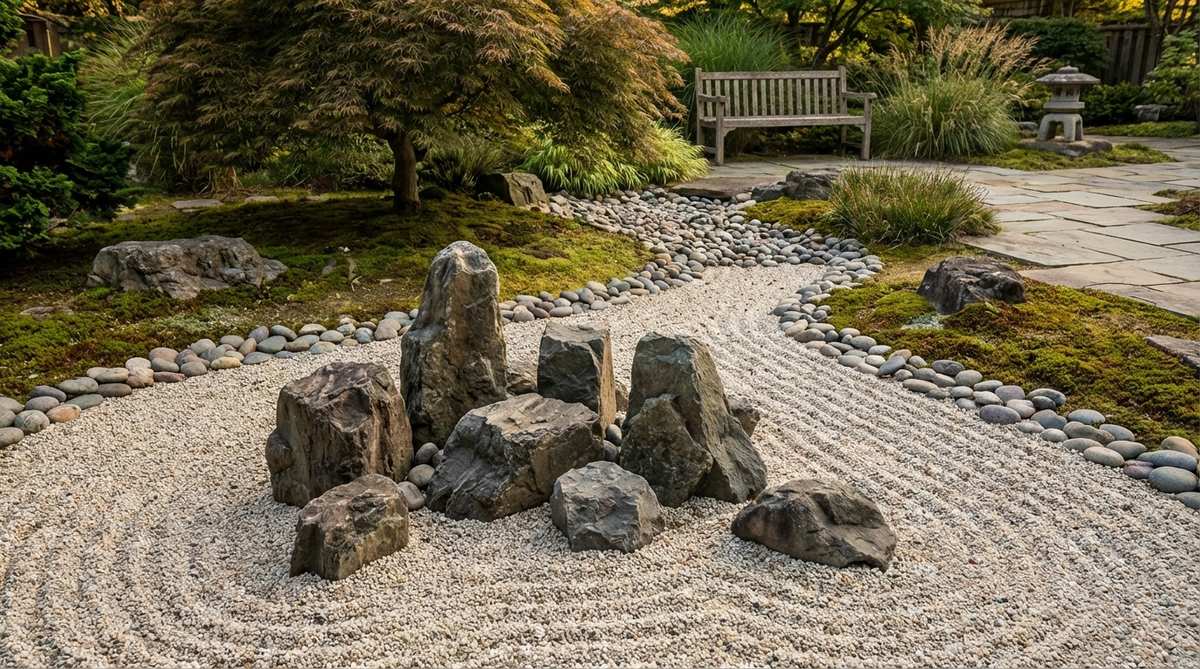
A cluster of stones represents a mountain spring where water emerges from the ground. Raked lines radiate outward from this central point.
The “stream” narrows as it flows away from the source, following natural water behavior. Gradually decrease the stone size along the flow path.
This design tells a clear origin story. Viewers understand the narrative direction immediately.
19. Delta Fan Spreading
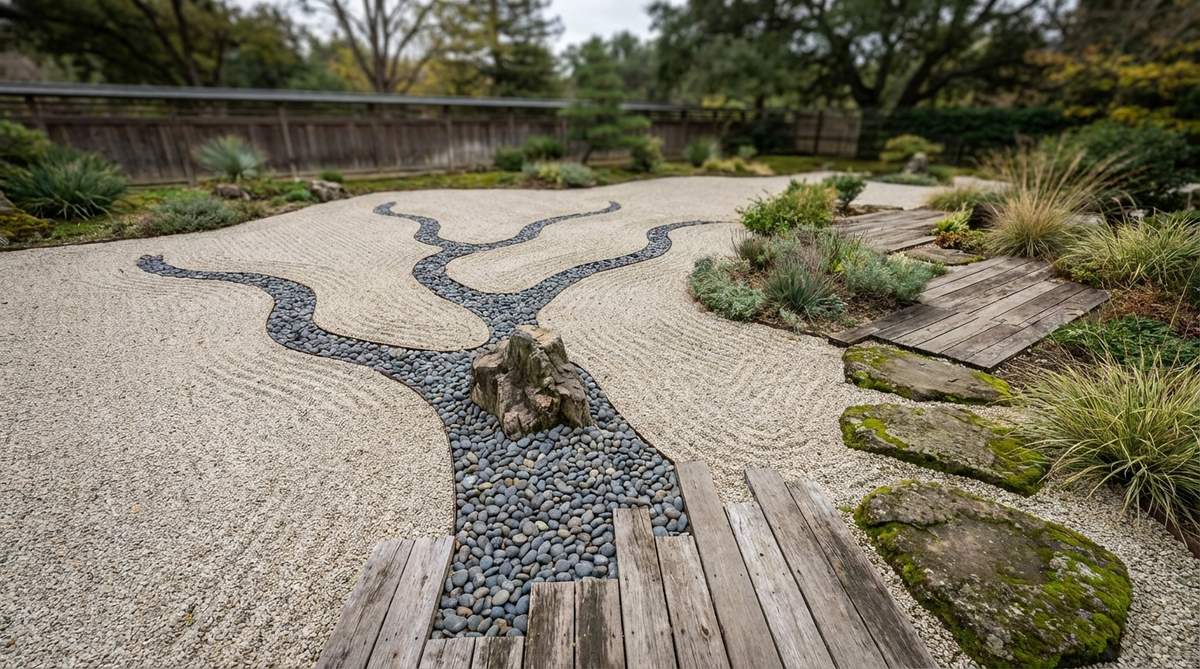
Multiple channels diverge from a single source to create a delta pattern. Small stones branch into separate paths as they spread across the gravel surface.
This composition works well for gardens that widen toward the viewing area. The expanding pattern pulls the eye forward.
Natural sediment deposition provides the conceptual model. The design educates while beautifying.
20. Underground Stream Bed
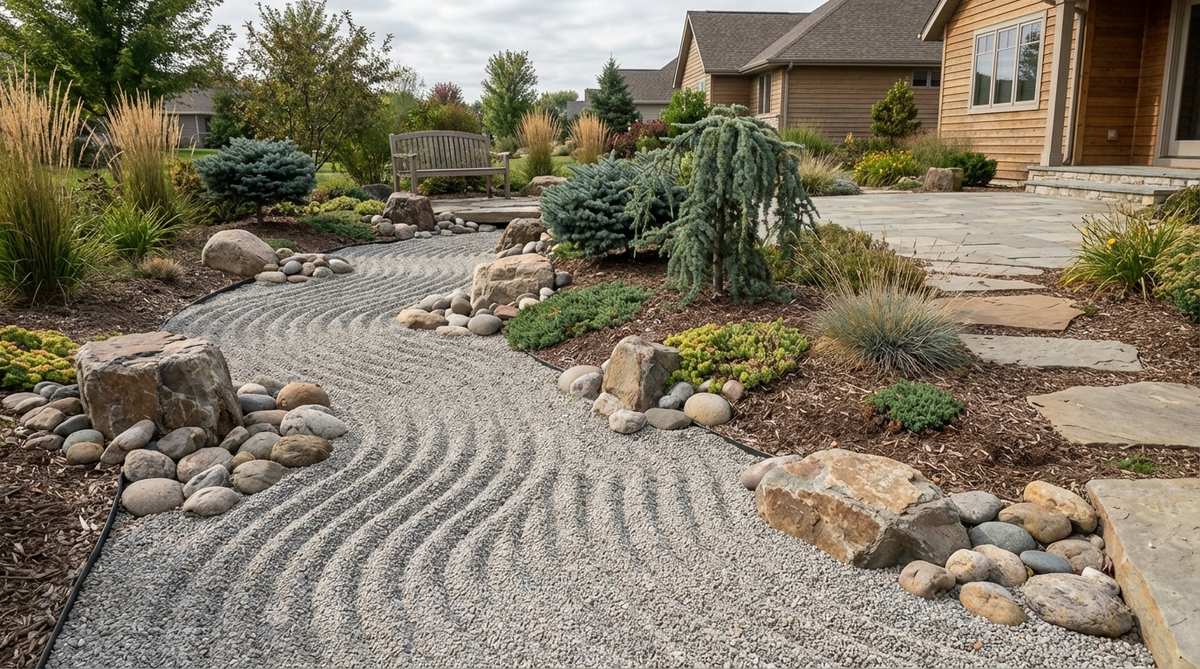
A depression in the raked gravel suggests a dry stream bed waiting for seasonal flow. The channel remains visible even without stones filling it.
Deeper raking along the channel creates shadow that enhances three-dimensional perception. Side slopes angle gently upward to surrounding grade.
This subtle approach emphasizes negative space. The absence of water becomes the design statement.
21. Braided Channel System
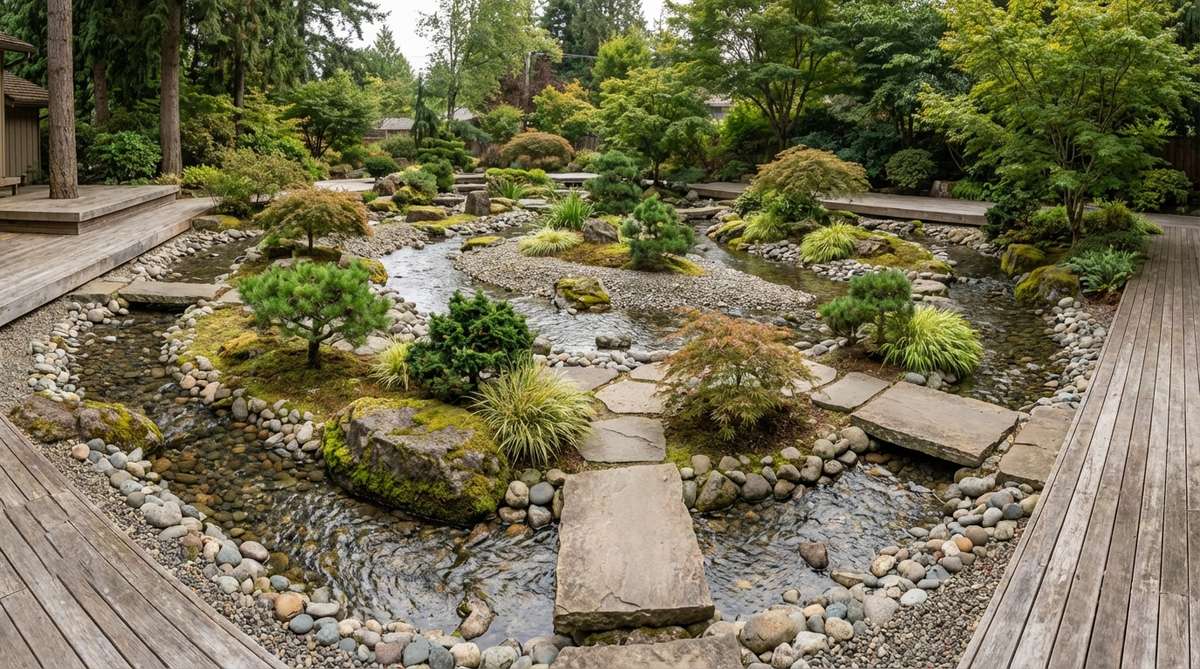
Multiple parallel streams separate and rejoin to create a braided pattern. This complex arrangement indicates a wide, shallow watercourse.
Vary the island sizes between channels to suggest natural sediment bars. The pattern appears organic rather than constructed.
Braided systems work best in wider garden spaces. The horizontal complexity requires adequate room to read clearly.
22. Cascade Over Ledge
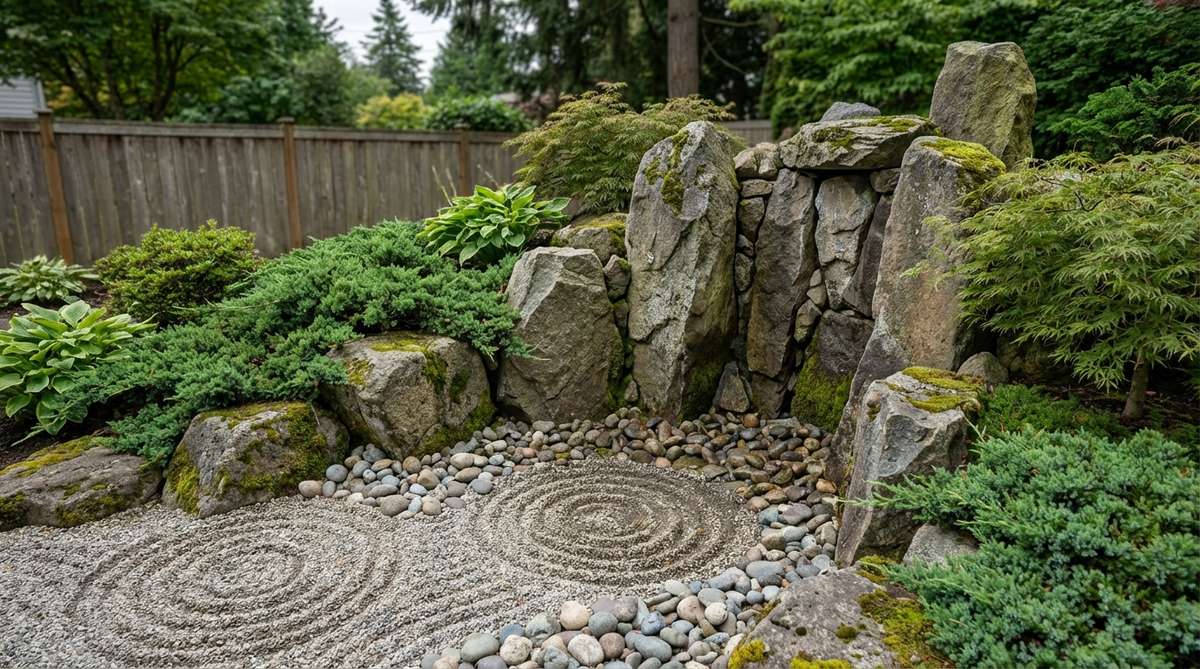
Stones arranged in a sharp vertical drop represent a waterfall’s edge. The elevation change can be actual or entirely suggested through placement.
Below the fall, raking patterns show disturbed water where the cascade lands. Circular patterns indicate the splash zone.
Dramatic elevation changes add vertical interest. The technique combines with flat areas for compositional variety.
Artificial Hill Tsukiyama Landscapes With Elevation Changes
Tsukiyama-style karesansui incorporates mounded earth and sloped terrain to represent mountains and valleys. This three-dimensional approach creates more dramatic topographical variation.
23. Sacred Mountain Peak
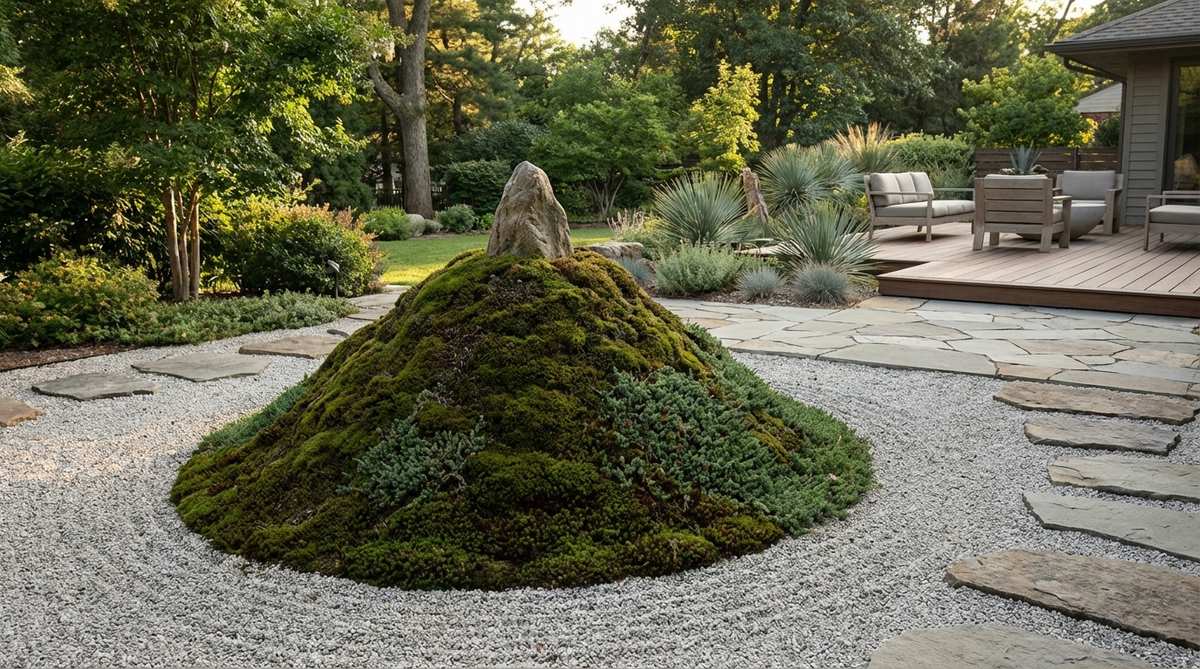
A single prominent mound rises from flat surroundings to represent a sacred mountain like Mount Fuji or Mount Sumeru. The peak stone crowns the summit.
Grade the slopes evenly on all sides for a conical profile. Plant moss or low ground cover to stabilize the soil.
This bold form creates an unmistakable focal point. The vertical emphasis contrasts powerfully with horizontal gravel plains.
24. Mountain Range Sequence
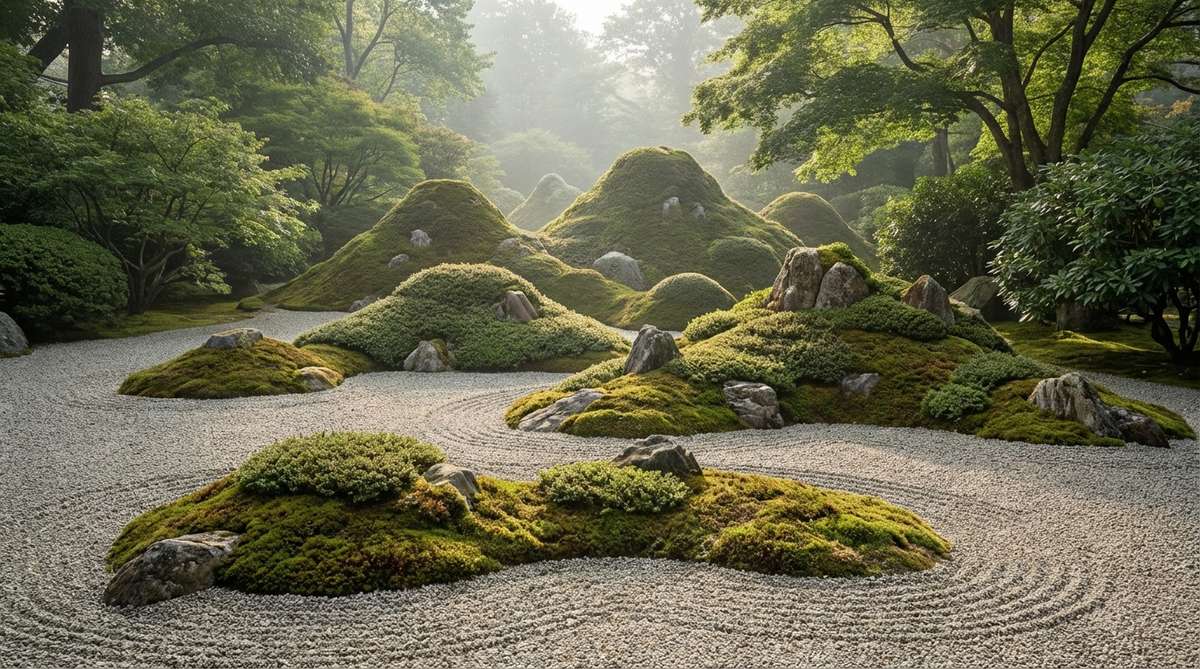
Multiple mounds of varying heights suggest a mountain range receding into the distance. Lower mounds in front establish foreground while taller mounds appear to rise behind them.
This counterintuitive scale reversal uses atmospheric perspective principles. Our eyes read closer objects as larger and vice versa.
The technique adds remarkable depth to confined spaces. A small garden can suggest vast landscapes.
25. Valley Between Peaks
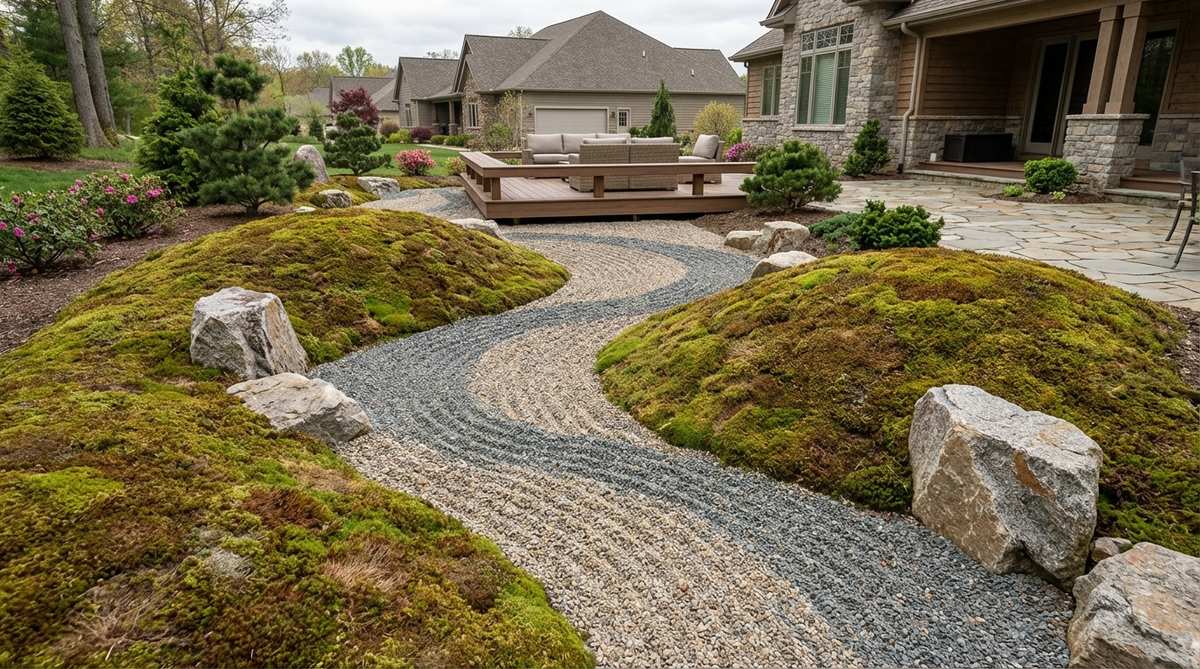
Two mounded areas flank a lower central depression. The valley floor can hold raked gravel representing a stream or lake.
Plant the slopes with different moss species to create color variation. The valley bottom remains distinct through contrasting material.
This concave-convex relationship creates spatial intrigue. Viewers’ eyes travel into and through the composition.
26. Terraced Hillside
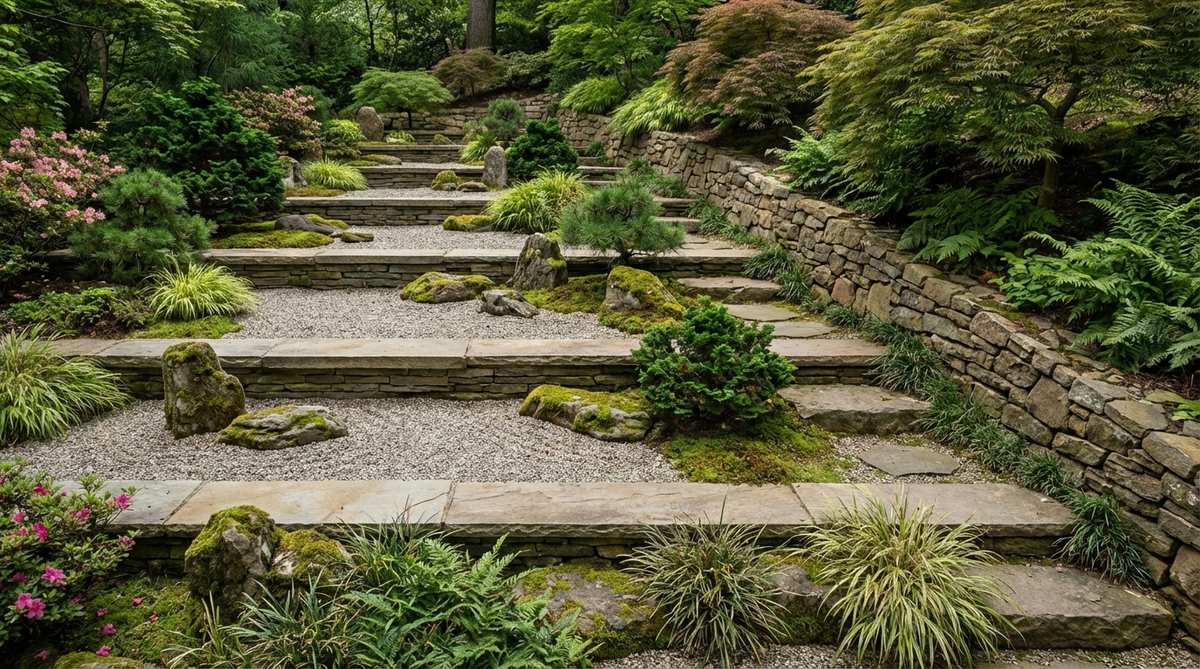
Horizontal platforms step up a slope like agricultural terraces. Each level can hold different arrangements of stones or plantings.
Retain each terrace edge with carefully placed stones. The structure provides both aesthetic appeal and erosion control.
Terracing makes steep slopes accessible for detailed design. The layered effect adds architectural interest.
27. Cliff Face Outcropping
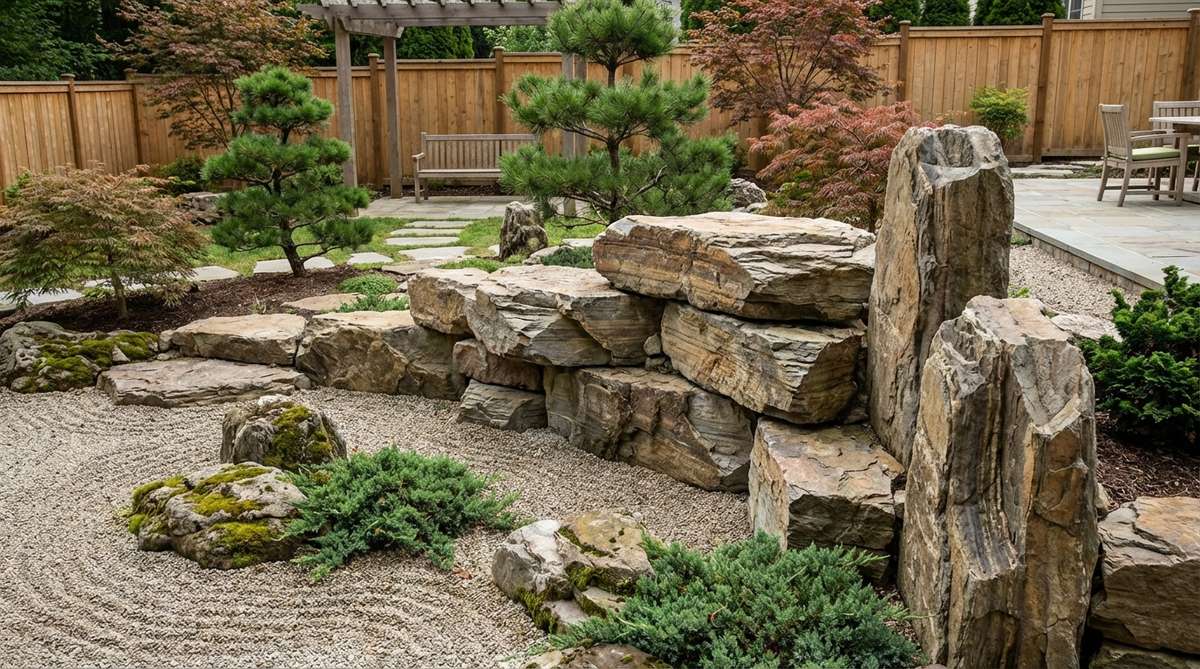
Vertical or near-vertical stone placement creates a cliff effect. Large flat stones stack to suggest geological strata and exposed rock faces.
This technique requires careful engineering for stability. Bury substantial portions of each stone to prevent shifting.
Dramatic vertical surfaces add powerful visual impact. The design evokes mountain wilderness in miniature scale.
28. Rolling Hill Sequence
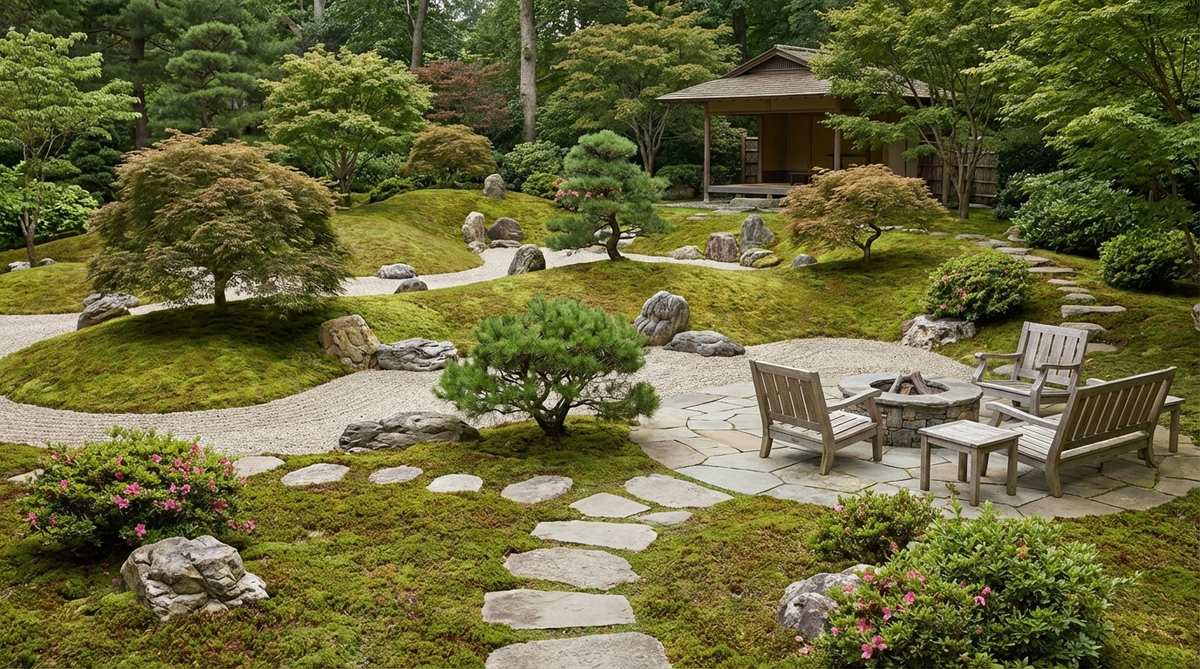
Gentle undulations across the garden surface create a rhythmic landscape. Avoid symmetrical spacing to maintain natural appearance.
This approach works well for larger properties where subtle grade changes register visually. The flowing topography suggests pastoral countryside.
Rolling terrain adds three-dimensional interest without dramatic elevation changes. The effect remains subtle and calming.
29. Volcanic Cone Formation
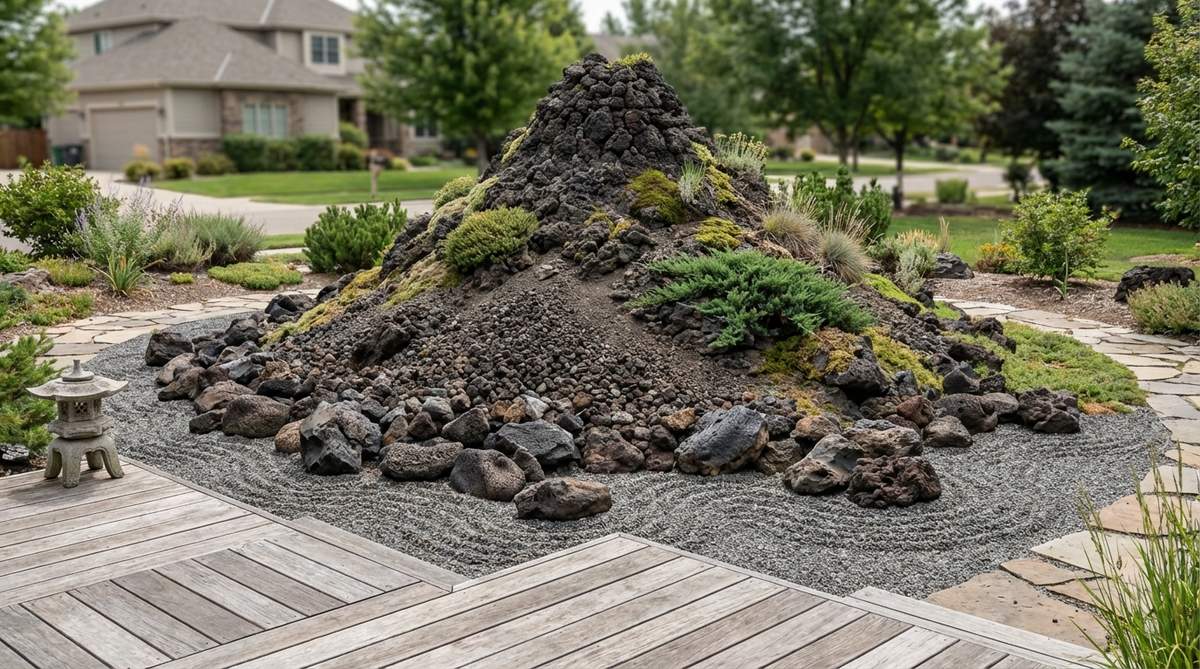
A steep-sided conical mound represents a volcanic peak. Dark lava-like stones around the base suggest past eruptions.
The dramatic form makes a bold statement. Sparse vegetation on the upper slopes indicates harsh growing conditions.
This design demonstrates karesansui’s narrative flexibility. Specific geological features translate effectively into garden form.
Gravel Raking PatternsThe Meditative Art Form
Raking gravel or sand into precise patterns constitutes both garden maintenance and meditative practice. The ephemeral designs change with each raking session while following established conventions.
30. Parallel Line Raking
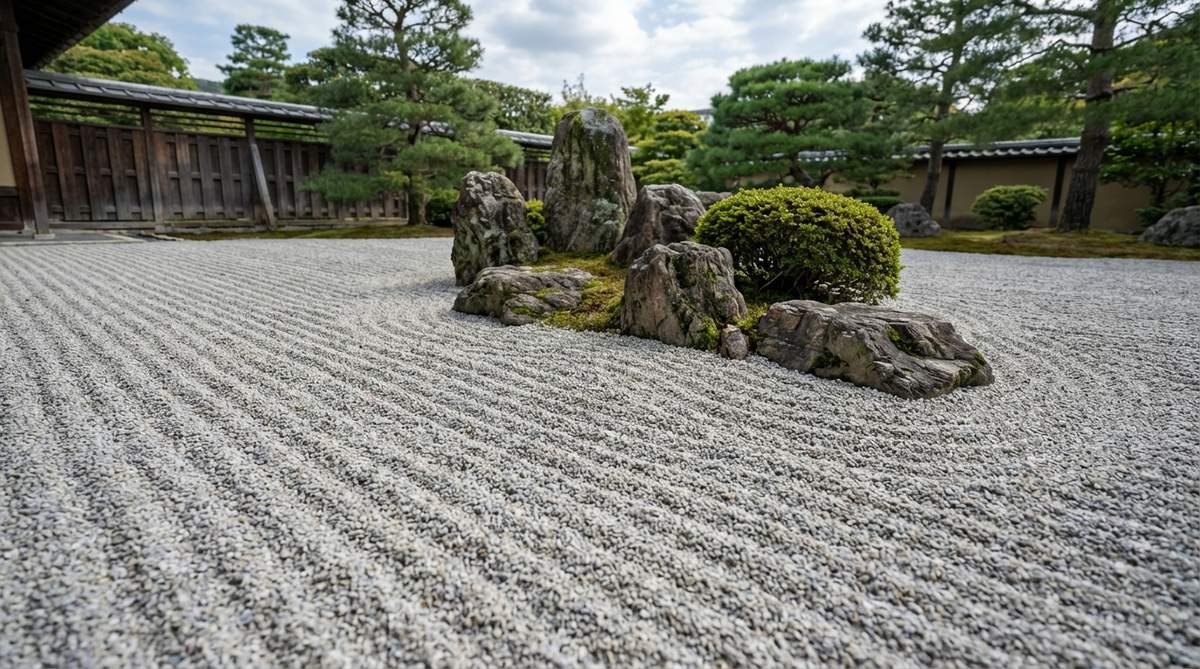
Straight parallel lines raked across the entire gravel surface represent calm water. Even spacing between lines requires careful attention and a steady hand.
Rake in a single direction from one edge to the opposite. Work systematically to maintain consistent line spacing.
This fundamental pattern serves as the base for many variations. The simplicity focuses attention on stone arrangements.
31. Concentric Circle Ripples
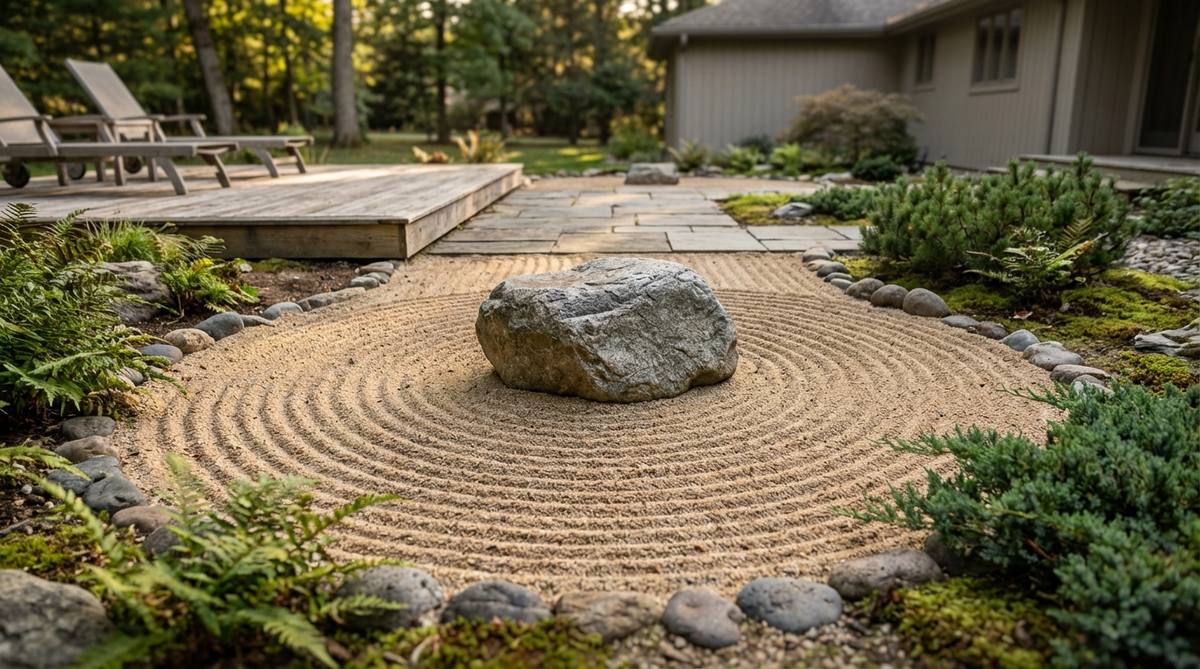
Circular raking patterns radiating from a central stone suggest ripples from a stone dropped in water. Spacing increases slightly as circles expand outward.
Begin with small circles close to the stone and gradually widen your arc. Maintain consistent spacing throughout the pattern.
This dynamic pattern adds movement and focuses attention on the central element. The effect simulates water disturbance perfectly.
32. Wave Pattern Undulation
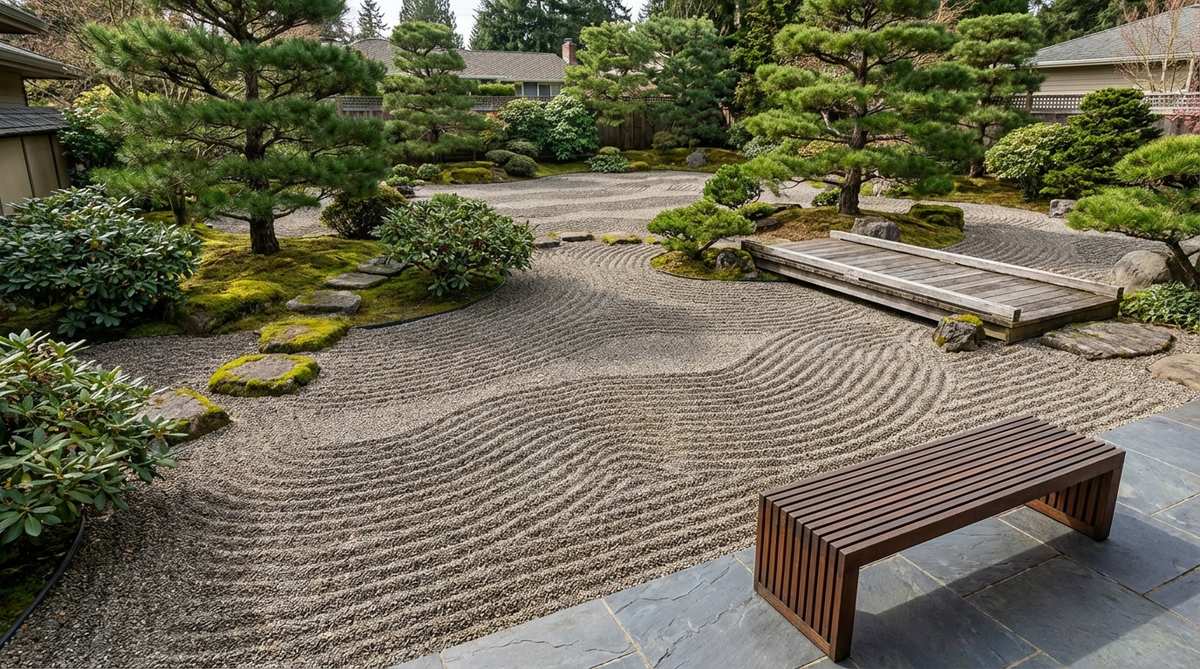
Gently curving parallel lines create a wave effect suggesting water surface movement. Alternate the wave amplitude for naturalistic variation.
Maintain consistent wavelength intervals while varying the curve depth. The pattern should flow smoothly without abrupt direction changes.
Wave patterns add organic movement to flat surfaces. The rhythmic repetition has strong meditative qualities.
33. Checkerboard Grid Pattern
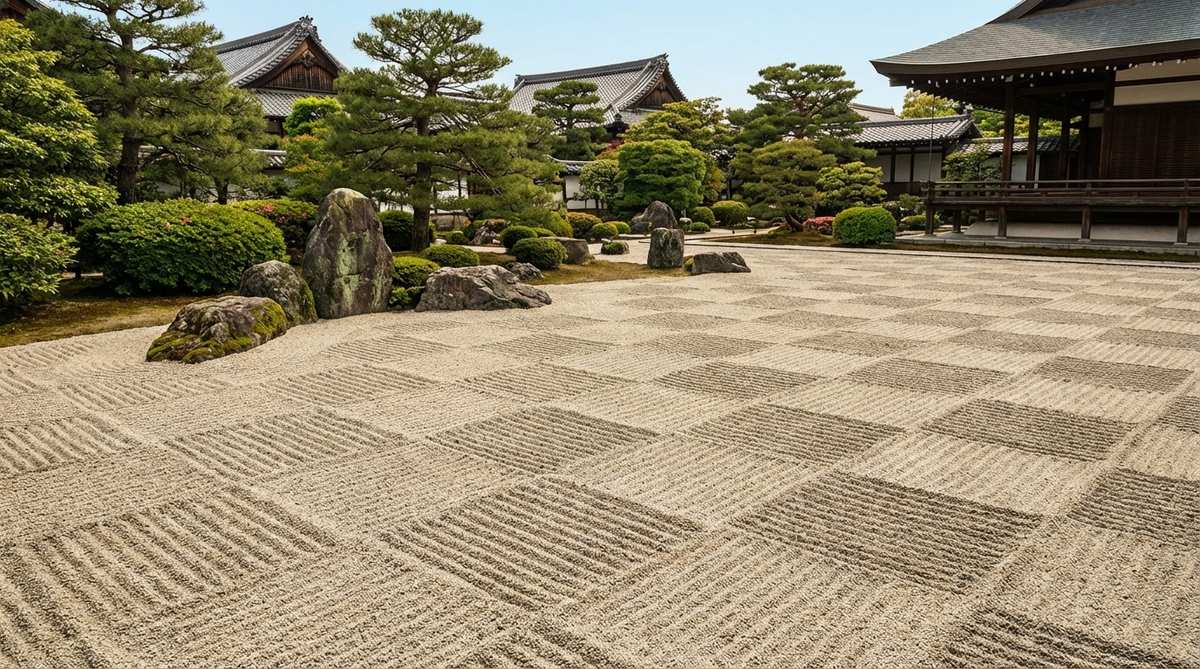
Perpendicular raking creates a checkered effect seen at Ginkakuji Temple. Alternating rake directions in square sections produces contrasting textures.
Divide the surface into equal squares using strings or guides. Rake each square in alternating directions to maximize contrast.
This geometric approach offers a modern aesthetic. The pattern demonstrates precise craftsmanship and attention to detail.
34. Spiral Vortex Pattern
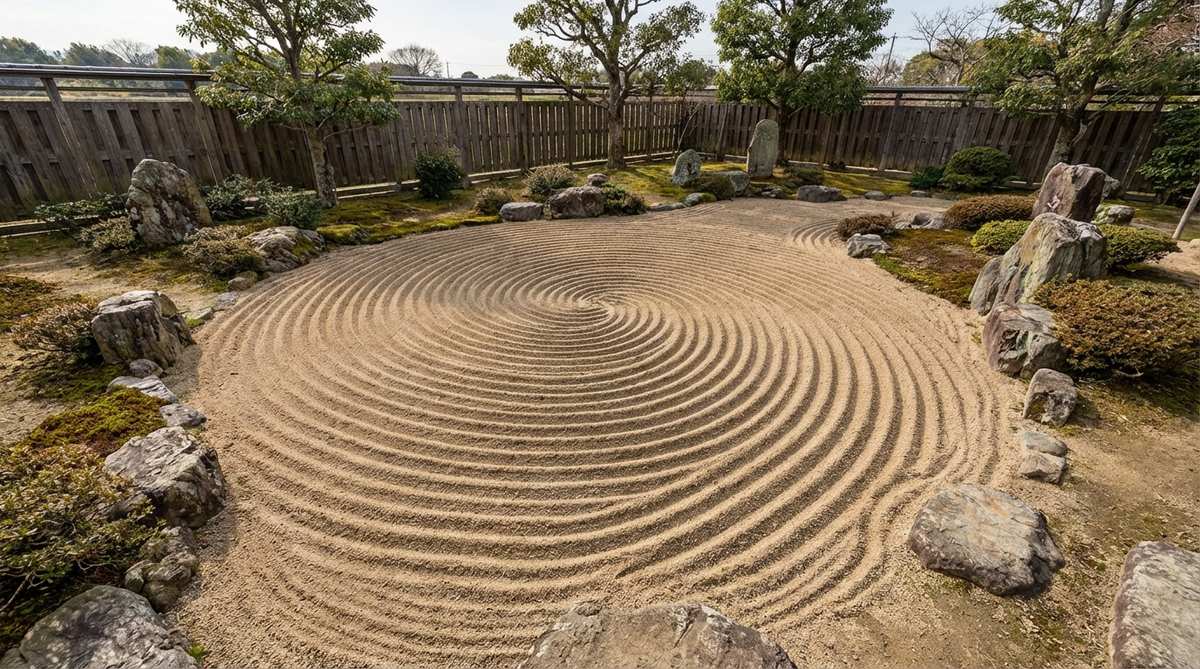
A continuous spiral raking from center outward creates a vortex effect. This complex pattern requires careful planning to maintain smooth curves.
Mark the center point and gradually expand your circular motion. Keep consistent spacing between spiral arms as they wind outward.
Spiral patterns add dynamic energy and draw the eye inward. The form suggests natural phenomena like shells and galaxies.
35. Flowing Around Obstacles
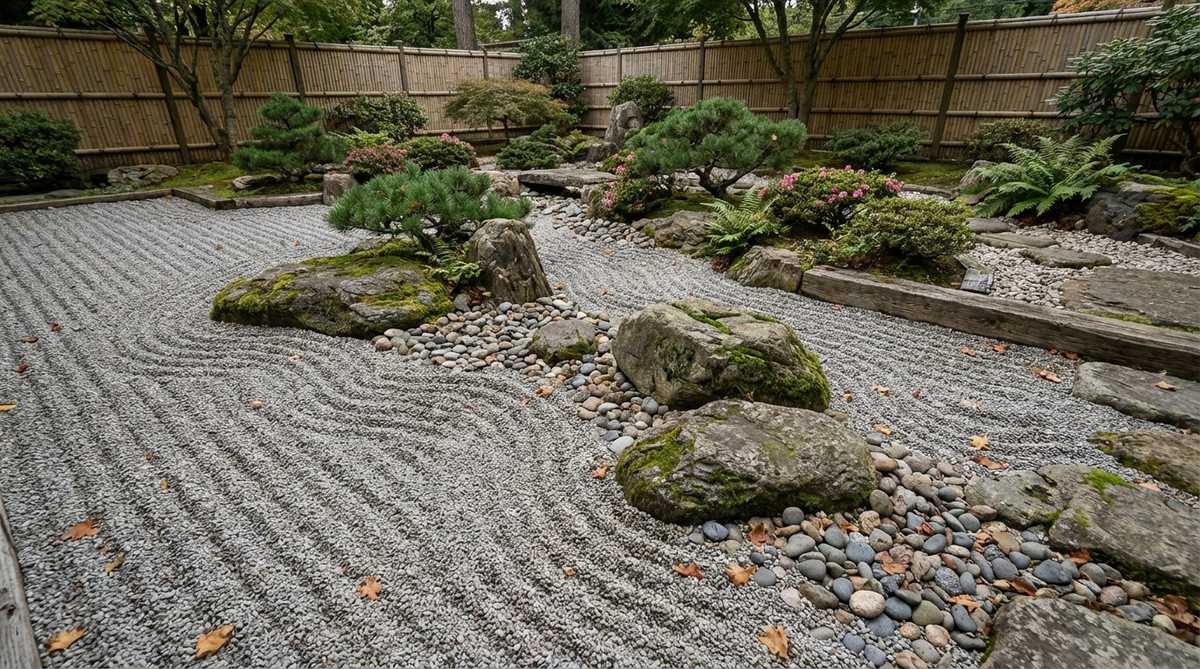
Raking lines curve around stones to suggest water deflecting around boulders. The pattern upstream remains straight while downstream lines show turbulence.
Approach each stone with straight lines that gradually curve around its perimeter. Behind the stone, create swirling patterns indicating eddies.
This technique integrates stones and gravel into unified compositions. The raking enhances rather than merely surrounds the solid elements.
36. Radial Burst Pattern
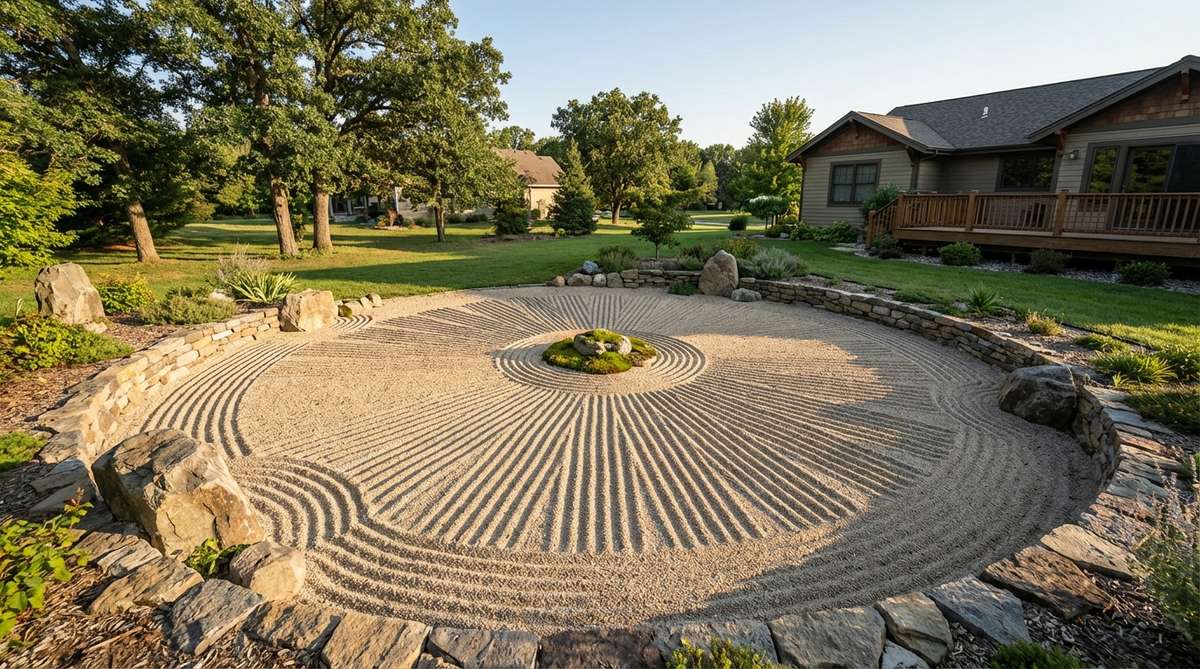
Lines radiate outward from a central point like sun rays. The pattern creates strong centrifugal energy moving from center to edges.
Mark the central point and rake straight lines extending outward in all directions. Maintain consistent angle spacing between rays.
Radial patterns work well for circular or square garden spaces. The dramatic geometry makes a powerful visual statement.
37. Zen Calligraphy Strokes
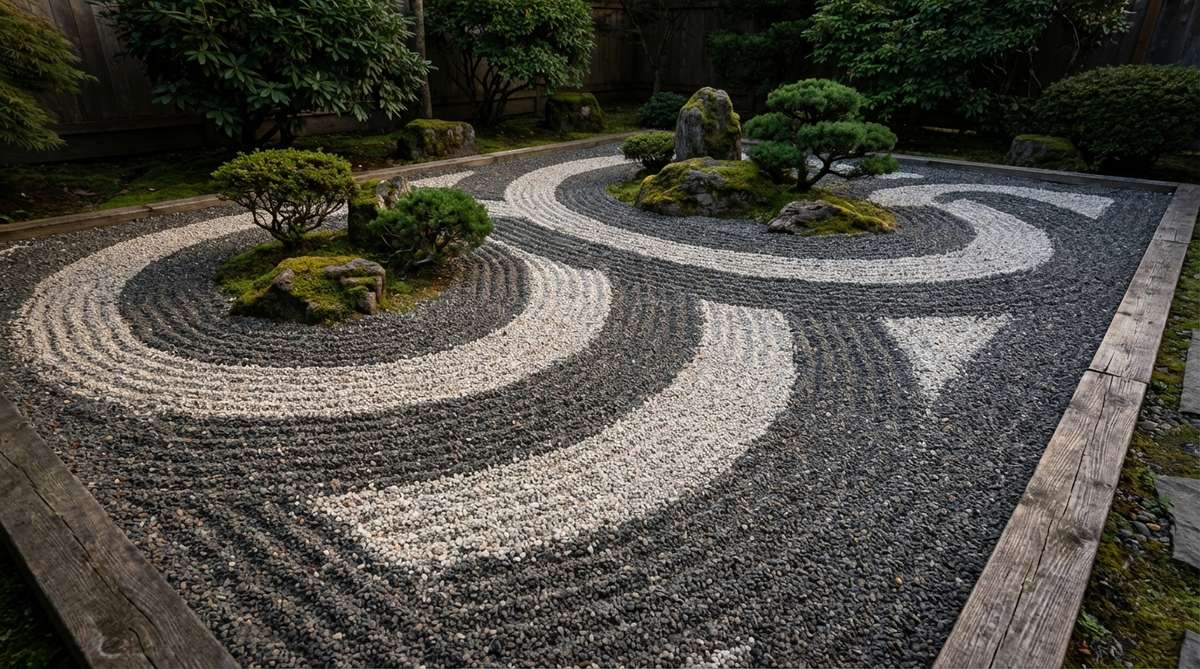
Raking patterns that echo Japanese calligraphy brushstrokes create artistic connections between writing and garden arts. Flowing curved lines suggest character forms.
Study basic brush stroke forms before attempting to replicate them in gravel. The translation from ink to rake requires adaptation.
This sophisticated approach layers cultural meaning into the design. The pattern appeals to viewers familiar with calligraphic traditions.
Stone Arrangement TechniquesPrinciples of Placement
Traditional stone setting follows established principles passed down through generations of garden masters. These guidelines help create naturalistic arrangements that appear effortless despite careful planning.
38. Rule of Three Grouping
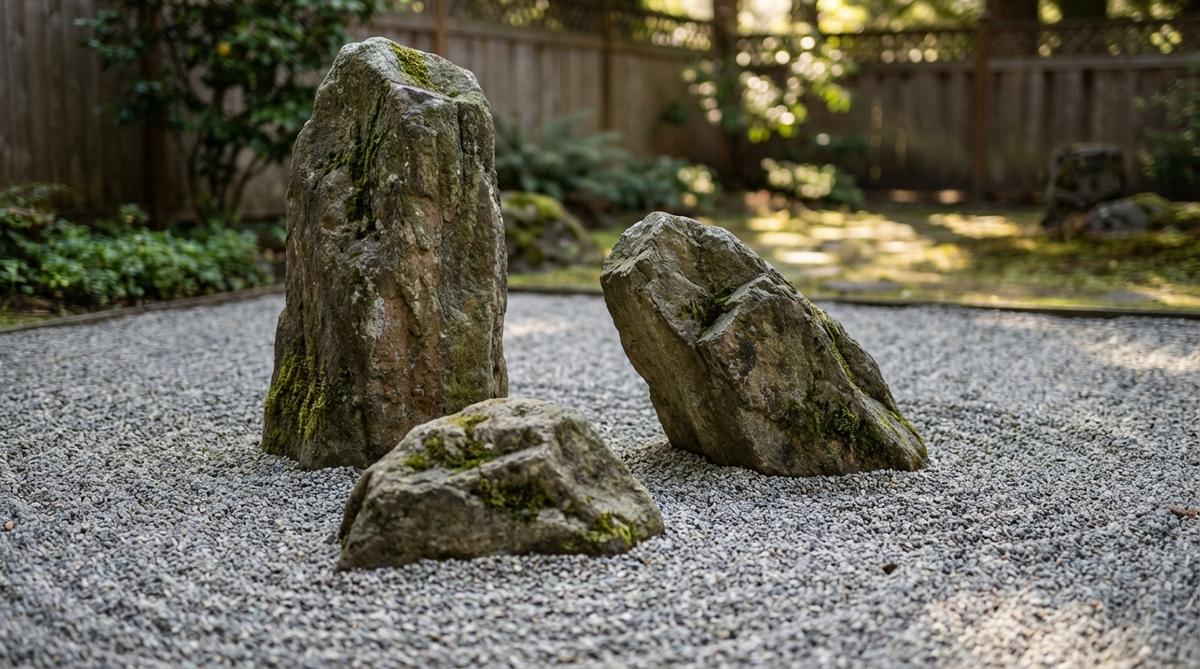
Three stones arranged with one tall, one medium, and one low create the most fundamental stable composition. This uneven trio avoids symmetry while achieving balance.
Position the tallest stone first to establish the group’s character. Add the medium stone at an angle that relates to the dominant piece, then place the smallest to complete the triangle.
This time-tested formula scales from tiny courtyard gardens to expansive temple grounds. The principle applies regardless of stone size or garden scale.
39. Vertical Stone Mountain
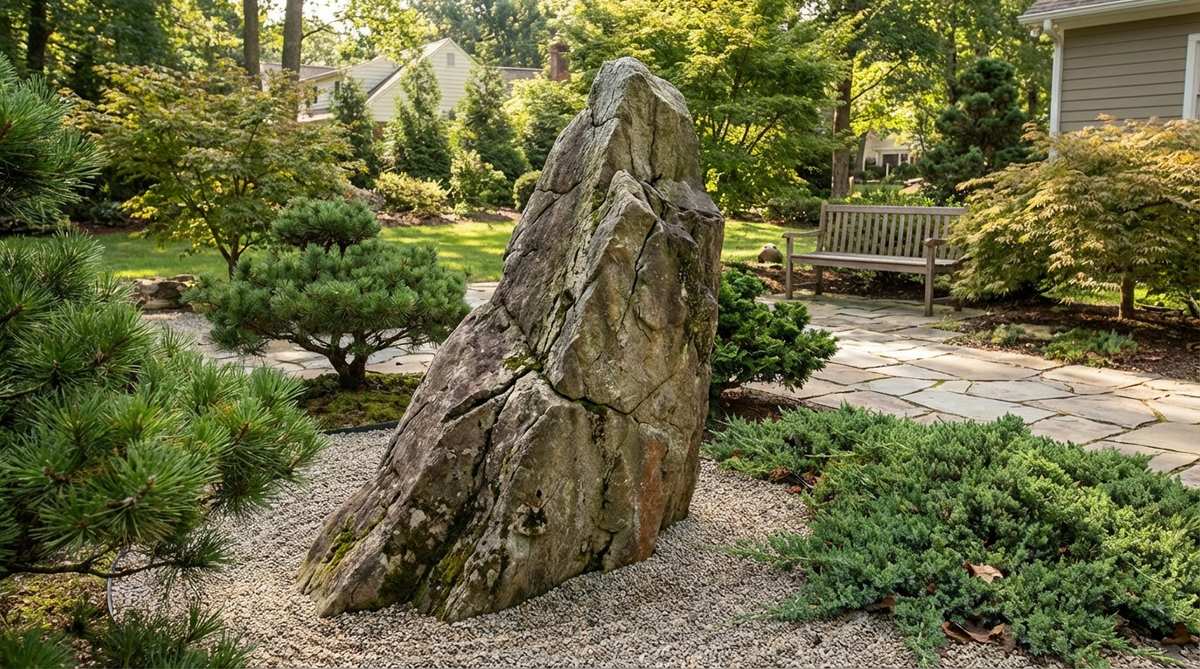
Tall upright stones symbolize mountain peaks reaching skyward. Set these stones deep into the ground—at least one-third of their height should be buried.
Select stones with naturally weathered tops that suggest wind erosion. The stone’s vertical axis should tilt very slightly from true vertical for naturalistic appearance.
Vertical emphasis creates dramatic focal points. These sentinel stones command attention and establish compositional hierarchy.
40. Horizontal Stone Water Edge
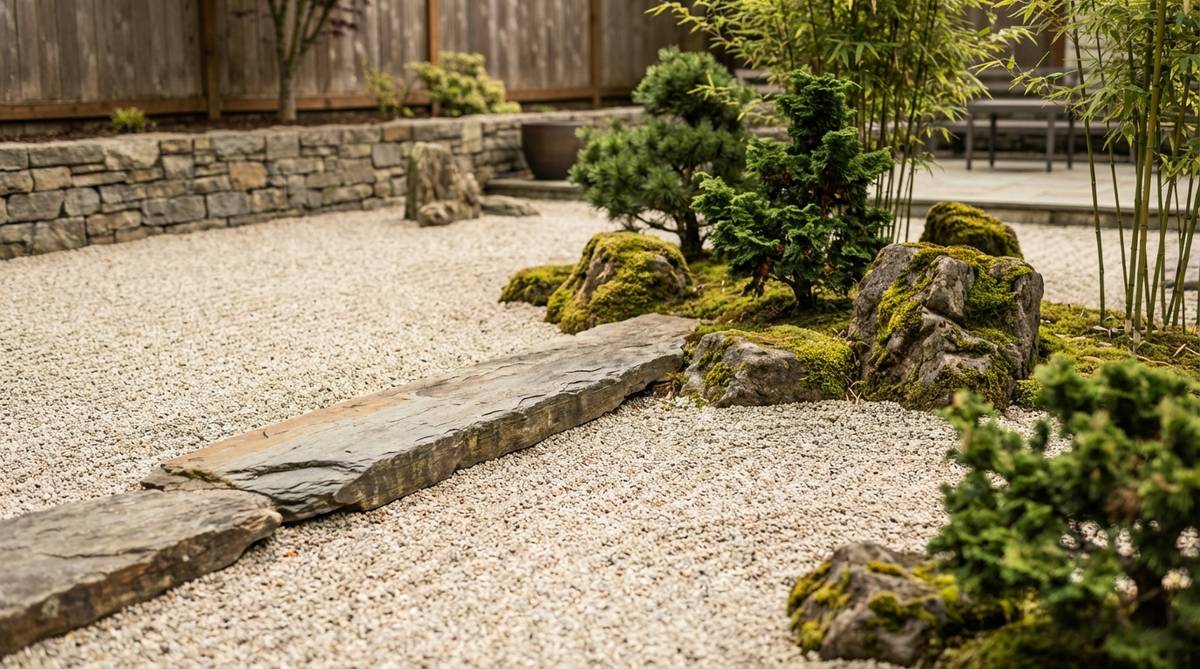
Flat, horizontally oriented stones represent shorelines and water boundaries. Their long axis runs parallel to the ground plane.
Position these stones partially buried with their longest edge visible. The horizontal line contrasts effectively with vertical elements elsewhere in the garden.
Water-edge stones provide visual rest between more active vertical compositions. The grounding effect stabilizes the overall design.
41. Triangular Stability Base
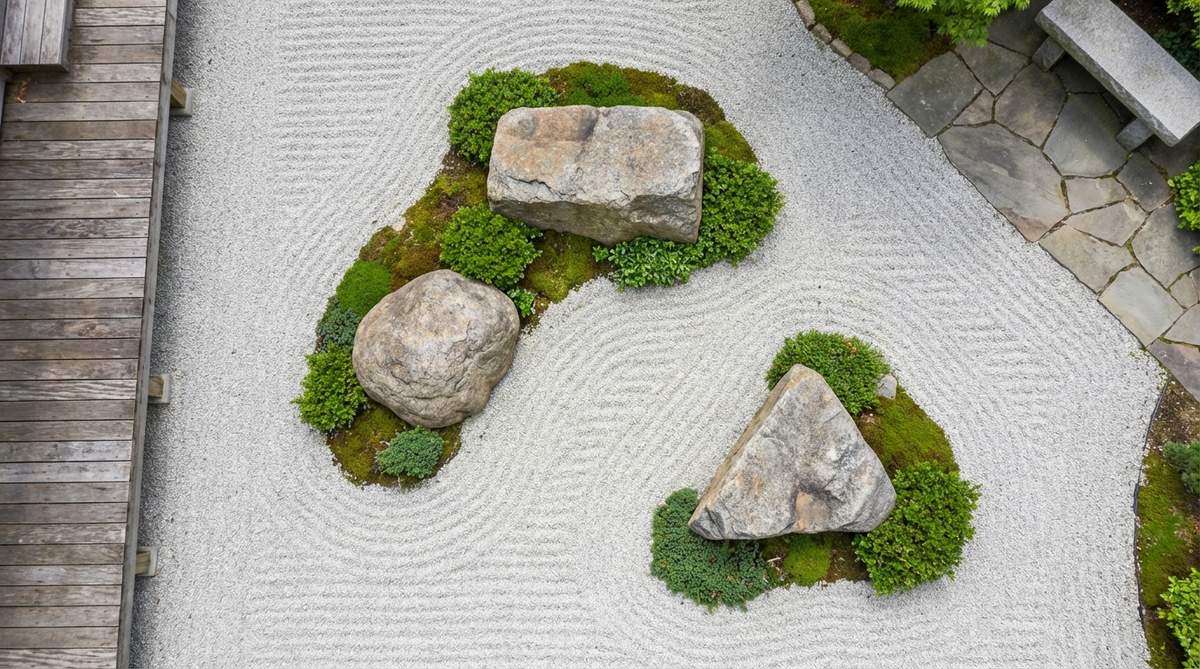
Arrange stones so their visual weight forms a stable triangle when viewed from above. This geometric foundation prevents the composition from feeling tipped or unbalanced.
Imagine lines connecting the three main stone positions. The resulting triangle should be irregular, not equilateral.
This invisible structural framework supports more complex arrangements. The underlying geometry remains subtle rather than obvious.
42. Odd Number Principle
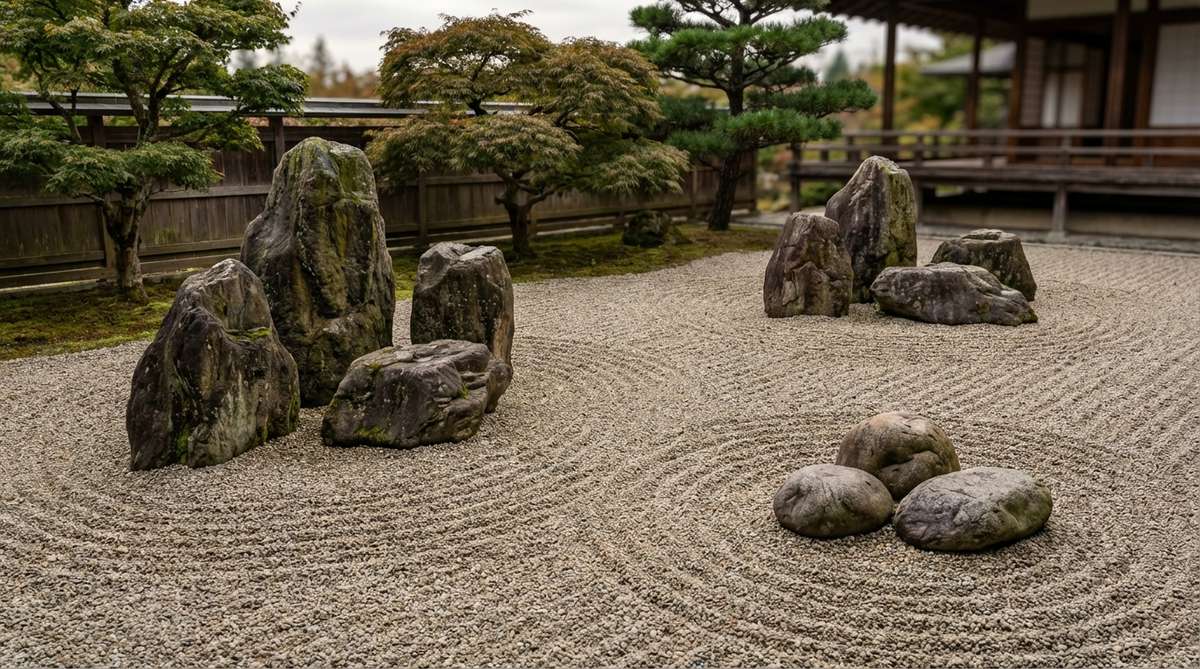
Use odd numbers of stones (3, 5, 7, 9) to avoid symmetrical pairings. Even numbers tend to split compositions into balanced halves that feel static.
When working with larger numbers, subdivide into smaller odd-numbered groups. A seven-stone arrangement might consist of a group of three and a group of four stones placed asymmetrically.
Odd numbers encourage dynamic visual movement. The eye travels through the composition seeking resolution.
43. Texture Variation Mixing
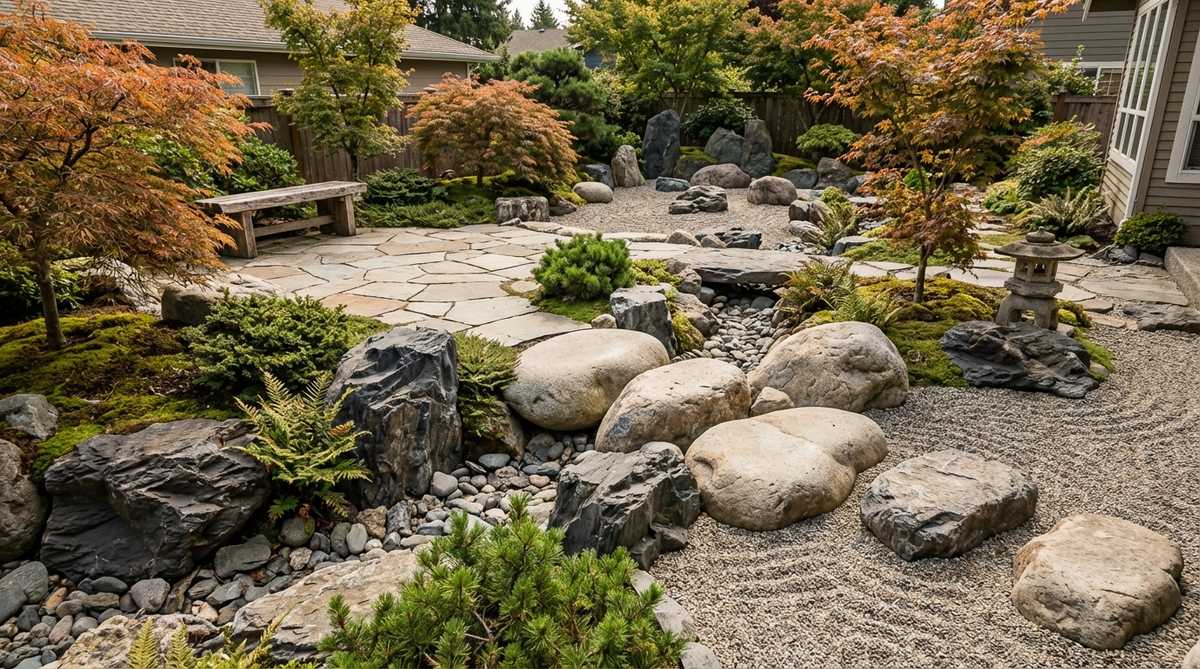
Combine stones with different surface textures—smooth water-worn boulders alongside rough angular rocks. The textural contrast adds visual interest and represents different geological origins.
Position smooth stones to suggest water-deposited formations. Place angular stones to indicate mountain bedrock or recent fractures.
Textural variety creates depth perception. Viewers perceive the garden as more complex and naturalistic.
44. Color Harmony Selection
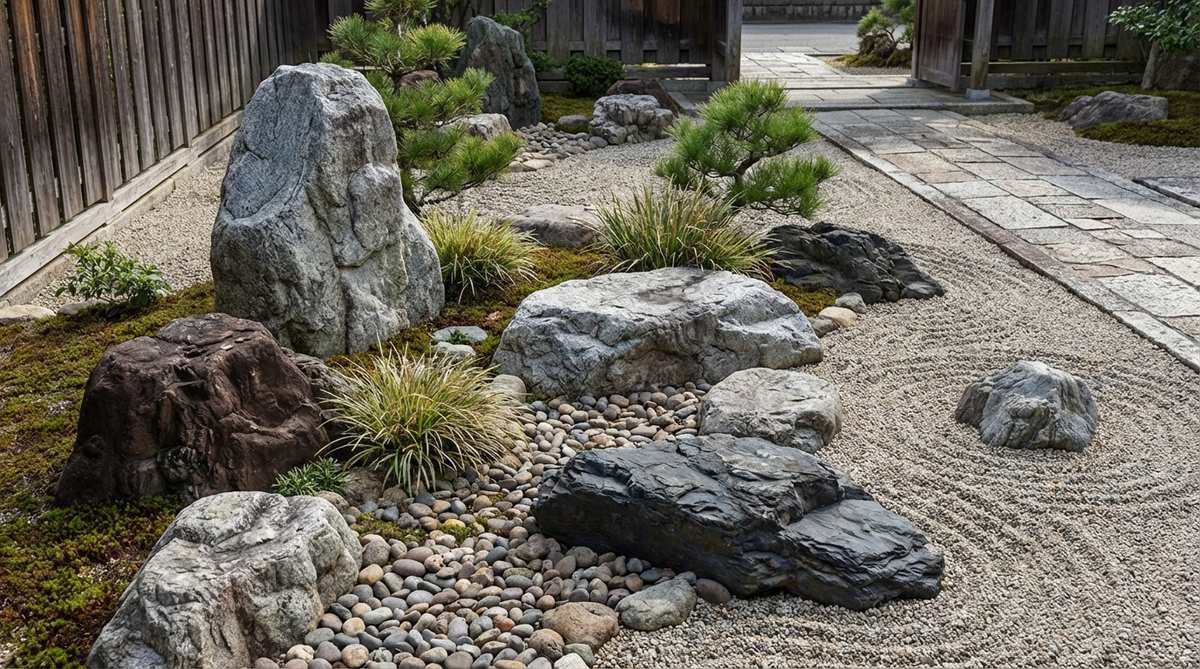
Choose stones within a limited color palette to maintain visual unity. Typically, gardens use grays, browns, and blacks from local stone sources.
Kyoto gardens traditionally feature gray granite from the Shirakawa River area. This regional material creates authentic character.
Color restraint prevents visual chaos. The limited palette allows form and texture to dominate the composition.
45. Scale Perspective Illusion
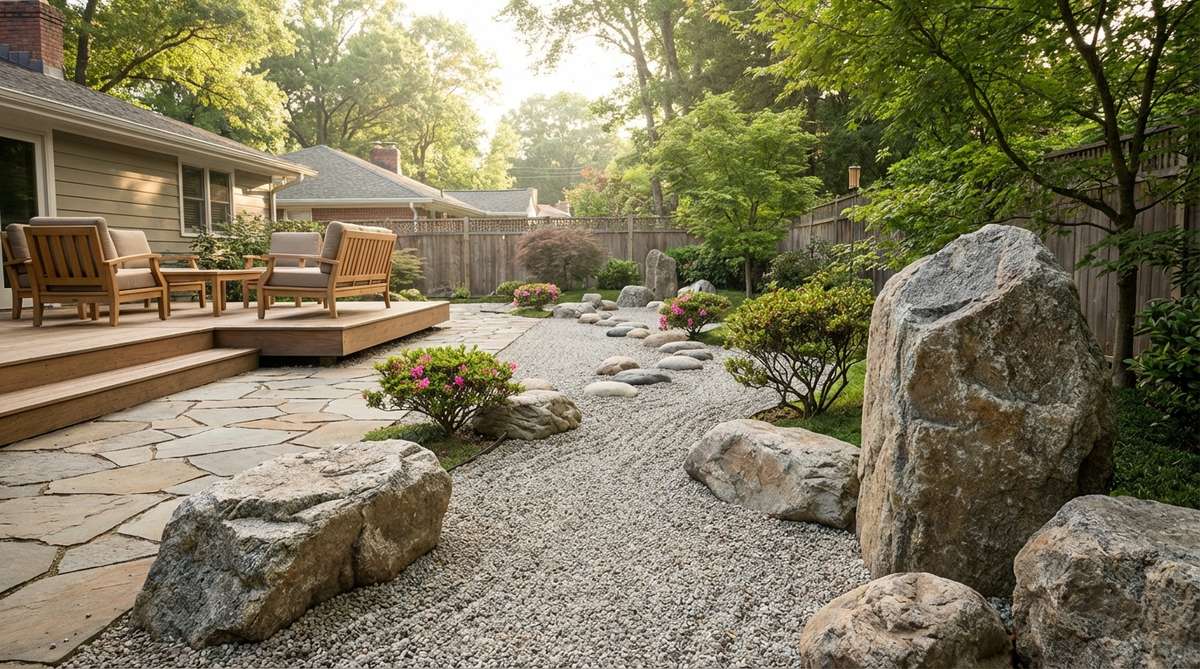
Place larger stones in the foreground and progressively smaller stones toward the background. This forced perspective makes gardens appear deeper than their actual dimensions.
The technique mimics atmospheric perspective in painting. Distant objects appear smaller and less distinct.
Small gardens gain apparent spaciousness through careful scale manipulation. The illusion convinces the eye effectively.
Minimalist Courtyard Applications for Small Spaces
Contemporary urban environments demand compact karesansui designs that function in limited areas. These scaled-down applications maintain traditional principles while adapting to modern spatial constraints.
46. Single Stone Focal Point
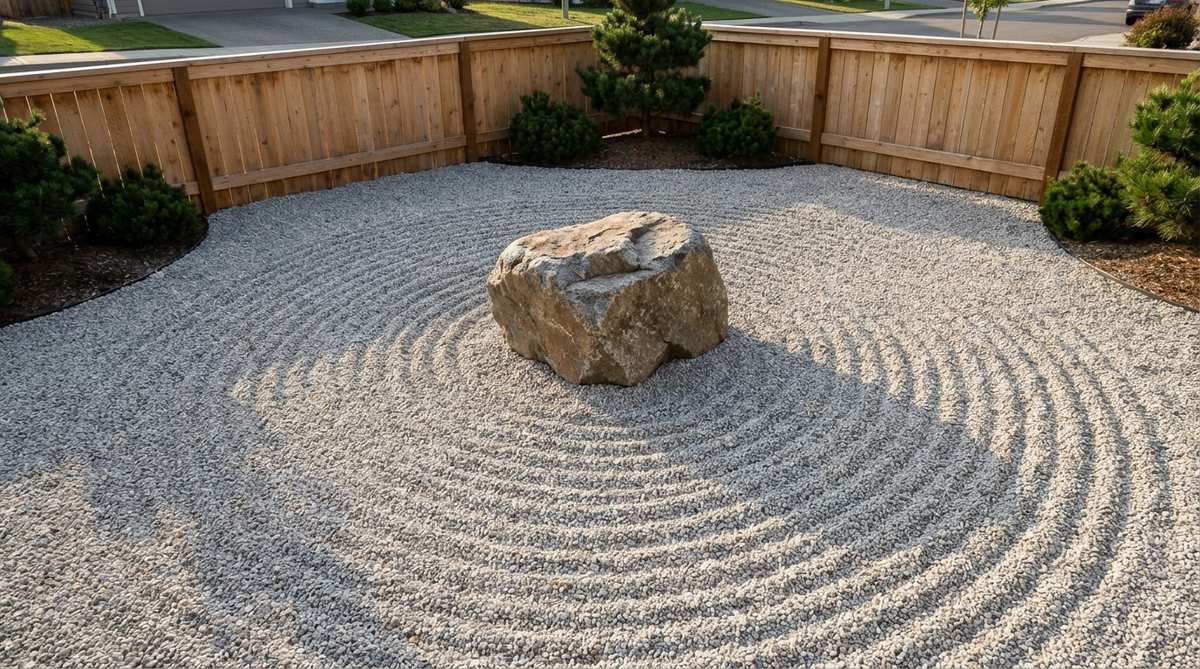
One carefully selected stone rising from raked gravel creates maximum impact with minimal elements. The singular focus intensifies contemplative viewing.
Choose a stone with interesting shape, texture, or color variation. Position it slightly off-center according to the golden ratio.
Extreme simplicity suits very small courtyards measuring just a few square meters. The design proves that less genuinely achieves more.
47. Corner Nook Garden
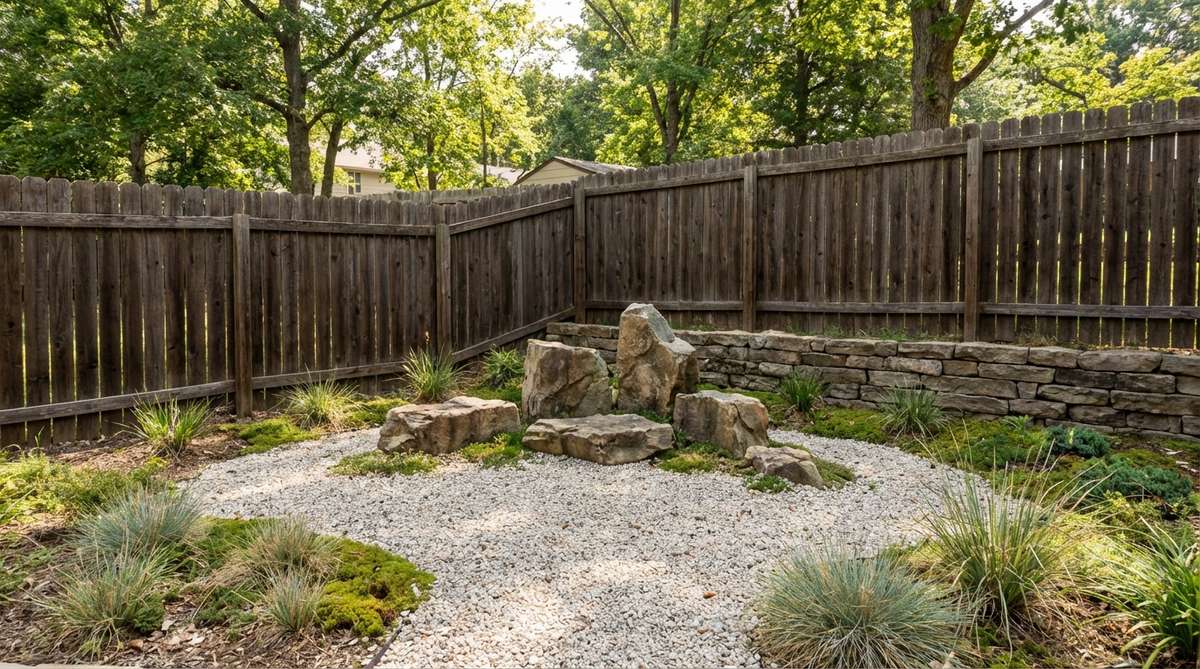
Transform an unused corner into a miniature dry landscape using a single stone group and limited gravel area. Architectural walls provide natural framing.
The confined space creates an intimate viewing experience. Approach the corner to discover the hidden composition.
Corner installations work in both indoor and outdoor settings. The scale suits residential applications perfectly.
48. Entry Courtyard Greeting
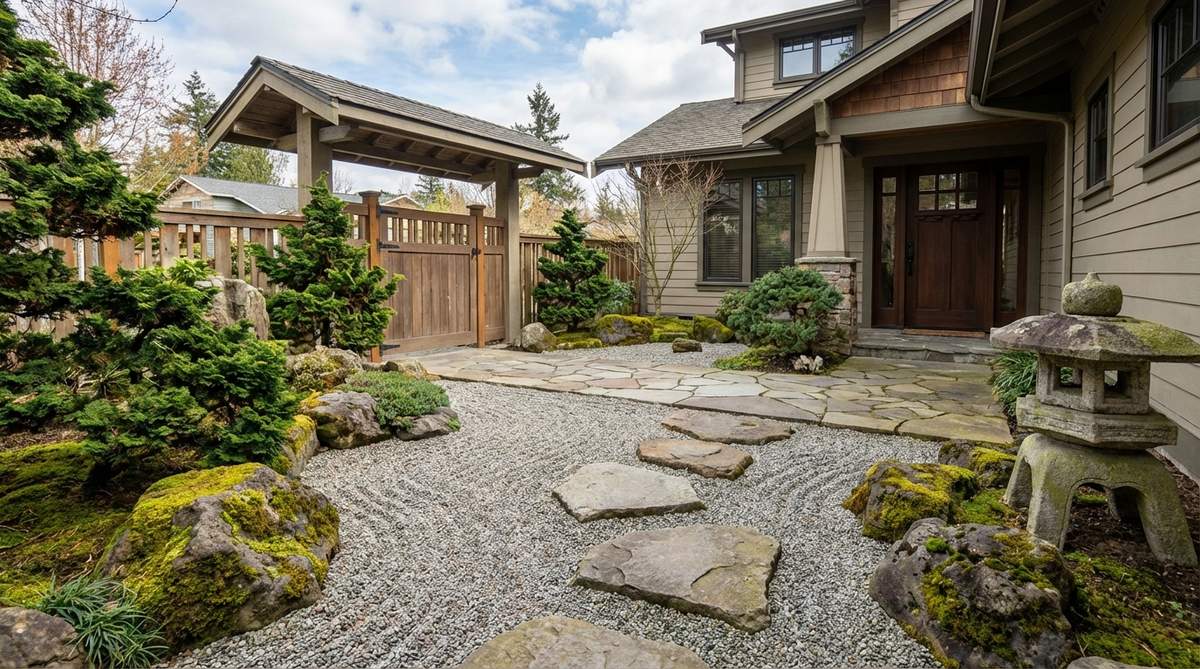
A small karesansui visible from the entrance sets a contemplative tone for the entire property. The first impression establishes the home’s aesthetic character.
Position the garden where visitors naturally pause before entering. The brief viewing moment provides a transition from public street to private interior.
Entry gardens serve practical and psychological functions. The design announces the homeowner’s aesthetic sophistication.
49. Window Box Tray Garden
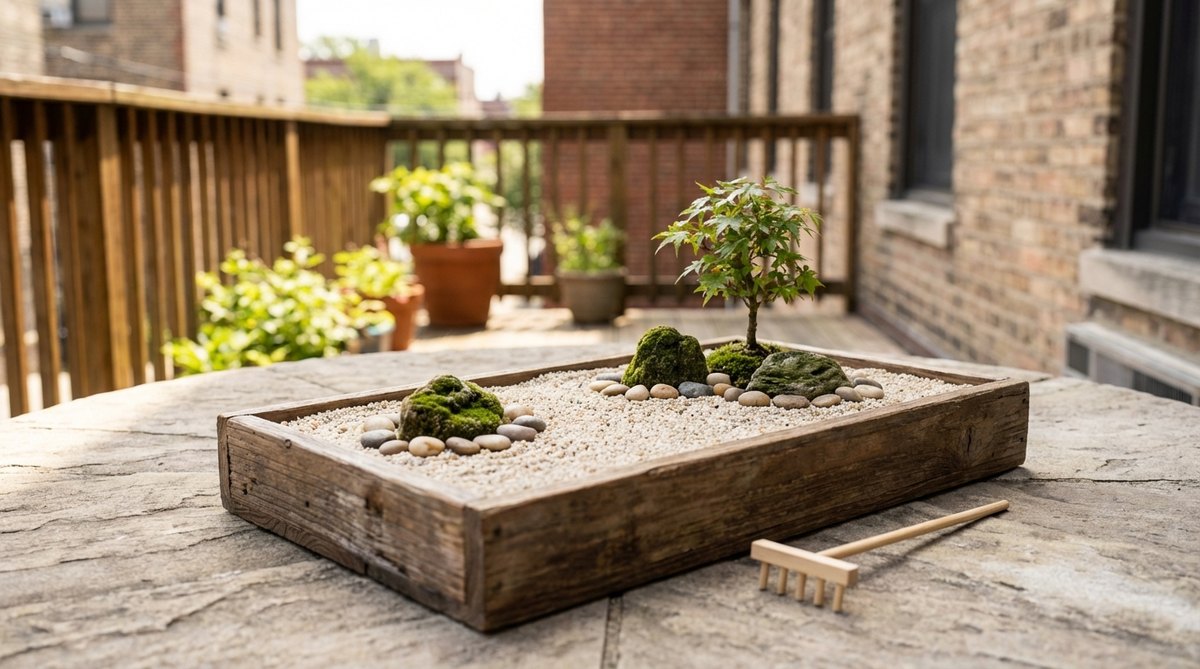
A shallow container measuring 50-90 centimeters long holds a miniature karesansui visible through a window. This portable version brings the tradition to apartment dwellers.
Use fine sand or small gravel appropriate to the reduced scale. Select pebbles rather than larger rocks to maintain proper proportions.
Tray gardens offer hands-on raking meditation. Change the patterns weekly as a mindfulness practice.
50. Meditation Alcove Backdrop
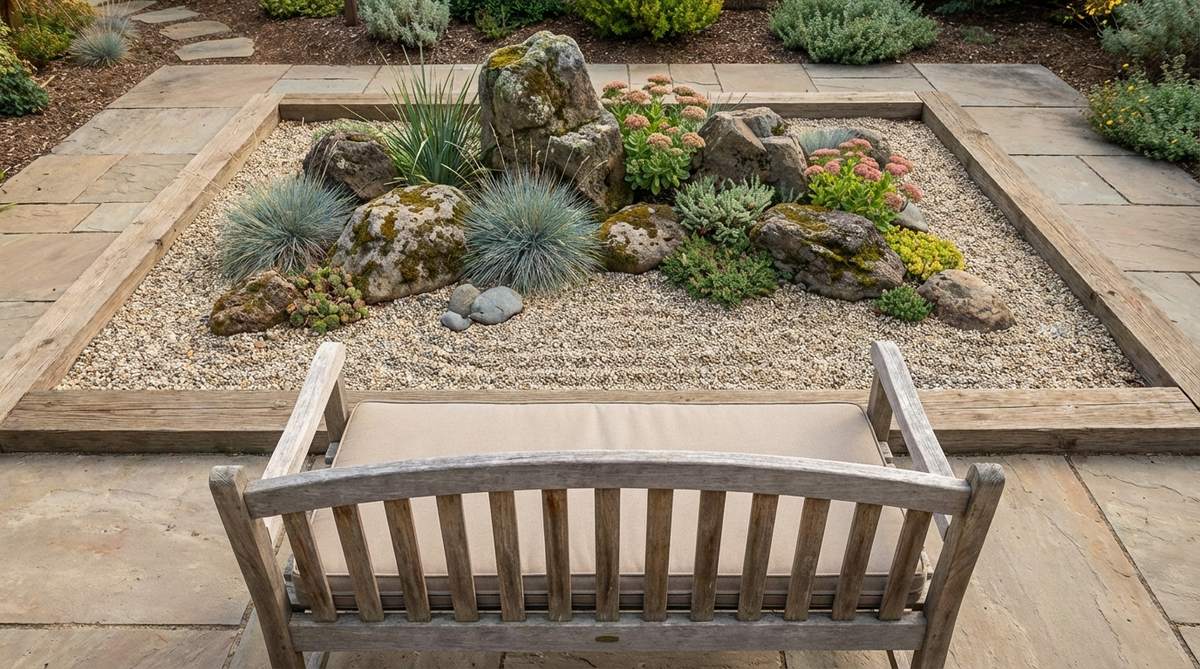
Behind a meditation cushion or bench, a small dry landscape provides a focal point for seated practice. The view supports concentration during zazen sessions.
Position the garden at eye level when seated. The sight line should meet the primary stone arrangement naturally.
This functional application integrates garden and meditation practice. The environmental support enhances spiritual discipline.
51. Balcony Container Installation
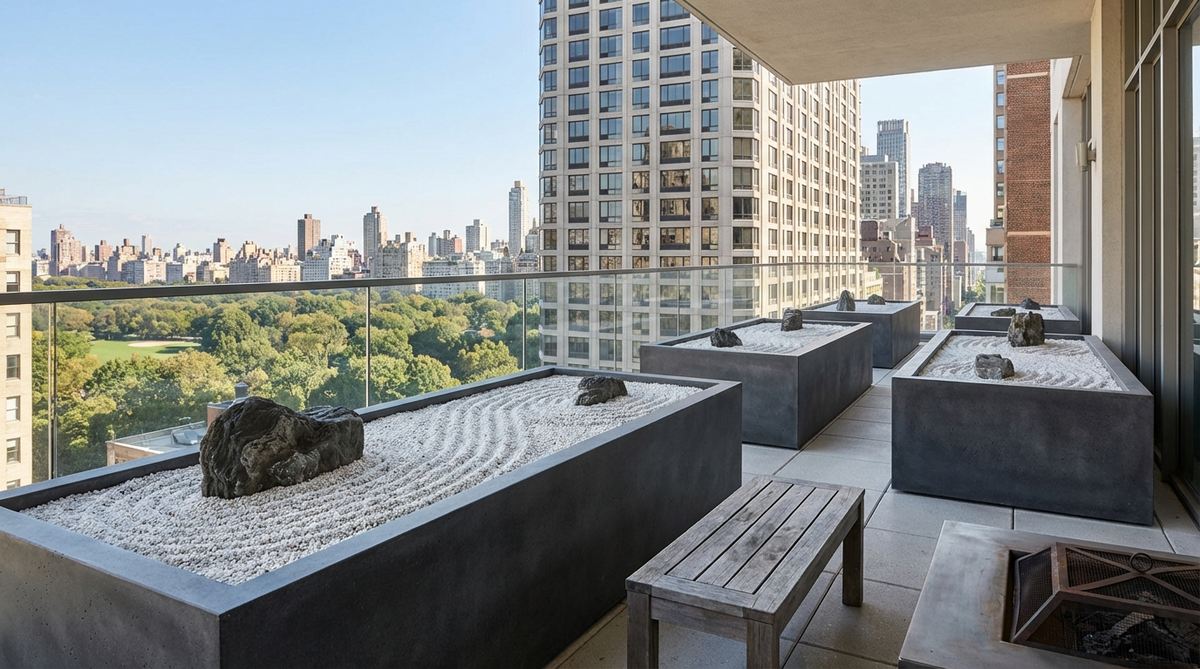
Large shallow planters adapted for karesansui use bring the tradition to high-rise balconies. Drainage holes prevent water accumulation that would damage the raked patterns.
Secure stones firmly to prevent wind displacement. Urban exposure requires attention to weather effects.
Balcony gardens prove that karesansui transcends ground-level limitations. Elevated installations offer unique perspectives.
52. Indoor Atrium Centerpiece
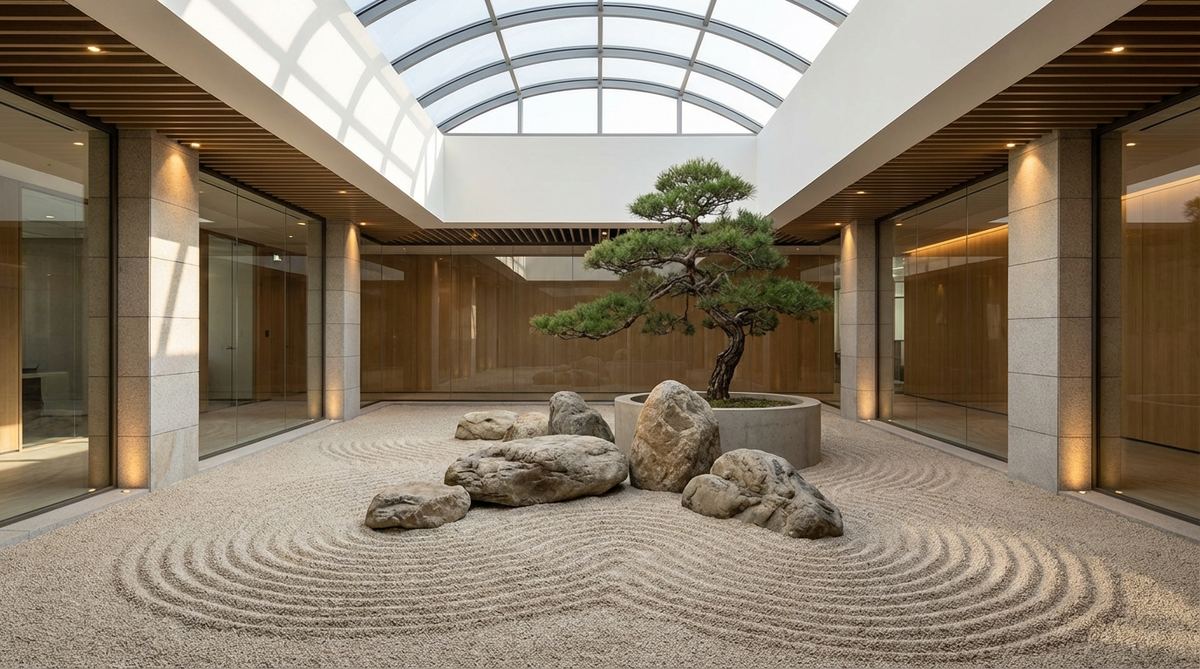
Corporate or residential atriums with skylights provide ideal settings for protected karesansui installations. Controlled environments eliminate weather concerns.
Lighting design becomes critical in interior applications. Both natural skylight and artificial accent lighting enhance the stones’ three-dimensional qualities.
Indoor gardens remain pristine longer without rain disruption. The raking patterns hold their form indefinitely.
Modern InterpretationsContemporary Karesansui Evolution
Twenty-first century designers continue evolving karesansui traditions through new materials, scales, and contexts. These innovations respect historical principles while addressing current aesthetic preferences.
53. Colored Gravel Experimentation
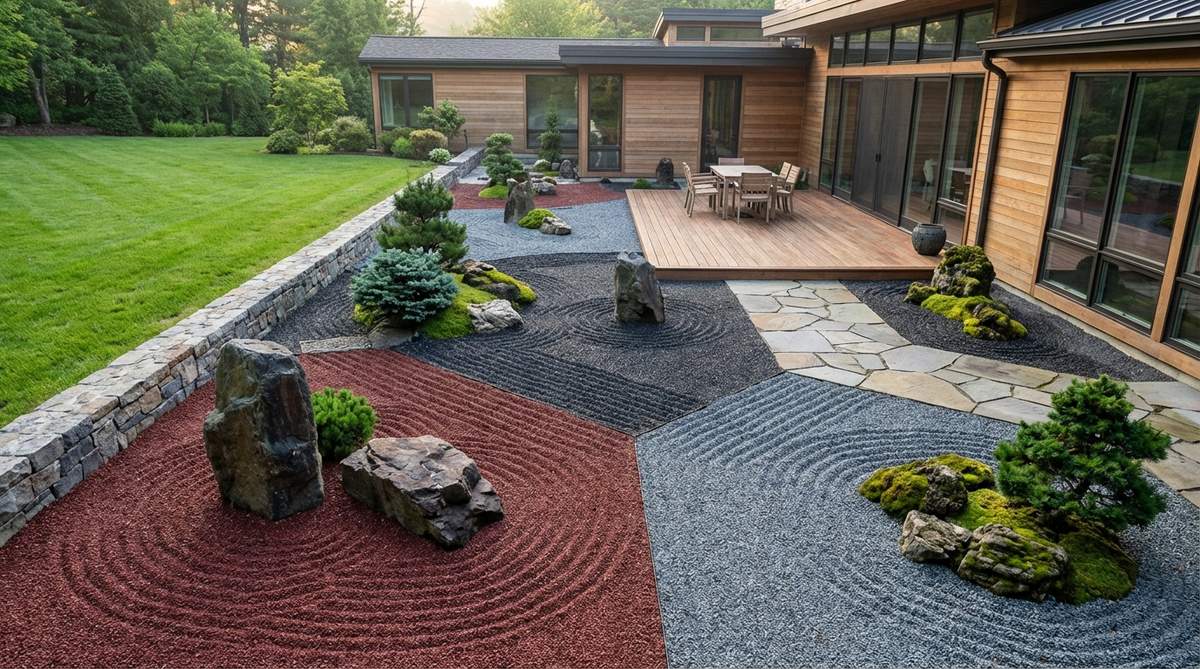
Non-traditional gravel colors—red, black, or gray crushed granite—create striking contemporary effects. The departure from white sand signals modern interpretation.
Choose colors that harmonize with surrounding architecture. The gravel should enhance rather than compete with structural elements.
Color innovation expands expressive possibilities. The technique remains controversial among traditionalists but gains popularity with younger designers.
54. Geometric Stone Cutting
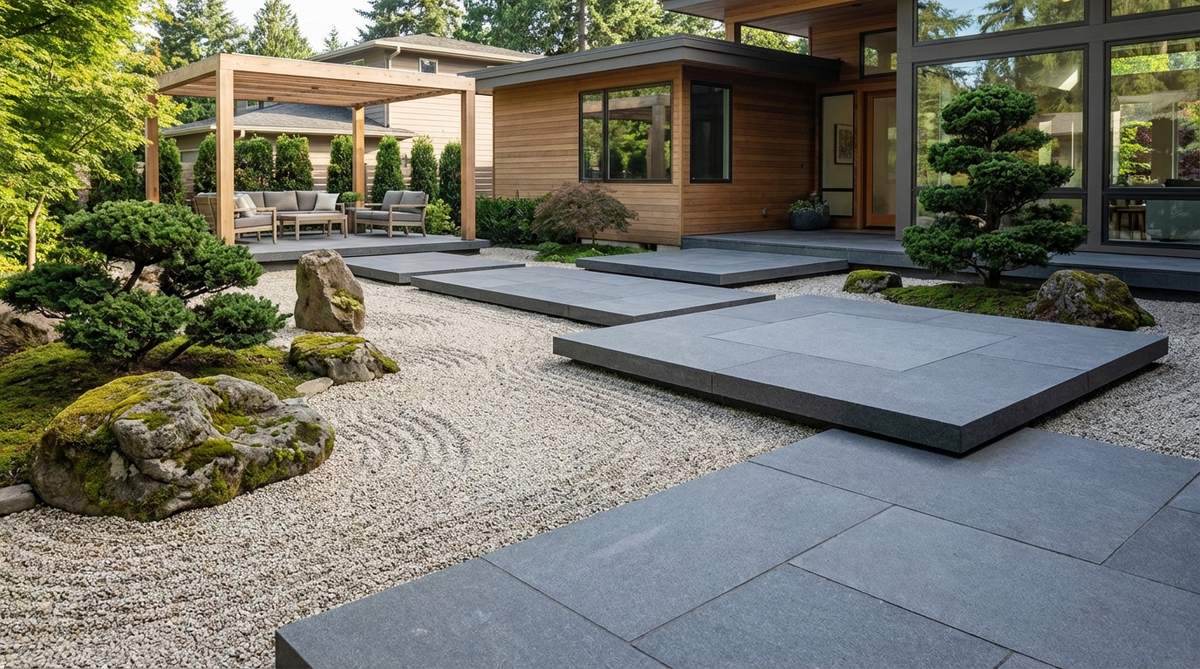
Machine-cut stones with flat surfaces and precise angles replace naturally weathered rocks. The manufactured perfection creates decidedly modern aesthetics.
This approach appears in avant-garde public installations and contemporary art museums. The geometric precision contrasts sharply with traditional organic forms.
Geometric stones suit minimalist architectural contexts. The design dialogue between building and garden becomes more explicit.
55. Large-Scale Public Plazas
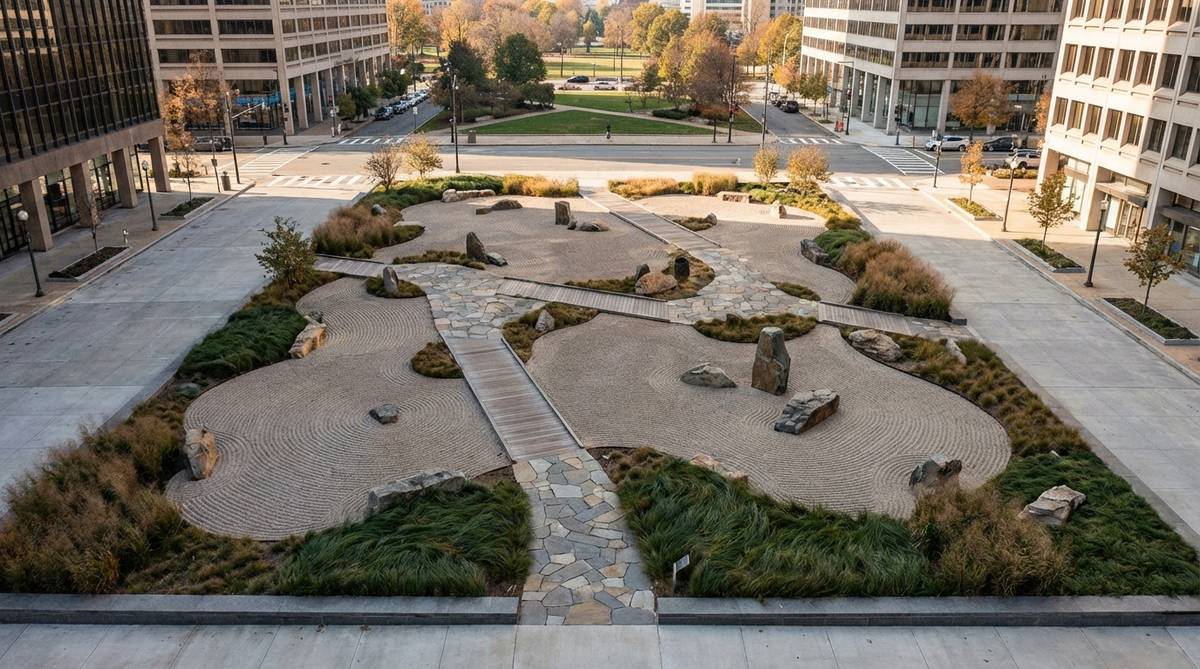
Urban plazas incorporate karesansui principles at unprecedented scales covering hundreds of square meters. Pedestrian circulation pathways integrate with the garden design.
These public installations democratize access to dry landscape experiences. Office workers encounter the tradition during lunch breaks.
Scale expansion tests whether karesansui principles function beyond intimate garden settings. Many successful projects prove the concepts remain viable.
56. Illuminated Night Gardens
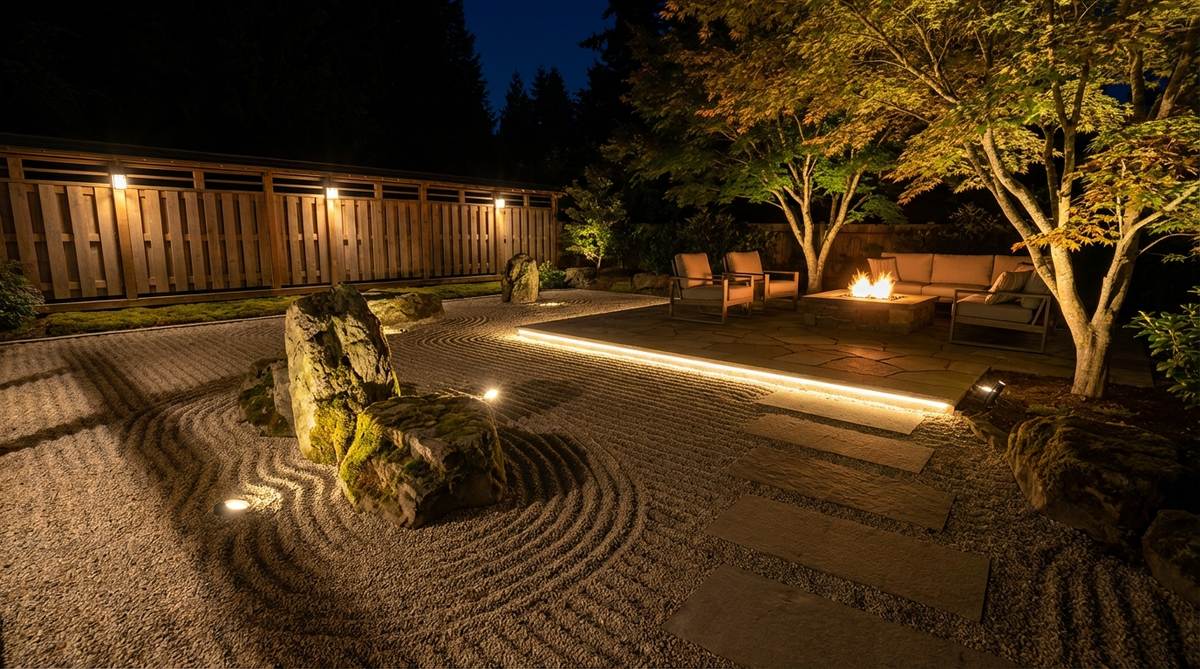
LED lighting transforms karesansui into nighttime experiences impossible in historical contexts. Uplighting emphasizes stone forms while grazing light reveals raking textures.
Designers program lighting to change subtly throughout evening hours. The garden presents different moods at different times.
Illumination extends the viewing period and creates dramatic effects. The technique works especially well for restaurant or hospitality settings.
57. Recycled Material Sustainability
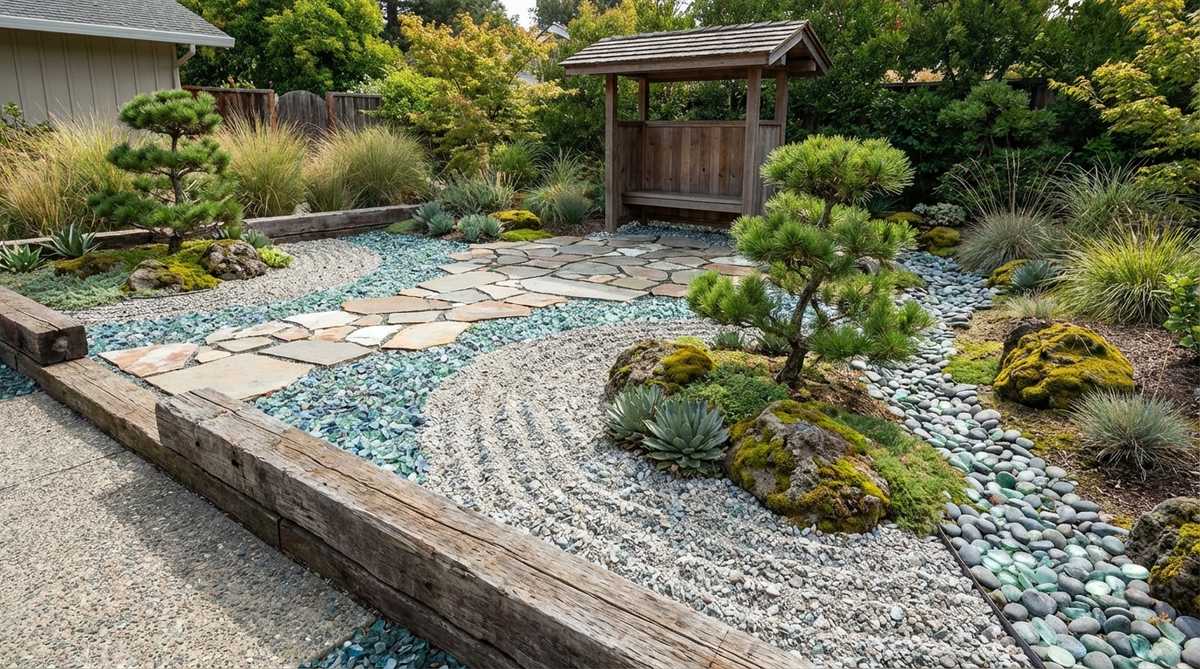
Environmental consciousness drives experimentation with recycled concrete, glass, or ceramic as stone substitutes. Crushed materials replace mined gravel.
This approach addresses ecological concerns while maintaining visual principles. The material source remains invisible in the finished composition.
Sustainability adds ethical dimension to aesthetic choices. Younger practitioners embrace this direction enthusiastically.
Bringing Karesansui Principles Into Your Landscape
These 57 japanese zen garden examples demonstrate karesansui’s remarkable versatility across scales, contexts, and interpretations. From Kyoto’s ancient temple masterpieces to contemporary urban installations, the dry landscape tradition continues evolving while maintaining its contemplative essence. Whether you’re planning a traditional courtyard design or exploring modern minimalist applications, these examples provide solid foundations for your own karesansui creation.
Start with the fundamental principles—asymmetrical balance, minimal elements, and symbolic representation—then adapt them to your specific site conditions and aesthetic preferences. The timeless appeal of raked gravel and carefully placed stones transcends cultural boundaries, offering peaceful contemplative spaces in our increasingly hectic world. Visit Fresh Garden Ideas for additional inspiration and detailed design guidance for your japanese zen garden project.
Frequently Asked Questions
What is the difference between karesansui and other Japanese garden styles?
Karesansui gardens use no water features—only rocks, gravel, and minimal plantings to symbolize natural landscapes. Other Japanese garden styles like chaniwa (tea gardens) and tsukiyama-sansui (hill and pond gardens) incorporate actual water, extensive plantings, and more complex topography. The dry landscape approach developed specifically for Zen Buddhist temples where water couldn’t be used due to confined mountain sites and emphasized meditation through simplified viewing experiences.
How often should I rake patterns in a zen garden?
Traditional temple gardens receive fresh raking daily as part of monastic meditation practice. For residential gardens, rake weekly or whenever patterns become disturbed by wind, rain, or debris. The raking process itself serves as a mindfulness exercise, so many practitioners schedule regular sessions regardless of pattern condition. In protected indoor installations, patterns may hold for weeks or months without maintenance.
What type of gravel works best for karesansui gardens?
Fine crushed granite in white or light gray provides the traditional appearance, with particle sizes between 3-6 millimeters for optimal raking. Shirakawa sand from Kyoto represents the authentic choice, though similar materials are available regionally. Avoid rounded pea gravel which doesn’t hold raked patterns—angular crushed stone locks together to maintain lines. For smaller tray gardens, use even finer sand with 1-2 millimeter particles.
Can I create a karesansui garden in a small urban space?
Small spaces actually suit karesansui design perfectly—some famous temple gardens measure just a few square meters. Container installations on balconies or courtyards, corner nook arrangements, and even indoor tray gardens successfully incorporate dry landscape principles. The minimal material requirements (stones, gravel, rake) make karesansui more feasible than water gardens or extensive plantings for space-limited urban settings.
Do I need special training to arrange stones properly?
While professional Japanese garden masters train for years, homeowners can successfully create attractive arrangements by following fundamental principlesuse odd numbers of stones, vary heights and textures, create asymmetrical triangular groupings, and bury at least one-third of each stone’s height. Study photographs of authentic gardens, start with simple three-stone groups, and refine placements over time. The contemplative process of arrangement offers its own rewards regardless of expertise level.
What maintenance does a dry landscape garden require?
Karesansui gardens demand less maintenance than traditional planted landscapes. Regular tasks include raking patterns (weekly to daily depending on preference), removing fallen leaves and debris, occasional weeding between stones, and refreshing gravel every few years as particles break down or wash away. Moss areas require light watering during dry periods. The simplified plant palette eliminates pruning, fertilizing, and most pest management.